



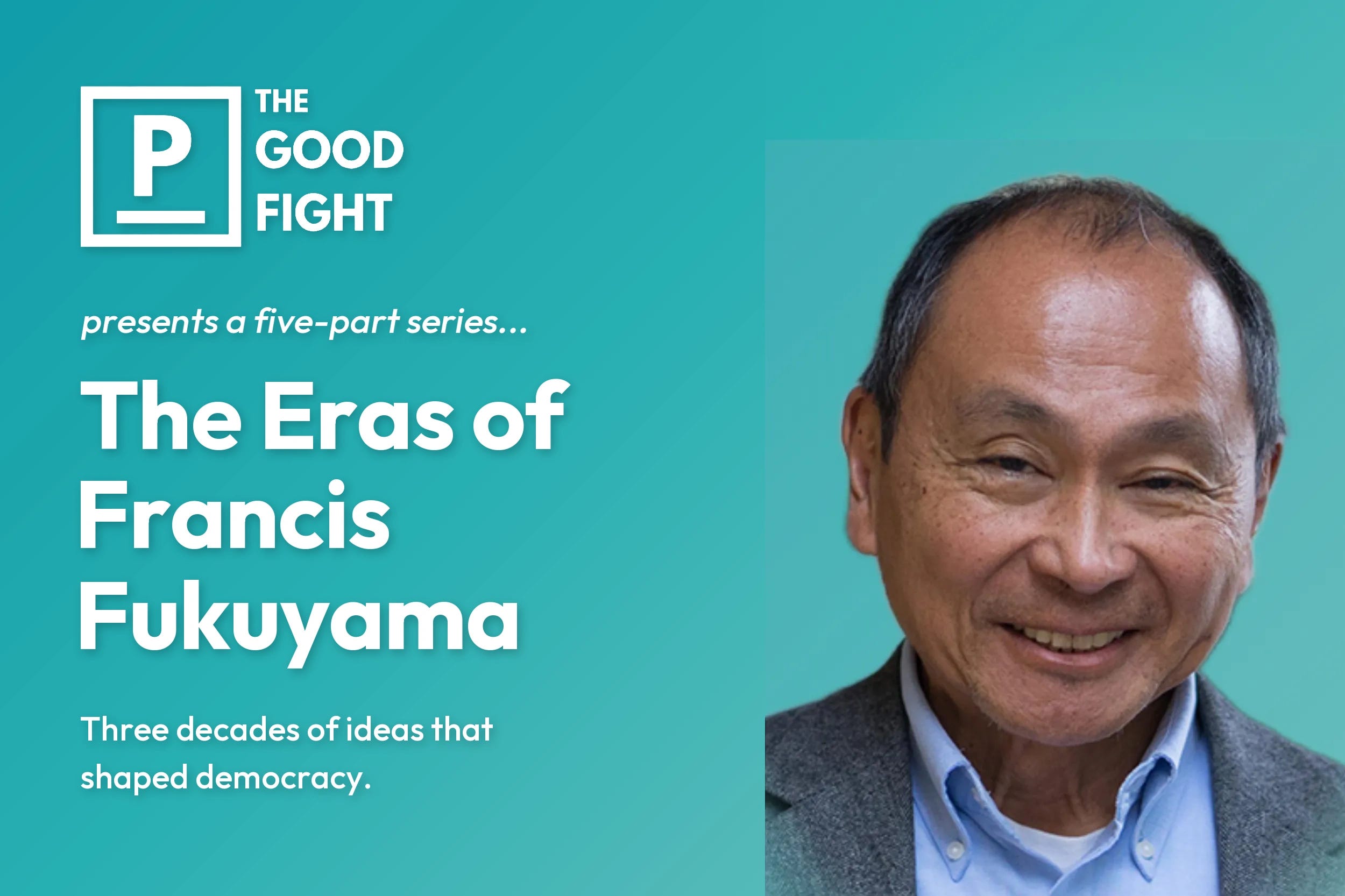
Francis Fukuyama is the Olivier Nomellini Senior Fellow at Stanford University. His latest book is In the Realm of the Last Man. He is also the author of the “Frankly Fukuyama” column at Persuasion.
In this week’s conversation, Yascha Mounk and Francis Fukuyama discuss why Fukuyama initially supported the Iraq War and what changed his mind, how the neoconservative movement’s experience of Eastern Europe shaped its disastrous assumptions about the Middle East, and what his break with former colleagues cost him personally and professionally.
Enjoying this discussion? In an event exclusively for readers of American Purpose and Persuasion, Yascha Mounk will be interviewing Francis Fukuyama about his life and thought at 5pm on Sunday, September 6 at The Abbey Centre, London. Find out more and get tickets here. Paying subscribers of Persuasion and American Purpose can access a code for a free ticket here.
We’re delighted to feature this conversation as part of our series on Liberal Virtues and Values.
This series, made possible with the generous support of the John Templeton Foundation, features content making the case that liberalism has its own distinctive set of virtues and values that are capable not only of responding to the dissatisfaction that drives authoritarianism, but also of restoring faith in liberalism as an ideology worth believing in—and defending—on its own terms.
This transcript has been condensed and lightly edited for clarity.
Yascha Mounk: We left in the 1990s, or I suppose the early 2000s, with your writing about human nature. So I think we’re going to try and cover the next fifteen or twenty years in this conversation. The starting point to a lot of political debate, and perhaps to some big changes in your reflections about the world, was the terrible terrorist attacks of September 11th and the decision by the administration of George W. Bush to invade Iraq. You initially supported that idea and then changed your mind about it. Tell us about that time.
Francis Fukuyama: Well, I had fallen in with a group of people that later became known as the neoconservatives—people like Bill Kristol and his Project for the New American Century, which started in the 1990s. It was a pretty hawkish group of policy intellectuals. I frankly hadn’t been thinking about foreign policy all that much in the 1990s. I was more interested in things like the wars in Central America, or the peacekeeping missions that had been undertaken in that period. It’s so long ago—we had this thing called the responsibility to protect, at a time when the West seemed so overpoweringly powerful and influential. And the question was: when were we going to intervene to restore order to disorderly developing countries?
Mounk: That now seems incredibly hubristic. I remember being quite skeptical about that idea when I first came across it as a young student. But of course, this came out of the failure to intervene in Rwanda—the sense that we had let these horrible genocides go on without doing anything. And so, if we had the power, if we had the ability, why shouldn’t we go in and save people from genocide? And we have the ability to do that—well, why shouldn’t we take it one step further and spread the joys of democracy and good government around the world? You have to give it its due—you have to place it in the historical context of where that instinct came from.
Fukuyama: I had been thinking about developing world conflicts, civil wars, intervention, and I hadn’t paid that much attention to this ongoing crisis over Iraq—even though when I was an intern at the RAND Corporation back in 1978, that’s what I did. I wrote a whole study that summer about Iraq’s—Saddam Hussein’s—relationship to the Soviet Union, which at that time was the most radical Arab rejectionist country. So I did sign on to a letter that Bill Kristol had sent around urging intervention in Iraq. To my embarrassment, I actually hadn’t thought that carefully about it.
Then September 11th happened. I was sitting in my office at SAIS on Massachusetts Avenue when the Pentagon was struck. One of my colleagues came into my office and said, “You’d better turn on the TV, because something big is happening.” And we watched the second plane go into the second tower, and looking out the windows we could actually see the smoke rising from the Pentagon, which had also been hit that morning. Everything seemed to change. And the question then was: what do we do about this? This led to this really bitter and prolonged debate over the causes of September 11th, and the inclination of a lot of my conservative friends to try to link this to Saddam Hussein and this longstanding problem that they’d had with Iraq and its attempt to develop weapons of mass destruction.
I don’t know that it’s worth going through all of the ins and outs of that latter issue. The elder Bush had intervened to get Iraq out of Kuwait back in 1991. In the subsequent years, they discovered that Iraq was actually working on a nuclear program. They sent nuclear inspectors in, and Saddam Hussein kicked them out. And it did look like he was trying to do his best to deceive the outside world as to the existence of these WMD programs. But after September 11th, there was an attempt to link all of this to the September 11th attacks, and that laid the ground for the disastrous intervention in 2003. So that was the general background out of which I was operating back then.
Mounk: So at the time when you favored this intervention, which of the different kinds of justifications for the war did you find to be most compelling? There was the most idealistic, neoconservative one—we’re going to turn Iraq into a flourishing democracy, and that’ll be an example to the rest of the Middle East, and if it means that all of these other countries also become flourishing, democratic, prosperous nations, that’s worth it. There was a more security-minded, hard-nosed one—Saddam Hussein has weapons of mass destruction. I believe one of the reasons why American intelligence was convinced that he had weapons of mass destruction is that he lied to his own generals about it—they had recordings of him telling his generals, “We have these amazing weapons of mass destruction that you don’t know the details about.” So there was a kind of security-based reasoning for it. Then, of course, there was a kind of cynical reasoning, which I assume was not what was driving you, but which may have been driving certain parts of the American state—I wouldn’t overstate this—which is that Iraq had oil, and America needed a stable supply of oil. Of these different reasonings, what was your initial reasoning, and what made you then change your mind?
Fukuyama: Well, the oil thing, I don’t think, was ever the driving force, either for me or for the administration. It was the weapons of mass destruction and the possibility that Iraq would get them. The idea of democratizing Iraq was really not on anybody’s radar at that point. That was a justification that George W. Bush began pushing after the failure of the intervention, when he was in the midst of an insurgency and had to come up with another reason for why he’d launched this war. That’s the only point at which they started saying they were going to bring democracy to Iraq, but I don’t think that was on anybody’s agenda back in the late nineties, early 2000s.
For me, I didn’t have a problem with the use of force to topple a dictator. It had been done—we toppled Hitler, we went to war with Japan, and we did all of these things using force that brought about good results in the end. My real objection had to do with the practicalities of actually restoring order in the countries we had intervened in, because my observation from Central America, from Vietnam, from the Philippines all the way back in the early twentieth century, was that that’s the point at which American foreign policy failed.
I had a mentor at the RAND Corporation, Steve Hosmer, a former Air Force officer who had worked very intensively—RAND at one point had a Saigon office when the Vietnam War was going on. He was a very wise person about third-world interventions, and his general warning was that the United States would get very invested in an intervention. The war would get a lot of support in the first year or two, but as time went on and we discovered how difficult these interventions were—to stabilize the country we were trying, ostensibly, to help—the American public would lose interest, and then we would pull out, and the whole thing would go to hell.
This has happened repeatedly in American foreign policy. It happened in the Philippines. It happened in El Salvador, or in Central America more broadly, in the 1930s, when we sent the Marines into Nicaragua. It happened in Vietnam, where we got tired after about five years and then decided we wanted to pull out. So my real concern was: okay, you’re going to take out this dictator—what is your plan to actually stabilize Iraq after that?
We hope you’re enjoying the podcast! If you’re a paying subscriber, you can set up the premium feed on your favorite podcast app at writing.yaschamounk.com/listen. This will give you ad-free access to the full conversation, plus all full episodes and bonus episodes we have in the works! If you aren’t, you can set up the free, limited version of the feed—or, better still, support the podcast by becoming a subscriber today!
If you have any questions or issues setting up the full podcast feed on a third-party app, please email leonora.barclay@persuasion.community
This is the point where I think the backgrounds of my neocon friends were really kind of a hindrance to clear thinking about this, because they had all been in power in the first Bush administration, at the point when the Berlin Wall fell. That was a historically unique moment, where there actually were crowds in the streets demonstrating to celebrate the downfall of these communist dictators in Eastern Europe. That was their experience of American power and influence, and I think they believed at the time that the same thing would happen in Iraq—that the moment you toppled Saddam Hussein, people would come out in the streets cheering the Americans on.
It failed to take account of all of the accumulated Arab grievances against the United States for its support of Israel, the general distrust, and just the sheer cultural difference. Eastern Europe had been part of the West for centuries, but the Middle East was a very different place—you had radical Islamists running all over the place, which you didn’t have in Eastern Europe. So I just think my friends in the administration had a rather naive view of the likelihood that this kind of intervention would actually work, or that they had enough cultural and political knowledge to pull it off. That was the situation, and that was my reason for becoming increasingly skeptical about the wisdom of the Iraq War.
Mounk: Obviously one other factor that was very important was the split between Sunnis and Shias, and the fact that even though Saddam Hussein was extremely unpopular among Shias and among many Sunnis—he was a terrible dictator, and that’s something we shouldn’t forget in retelling the story—the moment Sunnis felt like their power was being taken away and Shias were going to be in charge of the state, they had a very strong reason to try and organize against the new regime. That’s part of what then drove the civil war which ensued. At what point did you start to think this was really going the wrong way? And how did you decide to break with what at that point was the crowd of your friends, intellectual collaborators, and professional network? This was a time at which your feelings about the Iraq War were perhaps the most important litmus test in American politics. You broke with not just what had been the prevailing consensus of the Washington establishment and the media in the run-up to the war, but in particular with the project of some of the people who were your closest associates. That must not have been easy, professionally or personally.
Fukuyama: Well, as we got closer and closer to the actual invasion date, I was more and more skeptical. I wrote a piece in the Washington Post saying that we really shouldn’t intervene unless we got a Security Council resolution, which we never ended up getting. But I guess the real moment when I went public about all this was sometime in 2003. But at this point, an insurgency had already begun. American soldiers were already getting blown up by roadside bombs. There was a big conference to celebrate the war at the American Enterprise Institute, which at that point was the hotbed of neocon support for the war. My former SAIS colleague Fouad Ajami was there, and Bernard Lewis, the Arabists, both of whom had been counseling President Bush to do the intervention.
I was at this dinner—this very fancy, formal dinner—and everybody was talking about what a great success the war was. I remember Norman Podhoretz, the editor of Commentary, for whom I’d written quite a few pieces, said this was the biggest advance of democracy in the twentieth century. And I just looked around and said, what are these people smoking? Don’t they understand that this is not going well, and it’s not going to end well? That’s the point where I wrote a big piece for the New York Times about why this was a big mistake.
Mounk: What was the fallout from that?
Fukuyama: Well, I didn’t speak to a lot of my friends for several years. Some of them I never spoke to again, like Charles Krauthammer. I had a big break with Bill Kristol—Bill had been a friend of mine from graduate school; I actually inherited his apartment in Cambridge, since I was a year behind him—and we kind of broke off relations. I’m glad to say that we’re back together again now that he’s become a very enthusiastic Never Trumper. I think he also had a big shift in his orientation toward a lot of political issues in the aftermath of that. But yeah, I just had to hang out with a different group of friends at that point.
Mounk: One of the things that happened intellectually is that you started asking yourself questions about the origins of stable political orders. Am I reading too much into the relevance of these events to think that the failure of state building in Iraq—the failure of being able to impose, at least at first, a durable, peaceful, democratic order on Iraq despite the overwhelming military strength—is part of what got you interested in this mammoth project you end up publishing over the course of the 2010s?
Fukuyama: Well, that’s right. It wasn’t just Iraq, it was Afghanistan too. We did two interventions, in 2001 and 2003, where basically we succeeded in collapsing an existing state. In both countries, the famous Max Weber definition of the state—a legitimate monopoly of force over defined territory—had disappeared. They both fell into civil war. There were armed militias; there was no legitimate, single monopoly of power. And what I immediately recognized was that Americans had absolutely no idea how to deal with this. They kind of assumed the state would always exist, and the main problem was to limit the power of the state, not to actually create state power in the first place. They were at sea trying to do this in both of these countries—to create a state is really about force, so you have to have a police force and a military. The United States was busy trying to create these state structures in these extremely chaotic conditions.
But this is the point where I also realized the fault went deeper—at another level, in my home discipline of political science. Nobody at that point was thinking about state capacity, state building. For example, at Stanford, when I finally got there in 2010, everybody was into rational choice political science, in which they said, well, the state is predatory, and the main question is how do you restrain the state. Nobody was thinking about how you create state power in the first place and how you exercise state power legitimately.
That is further encased in an American political culture that is very anti-statist. One of my other great mentors was Seymour Martin Lipset, the great political scientist and sociologist who spent his whole career writing about American exceptionalism—about how America was really different from almost every other rich democracy. One of the dimensions of that was anti-statism. Lipset argued that this is one of the deepest aspects of American political culture: distrust of the state. In Europe, in Japan, in Korea, in other democracies, people see the state as something positive—the state is what protects them from foreign enemies, from the rigors of market capitalism, and so forth. But in the United States, both on the left and the right, there’s a distrust of the state that runs extremely deep. And that extends to American political scientists, who at that time weren’t that interested in studying the state. They wanted to study voting and legislatures, public opinion, all these other topics, but not really how you construct state authority and how you make it work more effectively. That’s what made me realize this is a big gap, and it needs to be filled, both on a theoretical level and on a practical level.
Mounk: So these two books actually were my introduction to your work. They came out while I was in graduate school, and I read them cover to cover at the time—The Origins of Political Order, which was published, I believe, in 2011, and then Political Order and Political Decay in 2014. It’s a two-volume series that really tries to understand, first of all, how the modern state arises, and then, secondly, how you get certain states—calling this somewhat seriously and somewhat jokingly—“getting to Denmark,” which have a lot of the positive attributes we might wish to have from a state, and what might eventually undermine those—how it is actually very difficult to sustain those states, and what kind of dangers that poses to contemporary democracy, particularly in the United States. Let’s go from the beginning. Why is it that the United States or France or China have capacious states that are able to shape significant parts of a social world in accordance with their will and their preferences, whereas in a place like Somalia we never got the emergence of a capacious state able to do that to a comparable degree?
Fukuyama: Well, it’s very interesting. There’s been a big academic debate over early state formation, and a lot of it arose in this period that I was writing in, because it was not a topic that was addressed by political scientists by and large—it was addressed by a lot of anthropologists and archaeologists, and there were various theories of state formation. There’s the hydraulic theory, associated with Wittfogel, that said states were needed to create irrigation systems, manage rivers, and so forth. That’s not really believed very much anymore. Probably the most prominent theory is that of the sociologist Charles Tilly, who talked about early modern Europe and the pressure of military competition in forming states.
So you had political orders that were basically based on kinship—some marauding band of roving bandits conquers a territory, kills off the men, marries the women, and settles down, and it’s all based on friends and family. The question is: how do you get to a more modern state—one that is more impersonal, that has permanent bureaucratic structures that can administer a territory, and isn’t dependent on the single charismatic authority of the guy who led the marauding band in the first place? Tilly’s thesis was that this was the result of military competition—if you hired your cousin to be your commanding general and he was incompetent, you were going to lose the war, and you and your family would get killed. That’s a pretty powerful incentive to pick a competent person. So the idea of meritocracy, for example, arises under these circumstances, where you desperately need people who actually know what they’re doing—and if your friends and family can’t provide that, you’re going to have to go out to somebody different.
As I started looking around the world, this became evident as a general problem—you have to get beyond kinship. The earliest types of social formations are all kin-based. Hunter-gatherer societies have basically very small groups of relatives, bands of forty or fifty people. The first states are created with a hierarchical and centralized form of authority, but again, they are what Max Weber called patrimonial, because they all arise out of the household of the ruler—the bureaucracy is just the cousins, sons-in-law, and so forth of the ruler. But it was only in the early modern period, when you had intense conflict between these European early states, that they suddenly realized: we need tax collection. That means we need a cadastral survey to find out who owns property, because those are the people we want to tax. We need a bureaucracy to collect the taxes; we need an army recruited based on merit rather than simply kinship ties. That’s really his explanation for how the modern state began to originate.
When I started looking at this, I suddenly realized this is absolutely true in China as well, and that China had followed this exact same path, but a couple thousand years before any society in Europe had gotten there. You had a very decentralized Chinese political system in 1000 BC—maybe a thousand political units—that consolidated down to about seven by the time you got to the Warring States period. Then, after the Warring States, a single one of those seven states, the state of Qin—like the Prussia of Chinese history—consolidated everything into a single Qin Empire. The word “China” comes from the state of Qin, this Chinese Prussia, and ever since then they’ve had a centralized state.
The one thing I began to realize is that the Tilly process had driven modern state formation in China in very much the way Tilly anticipated had happened in Europe. They developed the same sorts of ideas—meritocracy is one of the deepest aspects of Chinese culture. Everybody takes a civil service exam. If you’re a poor boy growing up in rural China, if you take the exam and you do well, you could end up as one of the most powerful men in the empire, because they promote on the basis of merit. And all of these modern features of states—centralization, uniform weights and measures, cadastral surveys, trying to know where your population lives and how you can tax it—all of these things happened in China after the Qin unification.
Mounk: Your argument here is that basically this mechanism that Charles Tilly identified—whereby states rise because they are in competition with other geographical areas, and unless you’re able to run an efficient military, unless you’re able to raise a budget for that military, unless you’re able to put competent generals in charge, this other state is going to conquer you—we could think of this nearly as a kind of evolutionary competition between different kinds of states.
Fukuyama: By the way, let me give you one more example of that. The United States in the nineteenth century did not have a modern state. At the time of the Civil War, we were in the midst of what was known as the patronage or spoils system, where basically every public official got there by supporting a politician. And the politician promoted—sometimes it was friends and family, a lot of times it was just political supporters. Abraham Lincoln was absolutely overwhelmed by office seekers, and a lot of his senior generals early in the Civil War were basically politicians he owed favors to. As a result, the Union side lost a whole series of battles. It was only a couple of years into the war that Lincoln discovered Ulysses Grant, who was actually a competent soldier, and began to promote people for competence rather than political connections. So this China–early modern Europe story played out in America not that long ago. That’s how we got to this idea that you actually need competence rather than simply loyalty or family connections.
Mounk: Now, some of this process is similar in the United States, in Prussia, in China, but there are obviously very important differences between them. In some of these countries, you end up getting a very powerful state, but not the rule of law—China might be an example of that. In some places, you get a form of rule of law, like you did for the Brahmins in India, but you don’t get very strong state capacity. What mix of attributes do you need to get to something like what we think of as the modern state? Why is it that in some places you get certain elements of that but not the whole gamut of these characteristics?
Fukuyama: Yeah, so that’s the biggest, I think, meta-historical question that is still being debated. In my Origins of Political Order book, the story about the state is really the story about military competition. The rule of law is all about religion, because to have a rule of law, it can’t simply be the commands of the executive. That’s what they had in China—they promulgated legal codes; the emperor promulgated a legal code, and if you disobeyed it, you’d get this very severe punishment, you’d get your nose cut off or something like that. But that’s not really the rule of law. The rule of law, properly speaking, has to apply to the state itself—the ruler can violate the rule of law and be held accountable for that.
So the question is: how do you get an alternative source of authority when the state has a monopoly over coercive force? They control the police and the military. The answer, I think, really lies in organized religion. In Europe, this comes out of the Catholic Church. There’s a very big, important, and I think underappreciated conflict known as the investiture crisis, which occurred in the twelfth century, when you had a very powerful pope who challenged the Holy Roman Emperor over the question of who gets to appoint priests and bishops within the Catholic hierarchy. The Pope said it should be the church; the emperor said no, it should be me. They fought a prolonged, multigenerational war that only ends with something called the Concordat of Worms, which was negotiated sometime in the early 1200s and allowed the church to remain independent and autonomous. I don’t think people appreciate how important the Catholic Church was for modern institutions—they point to the Protestant Reformation instead—because that’s where law comes from.
Mounk: Is the idea here that if you don’t have a separation between temporal and religious power, then you always have everything flow down from the will of the emperor or the king or whoever is at the top? The thing that this fight—which seems obscure to us today—over who gets to appoint the local priest really gets to is that you start to develop a kind of separation of powers. It’s not a separation of powers in our modern sense, but there’s this one set of things over which obviously the king of a particular realm makes the decisions, and another set of things which this other power gets to make decisions over. So you need to start having this apparatus for figuring out which kind of decision belongs to whom, and what is an appropriate thing for each office to decide on. That’s the origin of taking away that absolute power.
Fukuyama: It’s also a question of legitimacy—who has legitimacy to make laws. What happened in Europe was that at the time of the investiture conflict, they discovered a copy of the Justinian Code in a library in Italy. The Justinian Code was this highly developed set of laws that had existed for centuries in the Roman Empire, codified under the reign of the Byzantine Emperor Justinian, and then they were lost. But the Europeans found them—the Catholic Church found them—and they began to create a series of law schools, in Bologna, in Paris, that would teach what has now become the civil law. This is really the origin of the civil law, completely independent of earthly power—no prince controlled the church’s ability to promulgate this law, so it had moral and then legal authority that could stand against the authority of all the princes in Europe.
Now, the other really big thing that I think leads to the European outcome is the decentralization of power. In the Byzantine Empire, you also had the same legal code, and you had an emperor, but they were fused—the emperor could control the patriarch in Constantinople, and there wasn’t this kind of separation. In Europe, you did have a separation, because you did not have a centralized empire in Western Europe. I think that’s just an accidental result of geography and climate. Western Europe is cut up by mountain ranges, by big rivers that are very hard to move armies across, by very dense forests—in Central Europe and Germany, you could barely move a wagon through it because there were too many trees. So it was very hard to create a highly centralized political authority. And you had this source of religious authority sitting in Rome that was promulgating law. So you had this very long-term conflict between church and state of various sorts in Europe, and you never had the single unification of earthly and spiritual authority in a single individual the way you did in the Byzantine Empire, or in China, or in other civilizations.
Mounk: Another important element of this is the fact that the Pope is at least supposed not to have a family, and therefore cannot pass that power on to his blood relatives, to his immediate descendants. What significance did this—again, in some sense theological happenstance, but this is the way the Catholic Church is organized, which is not the way that most institutional religions in the world are organized—have on the development of the European state?
Fukuyama: Well, it’s not quite true that you don’t get parallel institutions in other civilizations. A common way of avoiding nepotism was eunuchs—you had eunuchs in China, you had eunuchs in the Byzantine Empire, and the idea was you wanted your civil administration to be run by people who couldn’t have children and therefore couldn’t want to pass their power on to their children. So it wasn’t completely unique.
There’s a whole other story—I’m not sure we want to get into it in this podcast—about a chapter I have in the Origins book called “Christianity Destroys the Family,” in which a series of decisions made by the Catholic Church in the eighth or ninth centuries established all sorts of rules against divorce, against cousin marriage, against basically all of these nepotistic practices that allowed kin groups to hold power within the kin group. That’s really the origin of individualism in Europe, where, for example, women under this system were allowed to inherit property, which wasn’t permitted in many other civilizations.
Mounk: So explain—I think it is very interesting, and some people like Joe Henrich pick up on that and make it crucial to their story about WEIRD, about how the West is different from many other parts of the world—why is this prohibition against cousin marriage so important?
Fukuyama: Well, you have to understand the motives for cousin marriage. In virtually every society, they go through a stage of segmentary lineages, which we call tribalism. The word “tribalism,” the way we use it today, isn’t anthropologically specific enough, but a truly tribal society is based on ancestor worship and the belief in descent from a common ancestor. Now, the way to keep property within a kin group like that is by having limitations on who your children can marry. Cousin marriage was important in this respect because it guaranteed that you would marry within your kin group—you wouldn’t be going to the next village to look for some non-relative to marry; you would have to marry somebody within this very small circle. That, of course, creates a lot of problems genetically, because it produces a lot of mental illness and so forth. But disallowing cousin marriage was something that really forced what anthropologists call exogamy—meaning you marry somebody from a completely different lineage—and that put the burden of choice on the people wanting to marry, and not on the kin group that was forcing you to marry somebody they approved of. Again, this is one of the long-term cultural grounds for the kind of individualism that then emerged in Europe in later years. Most social theorists, beginning with Karl Marx, dated this way too late—he said this was the result of capitalism. That’s just wrong. It really happened eight or nine centuries before the rise of modern capitalism.
Mounk: So help us bring together these different strands. You have the split of authority between the church and the state, between the pope and the local king or the emperor. You have the changes in family structure, which start to push you toward a certain kind of individualism and which also protect against certain kinds of nepotism. You have competition between different states, which forces states to expand their bureaucracy, raise more money, and professionalize the armies. How do those three forces come together to create the modern state?
Fukuyama: Well, it’s largely a matter of accident. I think that in the early modern period you had ambitious monarchs all over Europe trying to reverse some of these processes and get everything under the control of a single absolute monarch. This is true in France, in Spain, in Russia, and many other places. The one country where this didn’t happen was England, where the English monarch—the Stuart monarchs, in the seventeenth century—wanted to consolidate power, including the power to tax. England was unique in the sense that it had a very powerful aristocracy and merchant class. They were the ones who had money. The king wanted to get money from them; they didn’t want to give it to the king unless they could exercise influence through this institution called Parliament.
Parliaments existed all over Europe at this point—this was a medieval institution of estates, where the clergy, the aristocracy, and the bourgeoisie were all organized in separate orders. But in England, the people with the money had enough power and influence that they said to the king, “No, no taxation without representation.” They fought a civil war over this in the 1640s, which led to the beheading of Charles I, the Stuart king, and a prolonged period of instability. At the end, you had something in 1689 called the Glorious Revolution, in which England for the first time uniquely established the dominance of Parliament, and the king became something of a figurehead—to unite the country—but the real decision-making body was the taxpayers. That’s really what created the basis for what we now understand to be modern democracy, based on this principle: no taxation without representation.
Now, of course, ideas were important. You had writers like John Locke, who talked about the legitimacy of governments, and he contributed another important idea: that legitimate, just government lies in the consent of the governed. By strange coincidence, both the idea of no taxation without representation and government resting on the consent of the governed turn up in something called the Declaration of Independence, penned by Thomas Jefferson, who was a close student of John Locke’s. There’s a direct line that connects all of these different developments to American democracy.
Mounk: So roughly speaking, I think we’re now at the end of the first volume of this two-volume work. The second volume, as I briefly mentioned earlier, is devoted to the question of how to get to Denmark. I’ve read—you’ll correct me if this is wrong—that you actually borrowed that phrase from Lant Pritchett, who was on the podcast a little while ago. It’s motivated in some senses by a kind of paradox, which is that what the World Bank, USAID, and all of these development institutions are trying to do is help Iraq, Afghanistan, Somalia, all kinds of other places in the world, get to Denmark. But it’s not like Denmark actually implemented a World Bank program for how to build the core institutions you’re trying to aim at. So how is it that Denmark got to be Denmark, and how useful is it for us to know about that, since we’re not going to be able to speed-run the various stages of Danish history that got the country to where it is?
Fukuyama: Well, nobody’s going to replicate that story. There are all sorts of contingent historical facts. For example, the Protestant Reformation turned out to be very important, because the Protestants believed that every individual should be able to read the Bible and have a direct connection with God—you didn’t need a priest to mediate your relationship to God. That meant Protestants spent a lot of time and effort training peasants to learn how to read the catechism. That literacy meant that when the economy turned to a point where you could actually start doing things like export your surplus grain, in Scandinavia you had a whole peasantry that was really quite well educated and able to adopt these modern methods—whereas in neighboring Eastern Europe, and especially in Russia, you had a completely illiterate, uneducated peasantry that could simply be exploited by their lords.
So there’s just a lot of things that go into the specific story of Denmark. But ultimately, I think it comes back to this competitive survival, because if you don’t have a modern state, you really can’t wage war, you can’t defend yourself. Then, when you get to the modern era, if you don’t have a rule of law, if you don’t have property rights, if you don’t have contract enforcement, you can’t have a modern economy. So I do think there are these broad incentives that existed for state modernization, and they acted differently in different societies, but they really pushed everybody in that direction.
Mounk: But those incentives, roughly speaking, exist everywhere. Obviously it depends on how developed your neighbors are—if your neighbors are more developed, then you need to keep up in order to be able to compete; if your neighbors are less developed, perhaps there’s less pressure on you. But roughly speaking, there are huge rewards to having the best rule of law, the best ability to raise taxes, the most professional army, and all of those other things, and the biggest economy, which is the key factor in driving the sophistication of your weapons and your offensive capabilities. Those incentives existed everywhere. Yet you end up with a country like Denmark—to use your metaphor—because it is prosperous and democratic and reasonably well governed and has the rule of law and all of those kinds of things, and you have lots of parts of the world that clearly are doing a lot less well. So what explains the emergence of this cluster of characteristics in some places but not others?
Fukuyama: Well, this is where the contingency of history comes into play. For example, there’s been a lot of attention paid to climate and geography—the most successful states actually came about in areas that were fertile, alluvial valleys like the Nile River Valley, the Tigris and Euphrates delta, and so forth. But they also had to be constrained by physical geography so that peasants and slaves couldn’t just run away and escape the control of the state.
There’s a whole literature on slavery in the Western Hemisphere and the role of plantation agriculture—in the South, in the Caribbean, they grew a lot of sugar, and sugar is something that can be produced on an industrial scale with slave labor. In the northern part of the United States, it wasn’t conducive to sugar or these other plantation crops—you had a lot of family farming instead, where individual families just had a plot, and that was enough to keep them alive and produce a surplus under the right circumstances. That’s why you had this big institution of slavery in northeastern Brazil, in the Caribbean, and the American South—this triangular trade that brought slaves from Africa, then rum and sugar back to Europe. So, again, that’s just a kind of economic, climatic, geographic factor that explains the rise of this peculiar institution in that part of the world.
But ideas also played a role. One of the little anecdotes I like to tell is a comparison between Argentina and the United States. Climatically, Argentina is very much like the United States—a temperate climate, very good for all sorts of agriculture. In the 1860s, the United States was racked by civil war, but the winning party were the Republicans, and they did a couple of things. They passed something called the Homestead Act, which was based on a democratic idea: you had all this open land in the West, you wanted to settle it, but you didn’t want to concentrate power, so you gave forty acres and a mule to individual families. The state actually promoted the spread of family farming in the American West.
In Argentina in the 1860s, you had this dictator who arose in Buenos Aires province called Rosas—Manuel de Rosas—who did the opposite. He said, no, we should have big farms; I have a lot of rich friends, and I’m going to give them these huge haciendas, involving thousands of acres, and one family will control it. Despite the similarity in climate and geography between these two countries, Argentina ended up with a highly concentrated agrarian elite that then became one of the conservative obstacles to democratization. In the United States, you had a lot of family farms and people who were tough, independent, and self-reliant, and that dramatically helped the emergence of democracy in the United States.
So this is a long-winded way of saying I can’t give you a clear explanation for why certain institutions do better in certain countries. It’s just a very complicated mix of all of these different environmental, cultural, and ideological issues that sometimes come together.
Mounk: Let me draw out a similarity and a contrast with an alternative attempt to explain some of the same things. There’s a famous book called Why Nations Fail, by Daron Acemoglu and James Robinson, which tries to explain a slightly different question. It is mostly about economic prosperity rather than the political dimensions you are mostly focusing on, but obviously those are related and, to some extent, overlapping. They might point at some of the same stories that you told and say that the founding institutions in particular countries or regions are especially important—so if the climate just lends itself to the institution of certain forms of slavery, that is going to lead to a set of extractive institutions that are not going to be very conducive to long-term economic growth. When you were talking about the climatic reasons that led to the triangular trade and so on, that sounded like it would be quite compatible with the story that Acemoglu and Robinson tell. But then, when you say that ideas really matter, and happenstance matters—that Argentina could have had the Homestead Act, and perhaps, if the Civil War had gone a different way, if Abraham Lincoln had been a less honorable man than he was, the United States might have just given most of the land in the West to a few big oligarchs, and that could have gone very differently—that perhaps starts to pick a fight with them in a certain kind of way. Help us situate your grand historical overview in relation to their grand historical overview.
Fukuyama: I’ve had something of a contentious history, especially with Daron Acemoglu. I wrote a very negative review of Why Nations Fail when it first came out, and he got really mad, and we had an exchange. But I would say there are certain parts of their story that they don’t take seriously. Ideas is one—ideology as shaping people’s preferences and explaining why certain nations, as in the case of the Homestead Act, make decisions that push real property rights in a certain direction.
The other general problem I have with their explanation is that it’s very elite-driven. They have this one book on inequality where it’s all a question of elites who own property and how they interact with each other. They don’t have a sociology that talks about grassroots organization and movements—political movements springing from, let’s say, economic modernization. That’s really the story of the nineteenth century in Europe and the twentieth century in Asia, where you get technological change that produces employment for people, which then leads to their organizing, labor unions, and a push for democracy. Those sorts of processes are largely missing from their account of historical development.
For that reason, I think—they’ve got this book called The Narrow Corridor that actually says there are so many contingencies involved that it’s just a matter of luck that certain countries ended up rich. I’m not sure I agree with that, because it does seem to me that, first of all, there’s a lot of social learning—one part of the world sees that something is successful, they imitate it, and then they become successful. I do think there are larger imperatives that drive countries toward the development of institutions, and it’s a little less contingent than they think it is.
In the rest of this conversation, Yascha and Francis discuss the challenges of state building, why the United States is at risk of repatrimonialization, and how to reform the civil service. This part of the conversation is reserved for paying subscribers…
Listen to this episode with a 7-day free trial
Subscribe to Yascha Mounk to listen to this post and get 7 days of free access to the full post archives.


