



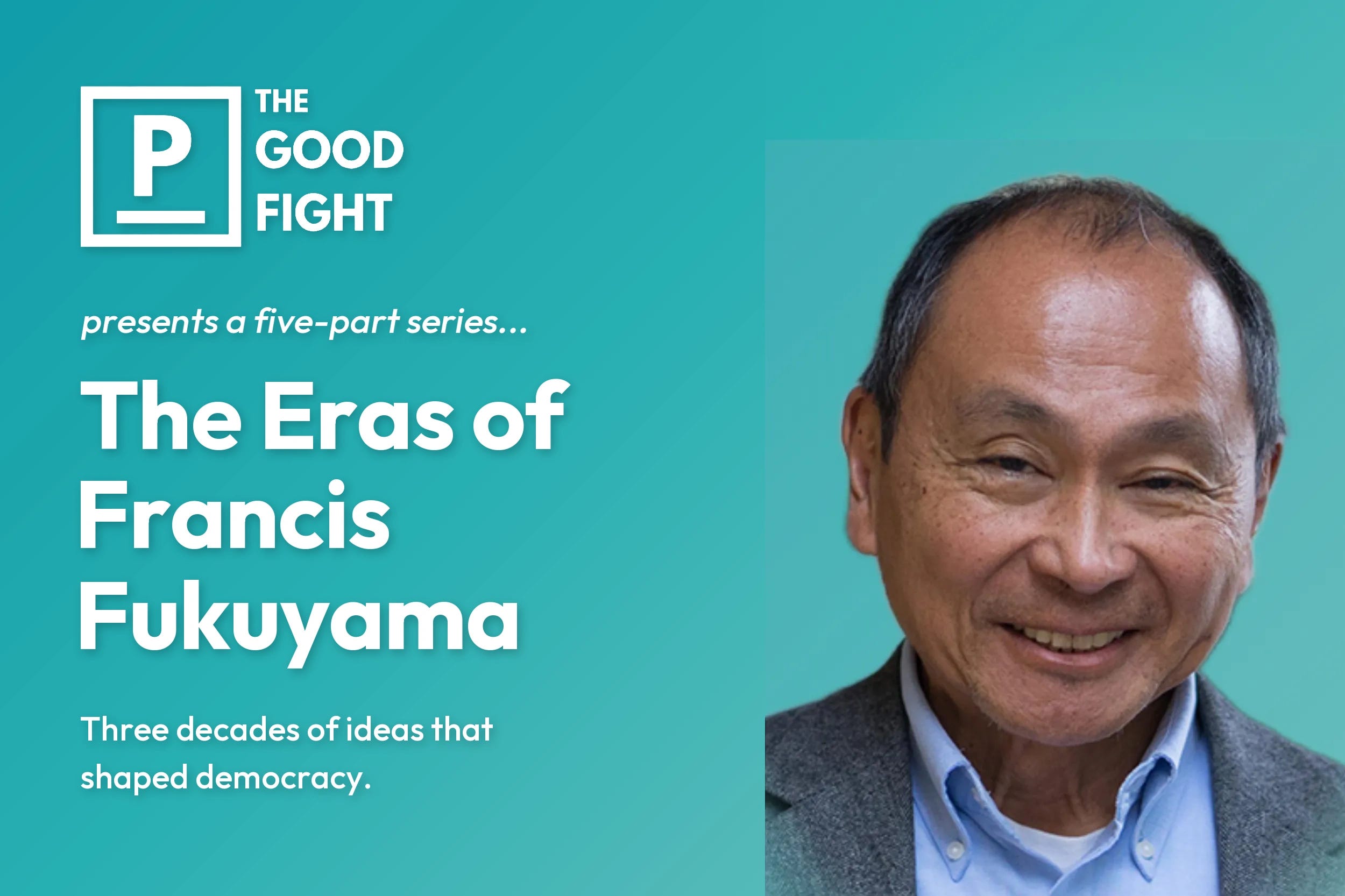
Francis Fukuyama is the Olivier Nomellini Senior Fellow at Stanford University. His latest book is In the Realm of the Last Man. He is also the author of the “Frankly Fukuyama” column at Persuasion.
In this week’s conversation, Yascha Mounk and Francis Fukuyama discuss why human nature has been so central to Fukuyama’s political thought, what modern evolutionary biology and anthropology tell us about the myth of primordial individualism, and whether human beings are best understood as fundamentally social creatures or fundamentally self-interested ones.
Enjoying this discussion? In an event exclusively for readers of American Purpose and Persuasion, Yascha Mounk will be interviewing Francis Fukuyama about his life and thought at 5pm on Sunday, September 6 at The Abbey Centre, London. Find out more and get tickets here. Paying subscribers of Persuasion and American Purpose can access a code for a free ticket here.
We’re delighted to feature this conversation as part of our series on Liberal Virtues and Values.
This series, made possible with the generous support of the John Templeton Foundation, features content making the case that liberalism has its own distinctive set of virtues and values that are capable not only of responding to the dissatisfaction that drives authoritarianism, but also of restoring faith in liberalism as an ideology worth believing in—and defending—on its own terms.
This transcript has been condensed and lightly edited for clarity.
Yascha Mounk: What we want to talk about for this part of a conversation relates specifically to two of your books, but also to themes that really pervade every part of your work, which is the role that human nature plays in understanding the social world. To start off with, I think that there is something somewhat unusual about a major social theorist of the late 20th, early 21st century putting so much emphasis on human nature in the first place. A lot of social theory in the 20th century started from the premise that there really is not such a thing as human nature and that any appeal to human nature is at best misguided and at worst dangerous. Why do you think that in reflecting about the kinds of politics we can have and should aspire to, we need to root ourselves in an account of human nature?
Francis Fukuyama: Well, I think there are several answers to that question. Historically you cannot understand the development of modern political theories about what a just society looks like without reference to human nature, because many philosophers in the past based their theories on a substantive theory of human nature. The other one is kind of commonsensical: there are certain human faculties and capabilities that strike me as not just uniquely human, but at the core of what we regard as our humanity, and the attempt to deny the existence of that core of capacities just strikes me as a little bit crazy. I think that is actually something only academics could convince themselves of, that everything is simply socially constructed. I am struck by many arguments where people will simply default to just saying, well, that is just human nature, somebody is greedy or violent or something. I think that is the default assumption of most people, that we live in a world that is framed by a certain set of characteristics that we call human nature.
Mounk: So that is a case for why we have to have an account of human nature. How then do we go about constructing that account? Obviously, people made claims about human nature in the past that turned out to be very wrong. They might have said, for example, that women are by their nature caregiving in ways that make women incapable of intellectual work. That has thankfully turned out to be wrong. How do we talk about human nature in ways that are true to human biology, true to the biological creatures that we are, but without actually ending up sanctifying the particular cultural assumptions of a time and saying that is just natural and unchanging and therefore we must assume that it goes to the heart of who we are as a species?
Fukuyama: Well, here I think modern natural science actually is a big help, because we know a whole lot more about what could be the basis for human nature than we did a hundred years ago, beginning with the understanding of the role of the genome, of DNA, in encoding certain characteristics in every species that exists, including the human species. That has actually served to debunk certain more naive theories about human nature that were typically held by conservatives. The realm of gender is the most clear case of this, where there were very firm beliefs about the roles of women and of men and what women could and could not do that were based on a kind of implicit theory of human nature, and I think we have gotten a lot more empirical information, most of which goes to debunk those theories. It is pretty hard to go from an understanding of DNA to actual behavior. What we have instead are a whole bunch of empirical studies that come from a variety of fields, of human psychology, of comparative anthropology. We understand, for example, a lot of human behaviors actually have roots in primate behavior, and we know a lot more about that now, where we posit that there must be some continuity in the evolutionary path by which some creatures became chimpanzees and others became human beings. That is all based on a common ancestor that had certain characteristics that are shared by modern humans and modern chimpanzees. So there are a lot of sources of our knowledge about what might be natural and what is simply socially constructed or cultural.
Mounk: So we can look at some of our close animal ancestors and see what we appear to have in common with other primates. We can look at what seems to be constant in humans across the historical record or across many different societies today. We can look at evolution as a kind of guide to what kind of faculties we may have developed over time. If we take those three things together, what is your account of human nature? What do you think stands at the core of who we are as a creature? In what ways does that give us great versatility? Clearly, one of the striking things about humans is how versatile they have been across different climates, across different arrangements of living, having adopted vastly different forms of political self-organization, economic self-organization, and adopted vastly different values at different times. What do you think is constant across all of that variation, actually remains the same throughout?
Fukuyama: Well, rather than try to answer a question as gigantic as that, let me try to do it in pieces, and provide a little bit of the historical intellectual history of these concepts. One of the biggest controversies in political theory is about individualism. Do human beings by nature start out as individuals largely concerned with their individual well being, or are they more socially oriented creatures who by nature want to be in communities and share norms and behave in social groups? This was one of the big divisions in politics, because early liberals like Thomas Hobbes or John Locke or Jean Jacques Rousseau posited an early state of nature, by which they meant human nature. The state of nature in this narrative is simply a metaphor for human nature. They are trying to uncover what is customary and what is by nature. These early liberal theorists postulated that the deepest characteristics of humans were individual, that you looked after your own material well being, maybe a little bit after your family. With Locke, even the family was kind of derivative of people wanting to maximize their own self interest.
Mounk: They obviously had huge disagreements between themselves about what that human nature was. Most importantly, somebody like Thomas Hobbes really thought that the individual desire to survive most of all, but also to strive after a form of glory, is what drove the state of nature. That is why, quite quickly, without anybody being evil, it led to a life that is nasty, brutish, and short, because it put us in competition with each other and we needed the state in order to manage that competition and create a kind of social peace. Whereas for someone like Jean Jacques Rousseau it was the opposite. Before civilization, before society, before politics, human beings were actually altruistic in a certain kind of way, and it is all of the evils of society that corrupted our nature further down the line.
Fukuyama: Well, that was even more true of Jean Jacques Rousseau, who felt that by nature individuals were solitary, timid, and happy, and that it was only when they first came together in society that they began to compare themselves, feel envy, and then make themselves terribly unhappy. They have very different views of what human nature is, but what they do share is this belief in individualism, that you need to study individual motives. This is also embedded in modern neoclassical economics, because a fundamental premise of the economic models that are taught in your Econ 101 microeconomics course is that human beings are rational utility maximizers, meaning they think primarily about their own utility—utility meaning for the most part material interest and not altruistic aspirations. Human nature comes back in all sorts of ways that we think about the contemporary world. The point I was on my way to making really had to do with primordial individualism. You are right that Hobbes, Locke, Rousseau all have very different accounts of what those individuals were like, but they all began with this assumption that we start out as individuals and come to society only over time, and that society is a kind of artificial construct, a social contract that people arrive at because they want to figure out how to get out of the state of nature.
Mounk: I see what you are getting at. That is actually against what the historical record suggests.
Fukuyama: Yeah, I think that is completely wrong, in retrospect. Here there are a lot of different fields that have contributed to this: comparative anthropology, primatology, where you discover that there never was a period of primordial individualism. Certainly not anything like what Rousseau described. Human beings always lived in groups and they always had very strong natural faculties for dealing with life in society. The whole field of evolutionary psychology is really a kind of evolutionary account of how these faculties got embedded into the human genome because of the need to cooperate, way before there were modern human beings. You still had this natural superiority that was conferred by your ability to cooperate with other members of your same species, and that is very deeply embedded. When you ask me what my account of human nature is, I would say, in my view, something like modern individualism is in fact historically contingent. It is not true of most societies, either today or historically. It is something that kind of evolves over time in a certain part of the world under certain conditions, but that kind of individualism is not natural, and that has a lot of political implications, because a lot of libertarians and people on the right are very invested in that individualistic story, and a lot of people on the left believe in the social version of it. But even there, there are disagreements, because you can believe that the social human is a state-centered member of a big society, or you can believe that they are basically much more socially oriented towards friends and families. I think those are all things that modern anthropology can tell you a lot about.
Mounk: There is an interesting argument by a biologist that humans are by nature kind of semi-monogamous. When you look at the monogamous species in the world and you look at the much larger number of species in the world that are non-monogamous, and you look at a whole set of physical characteristics they have, humans fall somewhere in the middle. That might explain why the theme of monogamy or non-monogamy, the theme of love and romance and marriage and betrayal, is so central to human literature. Could you by analogy say that humans are a semi-individualist species? You go back to the very earliest myths and stories about humanity—The Odyssey is on people’s minds at the moment because of a new movie—they very often have to do with the struggle of the individual with and against society. Antigone is obviously the most salient case. We evolved in bands of people, our membership in groups has always been a huge part of both our social reality and what made us successful. If you were incapable of cooperating with others, you probably were not able to survive and procreate. But there is also always a form of individuality and individualism that certainly distinguishes us from sheep or lemmings.
Fukuyama: Yeah, I think that one of the things you quickly discover when you start thinking seriously about the empirics of human nature is that it is very complicated, and to say that human beings have deeply embedded social instincts is only part of the story. I think you are right that human beings also are individuals that have individual, as economists would say, individual preferences for one thing over another. There is also within every human being a tension between that kind of individual selfishness and the desire to conform in social groups. But I think in general that the idea that we are deeply, fundamentally individuals is hard to support simply by the history of the evolution of human societies.
On the question of monogamy, that is a complicated one where you get into dangerous territory very quickly, because a lot of evolutionary psychologists have argued that male and female reproductive strategies are very different. This is a good example of where I think you have new sources of information. The basic argument that evolutionary psychologists began making in the nineteen seventies and eighties was that males just tended to be more promiscuous than females, because everybody is trying to maximize the chances of getting their genes into the next generation. For a male, the easiest way to do this was to have sex with a lot of women. For women, the path to doing this was by nurturing her own offspring, which required a lot of time and effort, much more so than in other species. Therefore women had to be much more selective about the partners that they chose, because they needed help in raising their offspring.
It turns out I was just speaking to a biologist friend of mine who pointed out that this is a pattern that exists in virtually all sexually reproducing species, with a couple of exceptions, and the exceptions are cases in which the male has actually evolved to spend much more of its time taking care of offspring than the female. Sure enough, the roles are reversed, so in that species the males are much more selective about their partners, and the females are much less selective. It just seems to me—that does not actually fully prove the theory, but it does suggest that if something is invariant across a lot of different types of creatures, there must be something biological going on there, because presumably these kinds of simple multicellular creatures are not making individualistic choices for themselves.
Mounk: I am struck by your skepticism about the idea that human beings are individualist, or at least by your skepticism about some of the ways in which theorists have thought of human beings as individualists. As you have pointed out, it is often the case that philosophical liberals emphasize individualism, and it is the critics of philosophical liberalism who say that really that is an abstract, wrong-headed notion and that we are really constituted by the communities of which we are part. That is, in fact, one of the interesting things that post-liberal critics on the right and the left have in common.
We hope you’re enjoying the podcast! If you’re a paying subscriber, you can set up the premium feed on your favorite podcast app at writing.yaschamounk.com/listen. This will give you ad-free access to the full conversation, plus all full episodes and bonus episodes we have in the works! If you aren’t, you can set up the free, limited version of the feed—or, better still, support the podcast by becoming a subscriber today!
If you have any questions or issues setting up the full podcast feed on a third-party app, please email leonora.barclay@persuasion.community
When you think of Zohran Mamdani in his inaugural speech in New York talking about the joys of collectivism, or when you talk about somebody like Sohrab Ahmari on a previous episode of his podcast, claiming that liberals are obsessed with autonomy and that is a problem with them and we should value community much more—how do you reconcile those two things? Why is it that liberalism is the right governing philosophy for humans, even though we are not by nature individualists in the kind of way that people, from Thomas Hobbes to John Rawls, may have thought?
Fukuyama: Well, one answer to that is that another part of human nature is to be very plastic or very adaptable. Even though something may be an inclination that is given to you by your genes and your biology, human beings can also overcome that, and we do that in all sorts of ways. That is why we have culture: the raw material of human nature often leads to very bad outcomes. The most obvious one is violence.
The early liberals were correct in a certain sense about the social contract, that one of the things that happens in human societies is you tend to develop cultural rules that constrain certain kinds of very dangerous behaviors on the part of the individuals making up the group. The thing about individualism is that it turns out it is very useful for economic development. If you allow individuals to make choices about what to buy, what to make, what kind of company to start, it turns out that you end up a lot richer than if everything is mired in a kind of collectivism.
There are societies that are based on what anthropologists call segmentary lineages, what other people somewhat inaccurately describe as tribes, where you cannot sell anything except to a kinsperson. If you are looking at a store and your cousin owns a store next door and you buy from the other store because they offer a lower price than your cousin does, your whole kin group is going to get mad at you and put a lot of social pressure on you to buy things.
Modern market economies really do depend on a kind of individualism in terms of economic decision making, where you have to get beyond the family and family ties. It turns out that if you want to run a bureaucracy and you stuff it all with your kinspeople, your brother-in-law and your son-in-law, and all the diplomats are kind of relatives of yours, you are not going to have a successful country, as opposed to picking people on the basis of a somewhat unnatural principle that merit ought to be rewarded. That is one of the tensions in modern politics, that good governance actually depends on meritocracy and the breaking of these social bonds, choosing the qualified individual over your relative or your friend, and yet there is a strong human desire to stick with family and friends.
That is one of the tensions I talk about in my Political Order books, where the material needs of a modern society run counter to some very basic human inclinations that we have. But because humans are adaptable, we can say, okay, I am going to pick the most qualified person and not my cousin.
Mounk: That is a great cliffhanger to a future episode of Francis Fukuyama’s Eras Tour, because I want to make sure that we devote a real conversation to the Political Order two-volume series.
Your account here is really interesting. A lot of the time we think that liberals have an anthropology, a view of human nature that says we are really by nature individuals and we are individuals before we entered political society, and therefore those political societies should respect and honor our individualistic natures by giving us the right to speak as we please and worship as we please and assemble with whomever we please and so on.
You are in a way saying something much more interesting, which is that human beings are not by nature individualistic, but that has some very bad consequences. If we think about everything in terms of our clan, that makes it much harder to have economic development, because you are not going to buy the better, cheaper product, you are going to buy the product of your second cousin twice removed, and otherwise you are going to be ostracized. You are not going to have an impersonal state bureaucracy that gives people services or locks them up depending on what they have done and how they have followed the rules, but on the basis of whether or not they are related. That is going to make it very hard to have a rule of law and all the institutions that have huge benefits. So we need an individualistic order in some ways to hedge against the negative elements of our collective natures.
There is a different way of putting that same point that I associate with Jonathan Haidt, but that I think has a much deeper tradition, which is to say that we are by nature tribal people, and that has the potential for political violence within it. We are often courageous and even altruistic in dealing with people who we think of as part of the in-group, but we can very often be cruel, unfair, even violent towards anybody who we think of as a member of the out-group. Part of the aspiration of a decent society, whether that takes the form of individual rights that are protected by the state, or even a form of liberal nationalism that tries to expand the circle of who counts as part of the in-group, is precisely to go against that nature. Is that a different way of rendering what you said? Is that a third element to what you said, or do you disagree with Haidt and that tradition?
Fukuyama: There are a couple of different aspects to the social nature of man. The one that I emphasized in my Political Order books had to do with friends and family, and there is a specific tradition within biology. William Hamilton was the scientist that articulated the idea of inclusive fitness, that we are altruistic in proportion to the number of genes that we share with other people, which explains nepotism basically, that we favor genetic relatives. Robert Trivers, who just passed away fairly recently, developed a theory about reciprocal altruism, that human beings have evolved a capacity to develop reciprocal relationships with other human beings based on gift giving and experience of mutual support. That basically tells you that friends and family is a very natural form of human sociability.
It is absolutely the case that if everything has to depend on friends and family, you are going to have a very limited society. That works in hunter-gatherer societies and certain forms of tribal societies, but if you want to have a state or anything that goes beyond just a circle of people that you know are related to, it becomes a big liability, and therefore you have to create impersonal institutions. This is one of the biggest themes that cuts across several of my books, beginning with my book Trust, but continuing through the Political Order books: if you want to develop a modern society, you have to get beyond the family, or this friends and family circle that is natural to us. In a way, all political orders are in a certain sense unnatural, because they require us to hire the most competent individual or the best general, rather than somebody that is an old drinking buddy of ours. That is one aspect.
The other aspect of human sociability that is more, in a way, dangerous has to do with this idea of norm following in much larger groups, where we actually want to defer to the authority of a single leader, and that we find safety and security in doing that. That goes beyond the family. That is really the basis of modern nationalism or ethnicity. Ethnicity is kind of a fake familialism, because people in the same ethnic group may have been related to each other a hundred generations ago, but they actually really are not genetic relatives. They think that they are part of a larger, homogeneous group, and they are perfectly willing to defer to the authority of people that will lead that large group.
Both on a small scale with friends and family and on a large scale with phenomena like nationalism, you do have this human instinct to conform with social norms that are created at a variety of different levels, and that becomes both the strength of the human species—if you say why did the human species end up being so dominant in the world, it is because of this ability to cooperate socially—and why it has also become very dysfunctional, in terms of leading to wars and destruction and racism and all sorts of things. Again, it is because we have these natural characteristics that tend us towards certain forms of sociability.
Mounk: Okay, let us get into some of the controversies. One concern with not having an account of human nature is that it might lead you, in some senses, in too libertarian a direction, making you think that human beings are really by nature individuals that need to be protected from the threats of community.
Another way that you might think about the dangers of having too individualistic a view of human nature is that it might make you think that you can completely change human nature. That is obviously the problem with some deeply collectivist regimes. I spent some time in Cambodia, and when you look at the way in which Pol Pot and the Khmer Rouge wanted to transform their society in denial of basic, I would say, individualistic aspects of human nature, that helps to explain what, on a per capita basis, was probably the worst regime in human history.
But it might, in a totally different way, also be true of much more understandable aspirations that people within our own society have to remake or refashion themselves from scratch. Do you think that an understanding of human nature should in some way limit our ambitions, whether that is to create a collective utopia or to completely refashion who we are as individuals?
Fukuyama: That is absolutely right. The communists in the Soviet Union wanted to create a new Soviet man who would not be interested in kinship, would devote themselves entirely to the state, and that proved to be not just a failure practically, but also a moral failure, because it meant that people had to be wrenched away from their families and their deepest personal commitments.
Let me give you one example of how a wrong theory of human nature leads to a lot of unhappiness. There is an Italian journalist named Alexander Stille who wrote a book called The Sullivanians. This is a very strange cult that occurred on the Upper West Side of Manhattan back in the nineteen sixties. It was formed by a couple of individuals, one of whom was a licensed psychologist, but it was premised on the idea, which was shared by a number of people on the left, that the evils of capitalism were deeply rooted in the family, and especially in the kind of monogamous heterosexual family.
What they tried to implement in these very nice apartments in Manhattan was a collective system that did not allow couples to bond over time and did not allow the mother of a child to raise that child. The children were ripped away from their biological parents almost from birth and given to somebody else in the little commune. It is a very hard story to read, because it created such a lot of personal suffering, both on the part of the parents that wanted to raise their own children and on the part of the children that wanted to have a mother and father. Instead they were put in this little collective thing that was driven by a couple of ideologues who somehow believed that they would solve the injustices of capitalism by raising children in this fashion.
Mounk: I experienced a much milder version of this when I was growing up, rooted in the same historical period and some of the same ideas, I think, which is that many of the friends and acquaintances of my mother when I was growing up had been students in the sixties or perhaps the early seventies, and they really disliked the idea of lifelong monogamous partnership.
They also had found partners that, despite all of their struggles, they seemed to like and wanted to stick with. The term that really was standard was that they introduced the partner as my Lebensabschnittsgefährte, my life segment partner, to somehow deal with the embarrassing fact that they seemed to be in a monogamous relationship, but emphasizing that this is really a temporary phenomenon. Of course, some of them split up or got divorced, but by and large, the Lebensabschnittsgefährte, the life segment partner, turned out to be the partner for all of the segments of their lives.
Fukuyama: There is a Latin poet, Horace, who wrote a poem that contains the line “tamen usque recurret.” It means “it always comes running back.” In the context, in the previous line it said: you can try to throw human nature out with a pitchfork, but it always comes running back. I think these are examples of that.
Mounk: The other striking thing is that Nicholas Christakis talks about this in one of his books, that every commune ends up going wrong in the same way. You have attempted communes in lots of different contexts, and when we go beyond just having roommates or something quite thin, when it really is trying to create this collective life, there are different stages of it, and the stages of decay they follow end up being remarkably similar across different contexts, because they are trying to do something that seems incompatible with human nature, and so therefore human nature takes its revenge in remarkably similar ways.
What about some of the areas in which what we assume about human nature does seem to have changed a lot? Very intelligent thinkers and writers made assumptions about women for centuries that turned out to be very wrong. Of course there were people even before the advent of natural science who recognized the folly of that. John Stuart Mill pointed out that it may be true that women up until that point in history had not accumulated great achievements in many areas of human endeavor, but that was because they were excluded from full participation in society in remarkably similar ways across all those contexts. Mill made the argument that we really do not yet know what women are truly capable of when those disabilities are removed from them, and he rightly anticipated that women in fact would come to have great achievements once they were allowed and encouraged to do that.
At the same time, there are clearly some biological differences between men and women, not just because women bear children in a way that men do not, but also because we are creatures driven in part by our genetics, and people who have two X chromosomes have a different set of genes from people with an X and a Y chromosome. How should we think about human nature in relation to gender differences?
Fukuyama: Well, actually, before we get into gender, there is a broader issue that also applies to things like race and ethnicity. People at one point believed that there was a natural hierarchy in the different races of human beings around the world, and that white Europeans, white northern Europeans, stood at the top of that hierarchy, and black people of various sorts and brown people were at lower rungs. That was used—there was a whole school of what is now called scientific racism that developed after Darwin published The Origin of Species, that then tried to apply this very crude, I think ultimately misunderstood, version of Darwinism to human racial stratification, and argued for, for example, European colonialism on the grounds that the colonized people were less human or lacked intelligence or other characteristics that Europeans had, and that justified their being held in bondage. So it really is much broader than just prejudices against women.
With regard to scientific racism, again, this is where I think the scientific method actually gets very useful. One figure in this movement was Franz Boas, who is really the founder of modern cultural anthropology. There had been this argument that, during the great period of immigration into the United States in the late nineteenth and early twentieth centuries that led tens of millions of people, mostly from southern and eastern Europe, to come to the United States, a lot of the racists at the time argued that these people were not as intelligent as Europeans, and they actually did this by measuring the head size of different racial groups.
The thing that Boas did was use the data: the army was measuring the head sizes of recruits when they processed people into the army for World War One, and Boas continued to measure, he did a longitudinal survey of what the children of these people were like, and it turned out that there was a convergence in head size once people started eating an American diet. It turned out that this supposed racial difference was simply a matter of environment, and that once these immigrants fed their children American food in enough quantities, their intelligence, head sizes, everything else began to converge with that of native-born Americans. This was one pretty clear case where actually the scientific method is very useful in clearing up something that is simply prejudice.
Now in the case of male-female differences, I think we have seen something very comparable to that, where a lot of people believed that women could not occupy—well, it begins with the mind. In the nineteenth century it was very common to hear men say that women are not rational enough to vote, and I think time has just proven that this is really ridiculous. Women actually have different preferences in what they vote for, but they certainly are absolutely qualified to exercise that kind of choice.
This is a problem that our current Defense Secretary Pete Hegseth has, in that he also believes women are not suited to combat positions. Empirically, again, that has been proven to be wrong, that you have a lot of female war fighters these days. As a group, in the aggregate, they may not be quite as good at lugging forty-pound packs of ammunition up big mountains, but there is no question that they can be just as tough and vicious in combat as men. So there has been a lot of disconfirmation of these earlier ideas.
The problem is that there are certain domains in which, despite the effort to equalize outcomes and equalize the environmental conditions for young boys and girls, there still remain differences in the aggregate. People have a hard time thinking about this because the truth is that any characteristic held by either men or women is distributed naturally. There is a normal distribution where you have got a center and then two tails of the distribution. It is the case that there will always be women that are stronger, faster, have more upper body strength than men on average, but the two normal curves overlap, and the tails are different, and there are certain areas where the average performance will be different. That, I think, kind of points to the irreducible nature of human nature. There still remain certain characteristics that will persist, and it shows up today, for example, in labor markets.
Mounk: These particular questions of gender are also related to structural changes in the economy that then went to follow on changes in society at large that you wrote about in the 1990s in your book, The Great Disruption.
Fukuyama: My least-read book was one I published in 1999 called The Great Disruption. I did not intend to do it when I started out on this project, but I ended up writing a book about gender. One of the arguments that I convinced myself of, and I think is still correct, is that the rise of feminism and the movement of hundreds of millions of women into the paid labor force beginning in the 1960s was not a kind of autonomous ideological event where suddenly people said, women really are equal, it is morally a terrible violation to treat them differently. I think it was really driven by technology.
At that moment you were making a big transition from an industrial society into an information society, in which the vast majority of workers were now working in a service economy which involved sitting in front of a computer screen all day. Many fewer people were involved in moving heavy objects or lifting things or working with gigantic machines that required a lot of upper body strength. As a result, women just had a much more natural place.
If you want to think about what are the remaining male-female differences that are very hard to explain except by biology, you think about characteristics like risk taking and crime, which are, I think, unfortunately heavily correlated. It is the case that the vast majority of crimes are committed by young men, let us say between the ages of fifteen and twenty-five. This is invariant. It is invariant across different cultures, it is invariant over time, across different levels of human development. That is the case.
One of the reasons that women are outperforming men, especially in low-skill occupations in today’s economy, is that women are just better at working in a service economy where you have to sit patiently behind a computer screen and the boss wants you to turn up reliably for work. Women will just do that much better than men. I do not think that that is necessarily a socially constructed difference. I think that is related to a more fundamental difference between the sexes.
Mounk: One important way in which questions about human nature show up in politics is not about the foundation of politics, it is about what kind of interventions in human nature we should allow. You started to think about that going back to the big debates about bioethics in the early 2000s, and have continued to reflect on it. Today we are capable of choosing certain traits for the children we have. We can have a lot of embryos and then test them for polygenic scores, and with some amount of likelihood select the embryo that is most likely to have a high IQ or most likely to be very athletic. We can of course select for particular diseases that we want our offspring to avoid. We are increasingly able, and will soon be able, to edit our genes to say that perhaps we have some character trait that is driven by or correlated with certain genes we have, and perhaps we can just edit those to change them.
How should you think about which of these treatments to allow and which of these treatments not to allow? There is an obvious tension between the enormous good that some of these kinds of treatments might make—when you are thinking, for example, about having some horrible hereditary disease that you want to make sure your child does not inherit—but also some real risks if you imagine a society in which half or a third or a tenth of society is genetically enhanced and much smarter and faster and so on than everybody else, and the rest of society is considered in some way a second-class, non-altered human. It is easy to imagine the kind of dystopian sci-fi scenarios.
Fukuyama: Well, in the early 2000s I was a member of President George W. Bush’s bioethics council for several years.
Mounk: As, I believe, was my doctoral advisor, Michael Sandel.
Fukuyama: Yeah, that is right. He was on that council as well. James Q. Wilson, a lot of very notable people. I also wrote a book called Our Posthuman Future, because I take a pretty conservative view on this type of biological intervention. If you talk about CRISPR-Cas9 and germline editing, you are talking about altering not just the behavior of a currently existing individual, but all of that individual’s subsequent descendants. The potential for doing something that has unintended consequences is, I think, much greater.
The other argument that I made—to answer your question about what I came to conclude as being legitimate and non-legitimate—is that, obviously, we have been intervening in our biological bodies for years and years. I had cataract surgery last year, so I have got these artificial lenses in my eyes and I do not need glasses anymore. I can hardly say that that is something illegitimate. What I had argued back then was that we ought to be open to enhancement technologies, or technologies that correct—sickle cell anemia is biologically rooted, and if you can select against that, or can actually edit someone’s genome to get rid of that horrible disease, there is no reason you should not do that. But we need to be especially cautious about enhancement technologies.
I had a very specific reason for worrying about that, because I think that people have these fundamental disagreements and also misunderstandings about what makes a human being a human being. I talked about there being a certain factor X that is what people historically have thought gave human beings dignity. It has something to do with the ability to choose, to make moral choices, to be morally autonomous. But I think it also has to do with the way we relate emotionally to the outside world, that we feel pain, we have consciousness that allows us to sympathize or empathize with other people, that drives our altruism and a lot of factors that allow us to live in society.
You do not want to monkey with those things that might impinge on that factor X, because fundamentally it is related to our view of human rights. You see this most clearly in the case of something like intelligence. If we could actually locate genetically where high intelligence resides and manipulate people to be smarter, I think that is going to be a disaster, because who is going to take advantage of this first? It is obviously elites that have the ability to—they are already putting their kids into private schools and giving them tutors and giving them a leg up in the race of life. If you can then also make sure from the time they are embryos that they are going to be smarter than other people, genetically smarter, that is going to create a tiered society where those advantages are going to be passed down to descendants, and that is a nightmare. Aldous Huxley talks about alphas, betas, and gammas in Brave New World, and that is exactly the kind of society that we would be heading towards.
In the rest of this conversation, Yascha and Francis discuss trans rights, what artificial intelligence teaches us about being human, and why Silicon Valley’s focus on life extension is a bad idea. This part of the conversation is reserved for paying subscribers…
Listen to this episode with a 7-day free trial
Subscribe to Yascha Mounk to listen to this post and get 7 days of free access to the full post archives.


