



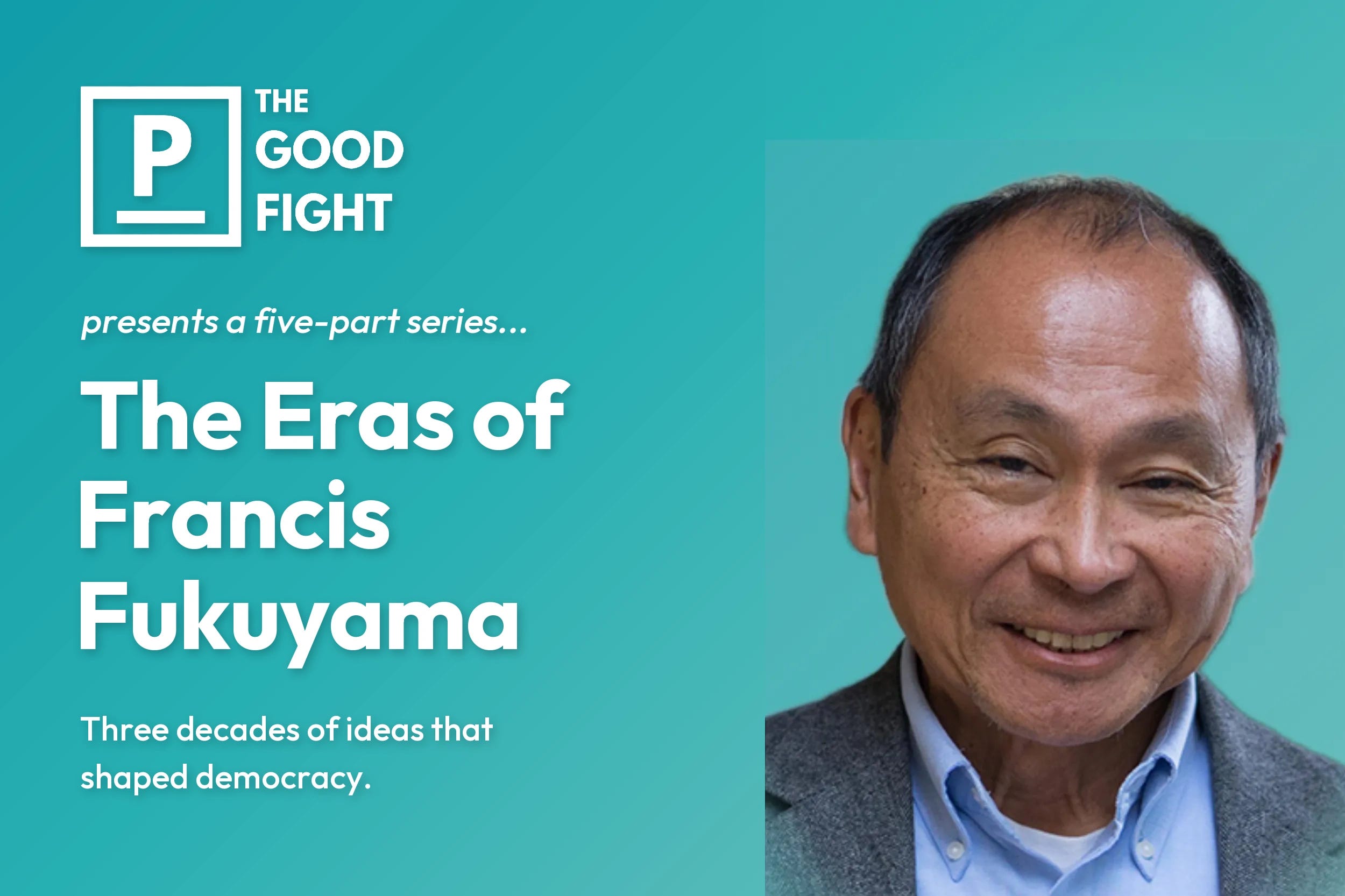
Francis Fukuyama is the Olivier Nomellini Senior Fellow at Stanford University. His latest book is In the Realm of the Last Man. He is also the author of the “Frankly Fukuyama” column at Persuasion.
In this week’s conversation, Yascha Mounk and Francis Fukuyama discuss the true meaning of “the end of history,” why the struggle for recognition—rather than material interest—is the engine of historical progress, and how his thesis holds up 35 years on.
Enjoying this discussion? In an event exclusively for readers of American Purpose and Persuasion, Yascha Mounk will be interviewing Francis Fukuyama about his life and thought at 5pm on Sunday, September 6 at The Abbey Centre, London. Find out more and get tickets here. Paying subscribers of Persuasion and American Purpose can access a code for a free ticket here.
We’re delighted to feature this conversation as part of our series on Liberal Virtues and Values.
This series, made possible with the generous support of the John Templeton Foundation, features content making the case that liberalism has its own distinctive set of virtues and values that are capable not only of responding to the dissatisfaction that drives authoritarianism, but also of restoring faith in liberalism as an ideology worth believing in—and defending—on its own terms.
This transcript has been condensed and lightly edited for clarity.
Yascha Mounk: This is the first substantive episode in our series on the eras of Francis Fukuyama. We started with a wonderful biographical conversation about your life and your family, but this is the first episode in which we really grapple with one of your major works, which is of course your most famous work, We’ll get to “the last man,” which is very important, but I want to start with the first substantive word in that title, which is “the end.” I think the first misunderstanding that people often have is that they understandably think about the end in terms of a closing, in terms of something being over, but of course the end is a kind of pun because it also means something like the purpose of history. So help us understand those four words: the end of history.
Francis Fukuyama: Sure. It’s not just the word “end” that’s problematic, it’s the word “history.” So let me explain both of them. The end of history really does refer to end in the sense of objective or target or direction. And the word history, I think today you would use words like modernization or development, because that’s the underlying concept: that there’s a broader pattern to history, that it unfolds over hundreds, if not thousands, of years, and that it has a certain coherence and direction. So the question of the end of history really has to do with that arrow. Where is that arrow pointing as we progress through historical time, and where does it look like it’s going to end up?
Mounk: To understand what you mean by end and what you mean by history, you need to go back to the thought of two philosophers, Hegel, the nineteenth-century German philosopher, and Kojève, the twentieth-century French philosopher. Let’s start with Hegel. There’s an old joke that a German scholar calls up his English colleague, and he’s well into his eighties at this point. He asks, Stephen, can you tell me a good English teacher? And Stephen says, well, why at your age do you now decide that you really want to improve your English? And he says, because I finally want to understand Hegel, because it’s often easier to read in translation than the original. Give us the one on Hegel.
Fukuyama: Sure. This may be a little bit more detailed than our listeners really want, but the idea of a progressive history has a lot of precedents. One of them actually is in Christianity, because history has a beginning in the Garden of Eden when God creates the world, and it has an end: the final revelation and the calling back of humanity to Christ and to God.
But in more recent times, I think it’s actually Jean-Jacques Rousseau, the French philosopher, who talked about perfectibility. In the late eighteenth century, when he was writing, the Europeans had discovered that there were all these primitive peoples living in North America and other parts of the world, and it made Europeans aware—they were aware that there was China and India and all these other foreign civilizations, but the idea that there’s actually a big difference between the indigenous tribes inhabiting North America and where they stood as Frenchmen was really quite enormous. Rousseau was really the first philosopher, in his Discourse on the Origin of Inequality, to provide a kind of long-term account of how early human beings evolved into modern human beings. He really kicks this idea off, and Hegel systematizes it as only a German can.
He’s the first historicist philosopher who argues that you can’t really understand any particular line of thought, ideology, or social condition except historically, because things evolve, things change over time. Just to take one obvious example: there is a time when virtually everybody in the world accepted the legitimacy of monarchy, because all states were ruled by kings or queens. There’s a time when many cultures took slavery as a kind of natural institution and they practiced it and didn’t see that there was anything wrong with it. Today we hold no king’s rallies, because we don’t believe that any monarch—except for constitutional ones—actually holds their position legitimately, and we certainly don’t believe in the legitimacy of slavery. This is an example of how, after Hegel, people began to say, well, that was right for their time, but we’ve moved on since then, and human thought has developed, and we no longer believe in those sorts of things. That’s what historicism means: there’s a general progress of human civilization that unfolds over time, and you can’t understand it without understanding that time dimension.
Mounk: That obviously raises the question of what it is that drives that historical process. Part of what drives it for Hegel, and part of what particularly drives it in Kojève’s interpretation of Hegel, is the struggle for recognition. You have the master-slave dialectic that Hegel talks about, but that Kojève then interprets in a way that is even more central to that philosophy of history. Why is it that the struggle for recognition is such an important driver of this historical process?
Fukuyama: Perhaps before we get to that definition of recognition, we need to talk a little bit about Alexandre Kojève, because there was a time when everybody knew who he was in France. He was extremely influential in the middle of the twentieth century. He was a Russian émigré who settled in Paris and taught a very influential seminar on Hegel. They codified the notes of that seminar in a book, Introduction to the Reading of Hegel, which is now available in English.
Mounk: Since France is a tiny country and everybody goes to the same one and a half schools, every great luminary—who may be a bigger household name today than Kojève himself—took that seminar, from Jean-Paul Sartre to Raymond Aron and many others.
Fukuyama: That’s right. Yes, he was extremely central to French intellectual life in the 1940s, ’50s, and onwards, and his particular take on Hegel really made central the problem of recognition. Karl Marx was another Hegelian. Marx took Hegel’s idea that history is progressive, but he said it’s really driven by human material interests, the means of production, what technologies produce wealth, and in the current era it was being produced by the bourgeoisie, and it was up to the proletariat to rise up in a proletarian revolution and take control of the means of production. That was a completely materialistic understanding of what drove history.
We hope you’re enjoying the podcast! If you’re a paying subscriber, you can set up the premium feed on your favorite podcast app at writing.yaschamounk.com/listen. This will give you ad-free access to the full conversation, plus all full episodes and bonus episodes we have in the works! If you aren’t, you can set up the free, limited version of the feed—or, better still, support the podcast by becoming a subscriber today!
If you have any questions or issues setting up the full podcast feed on a third-party app, please email leonora.barclay@persuasion.community
Kojève, following, I think, legitimately on Hegel, but with much greater emphasis, said, no, actually it’s not material desire that is the driver, it’s really the struggle for recognition. That had to do with his understanding of human beings: unlike every other natural creature in the world driven by material interests, only human beings could struggle for dignity. He says only a human being will die for a flag or for glory, and that’s what made human beings different. For Kojève, history begins in a postulated bloody battle in which two early human beings struggle not over women or territory or resources—they struggle over recognition. Who is going to be recognized as dominant?
This is the central issue that he said lay behind, for example, the French Revolution. It wasn’t simply over the poverty of peasants in France. It really had to do with the fact that the monarchy did not recognize non-aristocrats as human beings. An aristocrat could treat a peasant in a purely material way, like he would treat a horse or a farm implement. Hegel, through the voice of Kojève, argued, no, in fact, this is a struggle over recognition, the recognition of dignity. The problem, according to Kojève, was that in these bloody battles for dominance, nobody ended up satisfied in the end, because the master won the victory over the slave, but he was only being recognized by a slave who was somehow less than human, and therefore his recognition wasn’t sufficient—and of course the slave wasn’t getting recognized at all.
What Kojève argued the French Revolution did was, for the first time, enshrine the principle of equal and reciprocal recognition of all human beings as the central principle underlying the new political order. To translate that into more understandable modern language, it meant universal human rights. A doctrine of universal human rights was articulated in the French Revolution. It was not implemented in most places around the world, but the idea was finally spoken in the Declaration of the Rights of Man and of the Citizen. You could say the American Revolution did something very similar, in proclaiming a Bill of Rights that governments had to respect. That was the central innovation—this mutual respect and mutual recognition of dignity that, for Kojève, was really the culmination of this long historical struggle for recognition.
Mounk: Some people think that you were premature in declaring the end of history in 1989, when the article version came out. Kojève located the end of history in 1806, when Napoleon beats the Prussians, therefore universalizing, in a certain way, the principles of the French Revolution in 1806 at Auerstedt. That’s an even more ambitious dating.
Fukuyama: Yes, that’s true. I think it kind of gives you a hint about how to interpret Kojève, because Kojève did say history ended at the Battle of Jena. He was doing his seminar in the late 1930s, as Hitler was gaining steam, Stalin was still ruling Russia, and you were on the verge of the Holocaust, the Second World War. After the Second World War—decolonization, the rise of the United States, the Cold War—all of these things were still in the future, and yet Kojève calmly said, no, actually history ended in 1806. I think anybody reading that would have to realize that he was being playful. He was saying that the principles of the French Revolution—and you might say the French and American Revolution—were articulated then, and the defeat of the old Prussian monarchy at the Battle of Jena signified the spread of these liberal, modern ideas to the rest of old Europe.
There’s a passage that I quote in my memoir where he says it starts in the metropolis and spreads to the periphery. Many parts of the world hadn’t woken up to the news of the equality of rights, the equality of recognition, but it was only a matter of time before the provinces caught up with the metropole and this idea spread. I have to say that it’s not a crazy idea. If you go around the world and ask how many societies do not accept the idea of the essential equality of human beings, it’s very hard to find any. They don’t practice it, but the People’s Republic of China—the name of the country is the People’s Republic—they understand that somehow legitimacy comes from the people and their interests. That’s the sense in which I think you could say Kojève had a certain point: that this idea of universal human equality was an extremely powerful one, and it’s one that has spread relentlessly since then.
Mounk: So the struggle for recognition gets formulated in the vocabulary of Hegel and then Kojève. But as you point out, that distinctive feature of the human soul is both something you believe in, something that you take to be part of human nature, and something that writers and philosophers have recognized much earlier. Often when you talk about it, you use the vocabulary introduced by Plato, of thymos. Why is it that liberal democracy is somehow better able to honor that demand for recognition, or to allow people to live in accordance with that thymos—for that thymos to have a place in their lives and in the way in which they’re treated in society—in liberal democracy? Because that, I think, is really at the heart of your claim that the end of history is liberal democracy.
Fukuyama: Sure. Again, we have to go back a little bit in time and explicate some of these terms. In the Republic, which is Plato’s book about justice, he asks the question—Socrates, the philosopher, through his mouth Plato raises the question of what justice is. Socrates asks his two young Athenian interlocutors: what are the different parts of the soul? The soul is psyche in Greek, from which our word “psychology” comes. I would say that when you ask what are the parts of the soul, he’s basically asking the same question about human psychology: what constitutes a human mind? They say, well, there’s desire for food and drink, there’s reason—these are two distinct parts of the soul. And Socrates says, isn’t there a third part, that he labels thymos, a Greek word that still exists in modern Greek? It often means anger or spiritedness, that is also something independent of either reason or desire. That is this desire for respect or for recognition—that in addition to their material needs, human beings want to be recognized as human.
Now, I argued in the book that there’s actually two different versions of thymos. The first is isothymia. This is a Greek word that I made up myself, meaning equal recognition. All people really hate it when they are disrespected, when they’re treated differently from other people, and they want to be treated equally. They say, I’m a person too—why did you ignore me and go to this person? Isothymia is really the Hegelian idea, or the Kojèvian idea, of universal recognition. We actually enshrine that in modern law. We have a Bill of Rights in the United States, we have a Declaration of Independence—whose two hundred fiftieth anniversary we just celebrated—that begins the second paragraph with “We hold these truths to be self-evident, that all men are created equal.” This doesn’t make them materially equal, but it states that all—well, at least all Americans—are entitled to the same kind of respect and rights, and we enshrine that in a Bill of Rights where we say that Americans have the right to speech, to association, to belief, to a whole set of things that we believe make us essentially human, and the state recognizes that humanity by protecting and enshrining those rights.
I would say virtually every modern country now has a similar kind of construct, where you have a legal structure that seeks to protect the equal rights of human beings. This is not in fulfillment of any kind of material demand—you could call it a spiritual demand, that we want the state to say, yes, you are a human being the same way as other human beings, and we’re not going to treat you as a second-class citizen.
Now the problem in modern societies is that there’s other demands for recognition—what I call megalothymia, meaning the demand for superior recognition—that many people, not everybody, but a certain group of people, want to be recognized as being superior. This obviously causes trouble in a democratic society that is committed to the equal rights of citizens, because certain people want dominance—they don’t want to be just treated like everyone else. This is a kind of essential tension that exists in every modern democratic society that, following Kojève and Hegel, grants universal and equal recognition to its citizens: you somehow have to deal with those that aren’t satisfied with simply equal recognition but want something more than that.
Mounk: That’s a little preview of a trouble we get to in The Last Man, and why it is that not everybody is satisfied with that. But to stick with isothymia for a moment, do you take that just to be an essential part of human nature, and perhaps even primate nature? I’m thinking here of the famous examples of giving two apes a reward for some kind of behavior—they’re very happy to get a grape for that behavior. But then when they see that you suddenly start giving the other ape a banana for that behavior, and they continue to just get a grape, some kind of inferior reward, they get incredibly angry. Should we—is that just a basic demand for fairness? It’s clearly not just that they think they need to get this amount of food for the behavior, so it’s something beyond that. But have we violated the isothymia of that ape? Is that what’s going on there?
Fukuyama: No, I think that’s absolutely right. There’s a lot of evidence from the primate world that other primates worry about recognition and this kind of equal recognition. Economists don’t think about thymos naturally—they think just about reason and desire. But there’s actually a lot of experimental evidence like the dictator game where you give both players a material reward, but you give more to one person than the other, and the difference starts increasing, and what economists have found is that if the difference is relatively small, people will say, I want the reward, I’m interested in the material outcome. But when it falls below a certain point, people will just say, I don’t want it. You’re disrespecting me by giving the other player so much instead of me.
Mounk: So the idea is: somebody gives me a hundred dollars to distribute. Now, in principle, I get to split the money however I want between the two of us. In principle, I could say, I give one cent to Frank and I keep $99.99, and you should be able to accept that, because one cent is more than zero cents. Why would you reject it? But what we find empirically is that in many cases, when what I’m giving you falls too low, when the split becomes too unfair, people say, I’d rather forgo ten dollars than accept a humiliation of you keeping ninety dollars for yourself and only giving ten dollars to me.
Fukuyama: That’s right. If you want another, more concrete contemporary example, look at the question of gay marriage. The demand for gay marriage appeared—you could have solved that issue in other ways. You have gay couples that have adopted children, and you have these questions of survivorship and inheritance and so forth. One argument for gay marriage is that you want a legal structure by which you can transmit property to descendants. But you could do that through a civil union. There are other legal forms, other than marriage, that would permit that, if you’re only interested in the material consequences of a gay or lesbian union. But the demand from gays and lesbians was not for civil unions. They wanted marriage. I think it’s a completely recognition-based demand: they wanted their unions, their love for each other, to be recognized as having the same dignity as that between a man and a woman. That was the essential issue. They didn’t want to be told, no, your union, your love for each other, is on a lower plane than it is between a heterosexual couple.
You can see manifestations of this demand for recognition all over the place. I forget whether this book was written in the 1950s or ’60s, but there was an African American author, Ralph Ellison, who wrote a very popular book at the time called Invisible Man. It was really about African Americans moving from the South up to northern cities, where you didn’t have legal segregation, back in the mid-twentieth century. His point was that there were indignities that were equally demeaning in the North, because people simply—even if you didn’t have legal segregation—you had a prejudice that made a Black man invisible to his white counterparts. That was the origin of the title, Invisible Man—that the indignity was something different from material prejudice or discrimination. It really had to do with the fact that white people simply didn’t see Black people as their equals.
Mounk: So being rende2red invisible in this way was a violation of isothymia. Let us get into the heart of the argument. We’re in 1989. We’ve seen a century in which there was a genuine fight between different kinds of ideologies. You go back to the 1920s, 1930s—there are people who are convinced that communism is the best way to rule the world, there are people who are convinced that fascism is the best way to rule the world. Those are genuine ideological competitors to liberal democracy. By 1989, you argue that that is no longer the case—that it is now evident that those ideological competitors have been discredited, even though at the time the Soviet Union was very much still a going concern.
Liberal democracy is the last ideology standing, in part because it is better able to offer isothymia than those other competitors, because it is able to accommodate the demand for recognition in a way that those other ideologies were not. Why is that? We’ve assembled the ingredients—now it’s time for you to cook.
Fukuyama: Well, I think it really does have to do with the question of rights—that communist regimes were dictatorships. They worked very, very hard to provide the material basis for their societies, and they did not do as well as their capitalist competitors in high technology and other areas, but they were developed societies. They were relatively rich societies where you could actually have a job, a guaranteed income, health care—a lot of things that satisfied the material side of your personality. But what they didn’t allow people to do was to be human beings in the deepest sense—to be able to express moral choice, and particularly in the question of their own self-government. Every individual governs himself or herself and their family, maybe, but a full human will also want to have a share of the governance of the broader society. This is something that communist dictatorships simply did not permit. You had a small elite in the Communist Party that made all of the important decisions. Nobody could disagree, nobody could criticize, nobody could complain. I think it was that absence of just a baseline of human ability to express agency in the face of a very powerful state that was really the single thing that people resented the most about dictatorship.
Mounk: That relates to how you define liberal democracy in your work, which is that it really is the combination of individual freedom and collective self-determination. Those obviously are two basic elements of a democratic system. But in the context of what you just said, part of why you define it in that way is that it is those two things in combination that are needed for people to feel like they have recognition.
Fukuyama: Well, I suspect we’re going to get into a discussion later in this podcast series about some of what ails contemporary liberalism, but there is definitely a conception of liberalism that has very old roots, way before the American Revolution, that says that freedom is not purely an individual thing. It’s not simply my ability to choose my occupation, my spouse, where I live—it’s also being able to have a share in collective self-government, and being able to participate politically to make the big decisions for the community as a whole. This is something, obviously, that communism simply never provided. You could make small decisions about yourself and your family quite freely in most communist societies—what you couldn’t do is participate in the larger structure of political self-governance. I think this has always been an important component of what we mean by the liberal part of liberal—well, the democratic part as well. It means exercising agency at all levels.
Mounk: Kojève says in his lectures, decades before you, that the Battle of Jena-Auerstedt is really where history, in a certain sense, ends. He’s obviously aware that there are historical events afterwards. You say, in the 1989 article version of “The End of History?” that history has ended—but you say something, I’m quoting this from memory, but I often teach the text to students, so I have it pretty exactly right—I think that the annual chronicle of events in the back of Foreign Affairs, which no longer exists, I think, will continue to list all kinds of historical events. But at this point, the battle for ideological supremacy has in some ways ended.
I guess there’s two different ways we can evaluate that. One is: what are all of the historical events that happen after? That is the way in which people often use that article as a kind of, I think, rather silly gotcha, or punching back, because they really haven’t understood what the article argues. There’s another challenge that I think is more serious, whether or not it succeeds—which is not that, but what about 9/11, and what about the Iraq War, and what about the current war in Iran? It’s very, very clear, from the first time that you give this lecture and publish the article and then write the book, that you expect those kinds of historical events to continue happening. So that’s not a real rejoinder to any sophisticated understanding of your article.
But there’s another rejoinder, which is: well, it turns out that liberal democracy has all kinds of internal problems, that it’s not able to resolve contradictions within its system as well as we might have thought a few decades ago. Look at all of its ideological competitors—look at Islamic theocracy, that is going strong in Iran, look at whatever exactly you want to describe the system as that has been very successful in China, and is the operating system of a country that is now a genuine geopolitical rival to the United States.
So, addressing that challenge: do you think that in 2026 there is a more serious ideological rival to liberal democracy than there appeared to be in 1989?
Fukuyama: Well, a lot of the answer to that question depends on your definition of “ideological.” I think that there are obviously many societies that continue to be non-liberal and non-democratic, like China, like Saudi Arabia, like Iran, and they’re based on different principles. For me, the question has always been: in the long run, over a period of time, are they likely to be more satisfying to the people that live under them than living in modern Europe or North America? There I think you can still raise a serious question. In many ways you have had a big Islamic revival among almost every majority-Muslim country in the world, but is that actually going to be a model that extends into the future? Can they actually make use of modern technology? The liberal Enlightenment encompassed not just a set of political ideas, it also encompassed an approach to modern natural science, to empirical inquiry, and the like. Although clearly the Iranian regime can adopt technology, it’s not clear that the complete absence of freedom in that kind of society will allow it to sustain itself in terms of pushing that frontier backwards.
Right from the beginning I felt that China was a much more plausible competitor. They clearly have a very different system. They have a certain amount of economic freedom, but they are a dictatorship and they don’t accept the principle of democratic accountability in anything like the way that Western countries do. They’ve been extremely successful, and in fact, in terms of their economic development, they’ve done everything much more quickly than any Western democracy has done in terms of raising living standards and so forth.
As you noted, my original “End of History” article had a question mark at the end, and I take that question mark seriously. I didn’t know in 1989, and I don’t know in 2026, whether any of these alternatives is going to end up superior. I would say, in terms of China, I’m not ready to come to the conclusion that they’ve discovered an alternative formula, because first of all, I don’t think the Chinese system is exportable, except within a kind of pre-existing Confucian cultural area. It requires too many things that are kind of culturally unique to Chinese civilization. Even in material terms, I’m not sure that this Chinese growth model is going to be sustainable, because it’s got a lot of problems right now that I’m not sure it’s able to solve. But I’m completely open to the fact that in another fifty years, or even less than that, another generation—I’m not going to be around anymore—it’ll turn out that the United States will have really decayed into a kind of messy anarchy, and China continues to be a world leader, and at that point I would say, yeah, I was wrong, there’s an alternative model out there.
Mounk: Let’s stay with China for a moment, because I agree with you that it is the most serious ideological competitor, in part because the appeal of Islamic theocracy is by definition limited to the part of the world that is Muslim. I can see two different kinds of challenges to China being a genuine ideological alternative. The first is about its ability to deal with its own internal contradictions. In a dictatorship, it’s very hard to know to what extent people actually are content. Relatedly, you might think that societies tend to do very well at a moment of rapid economic expansion—that when they go through that first flush of people going from being peasants to being industrial laborers to rising into the middle class, a lot of challenges and problems within the system are a little bit hidden. You see the strengths of the system, and the weaknesses are a little bit less visible. The real challenges for every kind of society start when they have economically matured, when they’ve been developed for a generation or so, when people are less content, because they can’t say, well, I may be unhappy about all kinds of things, but my parents had to use an outhouse, and my grandparents were lucky if they ate meat once a week. By comparison to that, I’m doing extremely well. Once that bottom-line-output legitimacy is no longer available to people, because they’ve been raised with higher expectations, the fault lines of the society become much more evident. I don’t think that China has quite reached that point yet.
The second challenge to China being a real ideological alternative speaks to the exportability that you touched on. I sometimes make the quip that China works pretty well in practice, but it’s a mess in theory. What I mean by that is that it is a society that has clearly been phenomenally successful over the last decades compared to other parts of the world, but also just compared to other periods of Chinese history. But it is a supposedly Marxist-Leninist state that is in practice a form of state capitalism with actually quite a limited welfare state. In some ways, it is a more extremely capitalist system than anywhere in the West, built atop a very long history of Confucian values and a meritocratic civil service. If you live in a poor country in other parts of the world—if you live in Zimbabwe or in Nigeria—and somebody asks you, would you want to have Chinese-style governance if we could assure you the same nature and quality of governance, perhaps the answer is yes. But if an elite in your country comes to you and says, I want to build the Chinese model here, are you going to trust me to do that? I think the answer is always going to be no, because how on earth are you going to do that in that very, very different context?
Do you think there’s a way in which China might overcome those limitations, and as it becomes potentially the most powerful country in the world, other countries are going to start imitating it? Or do you think that those limitations will always constrain the extent to which it can challenge the ideological supremacy of liberal democracy?
Fukuyama: Well, I obviously don’t know the answer to that question. I think it remains open. I would say that there is one argument I made in the 1991 book which I think has simply been disproven, which is some version of modernization theory. In the 1960s, up through the 1960s, there was a belief in American social science that development or modernization was a kind of unified process in which people would get richer, more educated, they would start to earn property, you’d develop a middle class, an urban middle class, their values would start changing, and they would be much more open to liberal democracy. That seemed to be playing itself out in other parts of Asia that were democratic, like South Korea or Japan, where they had hit a certain level of income and in fact established pretty successful modern democracies.
China has really blown that theory apart. I think it passed that level of transition into a middle-class society actually now quite a few years ago, and I don’t see any great demand on the part of middle-class Chinese to open the system up. Maybe it exists and it’s simply being repressed—that’s entirely possible. But it certainly doesn’t look like South Korea, or Japan, or Taiwan.
I do think that there are other aspects that will play out in the future which have to do with individual freedom and, in a certain way, with culture. China is really good in material terms, in providing living standards, employment—I mean, we’re seeing problems in those areas now, but so far it’s been pretty good. What’s not clear is that the other things that make up a modern life, that seem to be more dependent on individual freedom, are kind of missing in China. That has to do with culture. It’s very remarkable—both Japan and South Korea are successful liberal democracies that have very high standards of living, and among the things they’ve been able to create is not just semiconductors and computers and this sort of thing, it’s also culture. Both of those countries have exported cultural products that have been wildly popular all over the world. We just had a BTS concert here at Stanford, and it was unbelievable—the number of young Americans that flock to hear a Korean boy band. China does not export culture. They export almost everything else. The Chinese way of life—I think, if you live in North Korea it looks pretty good, but the Chinese way of life is not something that I think appeals to a lot of people. It certainly doesn’t appeal to people who understand and have enjoyed Western individual freedom.
That’s one respect in which I’m not sure that China is actually, in the long run, going to be satisfactory to its own population. But you’re right, I think the immediate transition to a very rich and successful country is really what explains the support for the regime as it seems to exist right now.
Mounk: That, I do think, is going to be one of the fault lines within China. When you talk to young Chinese people, I think they certainly have an aspiration for a lot of individual freedom, a lot of self-determination in terms of what their life looks like—which doesn’t mean that they want democracy, and doesn’t mean that they’re liberals, and it doesn’t necessarily even mean that they have a negative view of the Communist Party. But it does mean that they have a sense that the life they are being offered is extremely restrictive. This includes a lot of executives in China who are my age complaining about the young employees no longer being ambitious, because they feel that all they’re being offered is incredibly hard work for relatively little reward.
There’s a trend in China towards seeking what people call putong shenghuo. Putonghua is the common man’s language; putong shenghuo is the common man’s life. People who might be able to make a career in Beijing and Shanghai are saying, no, I’m going to go back to my hometown. It’s easier to find an apartment where perhaps my parents speculated with property and have an apartment they can give me. I’m going to take a job running a local post office or something like that, and that’s going to be a more decent life than really being part of the rat race in Beijing or Shanghai. I think there’s something very interesting about that development.
But that gets me back to the end of history. I wrote an article in the Journal of Democracy to commemorate the thirtieth anniversary of the publication of the article version of “The End of History,” in which I roughly argued that you were right about the ideological competitors to liberal democracy continuing to be absent, for the reasons that we’ve been going through and discussing—Iran and a significant question mark on China—but that the internal contradictions of liberal democracy have turned out to be much more significant than we might have anticipated. Why is it, insofar as you agree with that—and perhaps you completely disagree with that—that liberal democracies are in much more turmoil than we might have predicted a few decades ago? How is that related to the idea not of isothymia, but of megalothymia, as well as the boredom at the end of history?
Fukuyama: Well, this does get into some of the discussion of The Last Man, but you’re right that the internal contradictions of liberalism, if they prove to be very powerful and decisive, that’s the real counterargument to what I was saying back in 1989 or 1991. That argument is much more plausible today, when the American system does not seem to be working terribly well. I think that most people who analyze modern democracy would say that you need basically a social consensus behind certain ideas, and there is a certain liberal culture that needs to take hold if those kinds of systems are going to work. This is probably one of the more serious anti-liberal comments: that liberalism itself depends on a pre-existing culture that was not created by liberalism, and we’re living kind of off of the surviving borrowed capital from that earlier culture—but we’re spending it, and it’s disappearing.
There’s something to be said for that. This is something Samuel Huntington argued: that a lot of the success of democracy actually depends on Protestantism. It was Protestantism that created the idea of the individual—individual choice was sanctified—and the particular form it took in the United States actually turned out to be very productive, because it was not unified under a single state church, it was diverse and permitted a lot of experimentation and competition and so forth. But it is a wasting asset. It’s something that we can’t necessarily take for granted. In many ways, certain interpretations of Protestantism have either just disintegrated—like liberal Protestantism, which was the church that my father was part of—or taken a decidedly authoritarian bent in terms of Christian nationalism. Therefore, that capital really is not something that’s available for us to spend in the current generation.
I think one of the most disappointing things, that I wouldn’t have thought back when I wrote The End of History, was that the United States itself could make the kinds of political choices—I had always thought that one of the good things about the United States was that even in the depths of the Great Depression, you didn’t get a serious authoritarian demagogue arising, as you did in Germany or Italy or other parts of Europe, that would take advantage of that kind of economic distress to argue for an authoritarian regime. Yet what we’re seeing in the United States today is actually—no big crisis. We’re really not in such terrible shape. In fact, you could argue, along with Steven Pinker, that things have never been better materially today, and yet you have a deep unhappiness of people who want to reject the ideas that have created that material comfort. I do think that there is something internal to liberal democracy that is quite problematic. If you open the literature about the crisis of liberalism, there’s seven different competing theories as to why liberalism is in crisis.
Mounk: There’s people who talk about the economic roots of the crisis, there’s people who talk about the cultural and demographic transformations of the last decades, there’s people who give a technological account rooted in the rise of the internet and of social media, there’s people who talk about elite failure—either simply because of a series of shocking events from 9/11 to the Great Recession to the pandemic, or more broadly because they feel that a kind of cadre of highly educated people have gotten to the top of the institutions and are using them to impose their values on society in a way that alienates people. You can have any set of explanations for it. What do we gain by thinking about the origins of these social contradictions through the conceptual machinery that you laid out in your work? I assume you don’t disagree, in particular—certainly not with all of them, perhaps not with any of these competing explanations, they may not even be competing—but how is it that thinking about the struggle for isothymia and the struggle for megalothymia helps us better understand why liberal societies now struggle with keeping their citizens satisfied?
Fukuyama: Well, one distinction I think you need to make is a distinction between intrinsic and extrinsic challenges to our current liberal democracy. An extrinsic challenge is something that simply appears on the outside, that’s very threatening—like a pandemic, or a foreign invasion, or global warming—and it’s not really clear that this problem is either solvable by an alternative regime or even by a liberal democracy, but that’s not a problem of liberal democracy itself. An intrinsic problem is the sort of thing that we were just talking about, where the problem arises from the very concept of liberalism itself—it’s an internal contradiction. In Hegel’s theory, that was one of the big motors of human progress: that every prior political system had an internal contradiction that it couldn’t solve, and therefore led to a crisis that produced a synthesis that was an effort to overcome that contradiction, and that’s really what produced progress in the past.
I think it’s very important to try to determine for ourselves which of these explanations for the current turmoil in politics is intrinsic to the very idea of liberalism. If it is, that means that we need to think about alternatives—what’s beyond the end of history, is there an alternative social order that we need to move towards? Or is it just an extrinsic problem—we’re not handling it very well, but through somewhat different policies maybe you could deal with financial crises or pandemics or some other thing. That’s why I think the framework in The End of History is still useful in understanding where we are, but more importantly, how we get out of our current situation.
In the rest of this conversation, Yascha and Francis discuss how the concept of the last man is deeply relevant today, the two possible futures for America—and whether Francis would change the title of The End of History. This part of the conversation is reserved for paying subscribers…
Listen to this episode with a 7-day free trial
Subscribe to Yascha Mounk to listen to this post and get 7 days of free access to the full post archives.


