


Will you be in London on Thursday, October 8 at 6pm? Join me and Dan Williams for a live recording of The Good Fight podcast at the Halycon International School as we discuss whether AI will doom us all! Get your FREE ticket here! Please note that you must reserve a ticket in order to attend. Please email events@persuasion.community if you have any questions.

The smart money in American politics has always bet against the rise of third parties.
The reasons are both obvious and numerous. The two-party system has been firmly entrenched for 200 years. America’s electoral system makes it very difficult for candidates who are neither Democrats nor Republicans to gain traction because voters are rightly worried about “wasting” their votes. And while many people are deeply unsatisfied with the current offerings, they don’t necessarily agree on the alternative they would prefer: Just because Jane and Jill might both like the idea of a third party doesn’t mean they will ever agree on the same candidate.
That helps explain why third-party candidates usually fail, often helping to elect candidates who are ideologically very different from them in the process. Ralph Nader’s third-party run likely helped put George W. Bush in the White House in 2000. Jill Stein may have rendered the same service to Donald Trump in 2016. Even Ross Perot, the most successful third-party candidate of the past decades, ultimately helped Bill Clinton win the White House in 1992.
Want to hear me in conversation with leading thinkers of our time? Sign up for ad-free access to full episodes of The Good Fight by becoming a paying subscriber today!
To listen on your favorite app, click “Set up podcast” below. Once your personal link is properly installed, you should see “PREMIUM FEED” in the top-left corner of the podcast icon. If you are having trouble setting this up, please email support@substack.com.
The supposedly smart money is often based on conventional wisdom. But the problem with the conventional wisdom is that it is usually right for a long stretch—before suddenly proving to be disastrously wrong. Take, as an example, the longstanding conviction among political scientists studying the American primary system that party insiders ultimately decide who gets the presidential nomination, a supposed certainty that blinded large parts of the field to Trump’s rise in 2016.
When it comes to third parties, we may now be approaching a similar paradigm shift. Both in the United States and around the world, structural conditions once favored a duopoly of incumbent parties. But these structural conditions have since eroded to such an extent that the old certitudes no longer apply.
The conventional wisdom no longer holds: The rise of a successful third-party bid is much more likely than it was in the past. The past decade of American politics has felt unusually turbulent; if the hold that Democrats and Republicans have long enjoyed over the system suddenly fades, the decades ahead may prove to be even more chaotic.
The decline and fall of party duopolies is obvious wherever you look—and the sudden transformation of party systems in so many other democracies can help us anticipate what could lie ahead in America as well.
Throughout the history of France’s Fifth Republic, for example, two political parties dominated the country’s politics: the socialist left and the moderate right. These two movements drew the vast majority of votes, occupied the lion’s share of seats in the National Assembly, and won every single presidential election.
Support for these two parties had been eroding steadily for years. In 2002, first signs of the coming storm appeared on the horizon: Jean-Marie Le Pen, the far-right candidate, surprisingly edged out Lionel Jospin, the candidate of the center-left, in the first round of the presidential election. (At the time, Jacques Chirac defeated Le Pen in a landslide in the second round.)
In 2017, lightning struck: Emmanuel Macron founded an upstart centrist movement. He rose to power on a wave of discontent with the established parties, attracting millions of voters who had previously backed traditional parties. Macron’s star has faded since then—but both the socialist left and the Gaullist right have failed to recover. Opinion polls suggest that neither the leader of the traditional left nor the leader of the traditional right has any realistic chance of making the runoff of next year’s presidential elections.
Germany is undergoing a similar political metamorphosis. For much of the country’s postwar history, Social Democrats and Christian Democrats split the lion’s share of the vote. Between them, they usually took 70, 80, and at times even 90 percent of the vote. But support for these so-called people’s parties has cratered in recent decades. At the last federal elections, Social Democrats and Christian Democrats received markedly less than 50 percent of the vote, a record low. They have fallen even further in recent polls, to about 33 percent.

What is true in France and Germany also holds in scores of other democracies around the world, from Austria to Australia. In all of them, two parties once dominated politics. In all of them, these long-established parties have shrunk or altogether disappeared. The number of countries with effective duopolies is vastly smaller now than it once was.
In each of these countries, a similar set of causes has driven the gradual demise of the political duopoly: Voters are unhappy with the direction of their country, making it harder for traditional parties to retain their loyalty. The public sphere is increasingly fragmented, making it harder for a couple of catch-all parties to speak to most voters. Social media favors charisma and authenticity, making it much easier for new political entrants to storm the stage.
All of these factors are just as strong in the United States—which helps to explain why popular support for both Democrats and Republicans is rapidly eroding. The easiest way to see how much worse the two main American political parties have become at satisfying their voters is to look at partisan self-identification over time.
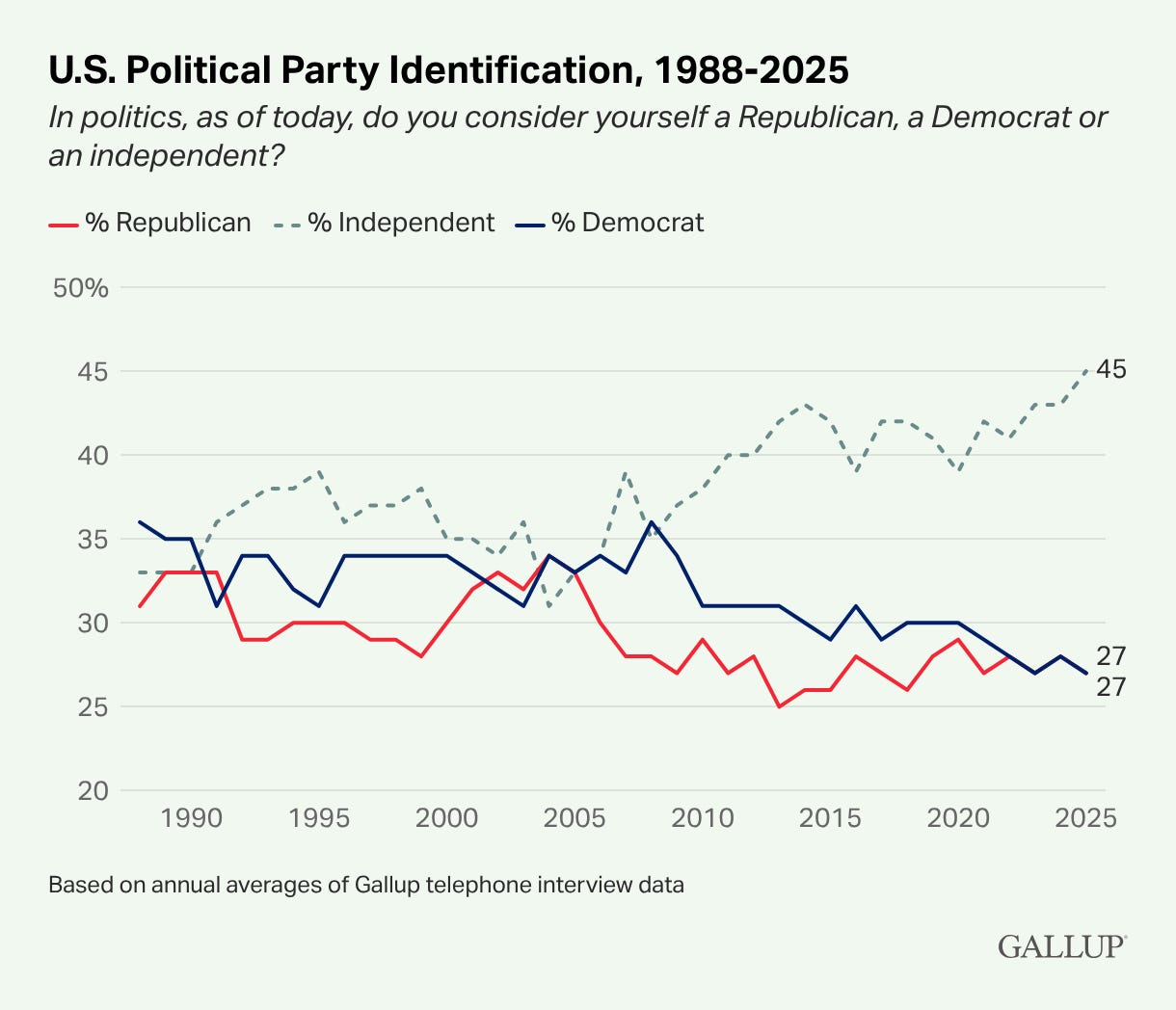
As recently as 20 years ago, the number of Americans who identified with either Democrats or Republicans was about double the number who thought of themselves as independent. Under these circumstances, third-party candidates would have needed to win over a large share of voters with strong partisan identities to be competitive—an all but impossible task.
Since then, the number of self-identified Democrats and Republicans has shrunk significantly. There are now nearly as many independents as there are Democrats and Republicans put together, creating more favorable conditions for third-party candidates: If a third-party candidate can win over a lot of independents, they can, in principle, be competitive with the support of a small fraction of traditional Democrats or Republicans.
Third parties are most likely to gain momentum when voters are deeply unsatisfied with the traditional options on offer. And as it happens, discontent with both traditional options is at or near record levels today. Trump is less popular now than he has been at any prior point in his first or second term: Polling averages show that around 60 percent of Americans disapprove of his performance in office, with only about 38 percent thinking he is doing a good job. Trump’s unpopularity has also dragged down support for the Republican Party as a whole. In a recent NBC poll, only 36 percent of respondents reported viewing the Republican Party positively, with 49 percent viewing it negatively.
In a well-entrenched two-party system, one party falling from grace to such an extent usually boosts the popularity of the other party. For much of the second half of the 20th century, approval ratings for Democrats and Republicans moved in opposite directions. Strikingly, that no longer seems to be the case. Even as independents soured on the Republican Party over the past 18 months, they have not become any more enamored with the Democrats. According to that same NBC poll, only 29 percent of respondents saw the Democratic Party positively, with 50 percent viewing it negatively. Net favorability for Democrats is even worse than it is for Republicans.
For now, elections remain a choice between two unpopular options. Though Democrats have a worse image than Republicans, the minds of most voters are unsurprisingly focused on the failings of the man in the White House. This year’s midterms are likely to produce a sizable, perhaps even a huge, blue wave. But Democrats would be fooling themselves if they took this to mean that most Americans have a positive view of the party or will necessarily stay loyal to it over the long run.
So long as Trump remains toxically unpopular and there are no realistic alternatives, voters will reluctantly flock to the Democrats. There is absolutely no guarantee that these two conditions will remain true forever.
Both Republicans and Democrats are very unpopular. So why has a third party so far failed to materialize? Why does virtually every representative and senator remain affiliated with one of these two parties? The answers have to do with the nature of the American electoral system.
In countries with proportional representation, such as Germany, voters can pick a small political party without feeling that they are wasting their vote. Even if a small environmentalist or pro-business party gets only 7 or 8 percent of the vote, it will still send some representatives to parliament and may even enter government as part of a broader coalition.
In countries with a majoritarian electoral system such as the United States, by contrast, a vote for a smaller party is usually “wasted.” If you vote for the Greens or the Libertarians this November, you almost certainly won’t affect the composition of the House or the Senate since those parties are very unlikely to win a plurality of the vote in any district. Even voters who might prefer the ideological profile of a local third-party candidate are therefore likely to “hold their nose” and instead support the major party candidate they dislike the least. (In addition, electoral rules are set by the incumbent parties, and those are unsurprisingly keen to make it harder for third parties to get off the ground; in many states, there are consequently major obstacles to even getting on the ballot.)

This helps explain why countries with a majoritarian electoral system have traditionally tended toward especially entrenched party duopolies. In the United Kingdom, for example, Labour and the Conservatives have for the past century split the lion’s share of the vote between them. Even if you liked other parties better, you opted for one of the two main parties.
But despite the structural obstacles to the emergence of third parties in the United Kingdom, that has started to change in recent years. While Labour and the Conservatives often took more than 90 percent of the vote between them in the postwar era, their cumulative vote share fell to 57 percent at the last general election and was as low as 37 percent in polling averages earlier this year—a development that looks strikingly similar to those in Germany and France. (Labour has somewhat recovered since Andy Burnham replaced Keir Starmer as prime minister, but it is too early to tell whether he can convert his honeymoon phase into lasting support.)
These changes are not yet reflected in the composition of the House of Commons. In a majoritarian system with five or six viable political parties, it is often enough to gain 30 percent of the national vote to sweep to a large majority. But by the same token, a new party can gain a majority at astonishing speed if it is able to rise to similar levels of popularity. If the far-right Reform UK party, led by Nigel Farage, recovers from recent funding scandals and gains 30 percent of the vote at the next election, it could well win an outright majority of MPs.
Majoritarian electoral systems, like the one used in the United States, create serious structural obstacles to the rise of third parties. But when voters get sufficiently disillusioned with the traditional duopoly that this system creates, these obstacles aren’t insurmountable, as the case of the United Kingdom shows. Could America be next?
America, unlike the United Kingdom, has a president who is directly elected. This means that voters pay comparatively less attention to parties and legislative elections, and comparatively more attention to personalities and presidential elections. It is therefore unlikely that the rise of new political parties would take the same form as in Britain or most other parts of Europe. I don’t anticipate that longstanding third parties like the Greens or the Libertarians will succeed in upending American politics by winning a succession of congressional races.
Instead, the most likely scenario for a third-party breakthrough would resemble some of the close misses of the past: A charismatic and (probably) rich individual would run for president without the backing of either the Democratic or the Republican Party, possibly succeeding in electing a number of senators or representatives on the candidate’s coattails.
To beat the odds, this kind of candidate would need to start with high name recognition and have tremendous financial resources at their disposal—in short, a celebrity who is famous for something other than politics. Billionaires are the obvious possibility, since they can finance their own campaigns. But a sports or movie or music star with a base of fervent supporters and a strong network of high-net-worth friends is also an option.
These conditions constrain what a successful third-party bid would look like. But they are hardly insurmountable. In a country as large, rich, and raucous as the United States, there is no paucity of charismatic celebrities with outsized ambitions and access to money.
In this respect, Trump proved to be the model. But while he staged a kind of hostile takeover of an existing political party, his spiritual successors may choose to assail the traditional parties from the outside. In part because Trump for now retains a sufficiently large fan club to block the way to any competitor on the populist right, future third-party candidates may choose to challenge the MAGA movement from outside the structure of the Republican Party.
Many readers will think that the fading hold of the duopoly is a good thing. Since most Americans now feel disaffected with both Democrats and Republicans, many of them understandably hope for a third party. I should in theory feel the same way: While I don’t have any difficulty choosing between the existing options, I don’t feel especially well-represented by either. Surely, I should be excited about the prospect of having more choices!
But that anticipation may prove to be premature. The views of independents are highly heterogeneous, and many of the people who now long for the day when they have a third option may find themselves deeply disappointed when the day comes. While I personally would love to have a political option that has moderate views on cultural issues and recognizes the danger posed by authoritarian regimes like Russia’s, I fear that it is much more likely that a successful third-party candidate, whether on the left or the right, would combine extreme cultural views with deeply isolationist tendencies.
And then, of course, there are the perils of celebrity politics. Given the nature of America’s political system, a third party is likely to be led by a charismatic leader with little prior experience in politics. Even if I should find the program on which they run to be congenial, it is far from clear whether the candidate would, should they succeed in entering the White House, advance a principled political alternative to the status quo or simply use the office as a vehicle for self-aggrandizement.
Sooner or later, the day of the third-party candidate is likely to be upon us. But when it comes, many who now find that idea to be exciting may be in for a rude awakening.
A version of this piece originally ran in The Dispatch.
Likely Yascha is more focused on the ideological persuasion of the recent upstart parties in Europe and sees something similar happening here. It’s possible of course but I’d argue the difference is that so many people are disillusioned by both D and R because both parties have raced to their respective spectrum edges. These parties used to be center-left and center-right but clearly neither calls the center home anymore. This is particularly an issue for the Democrats - in their wholesale embrace of divisive, left-wing “Progressive” ideology and their potential embrace of socialism/communism [which will all but guarantee I’ll never vote for another Democrat again] - and it is quickly becoming an issue for Republicans as the New Right takes hold online. This has opened a gulf between them that has never existed in the past in which neither party cleaves to the center and the Venn diagram which used to describe our duopoly continues to separate.
Personally I’d love to see a truly centrist, business forward, civil libertarian, liberal-nationalist third party arise to combat the authoritarianism, doomerism, and divisivism of our parties. It would put both major parties on notice and keep them both honest. Or it would continue to push them to their respective extremes at which point one would likely finally die leading to our future duopoly.
Because while I too have little trouble picking between these two parties given the options put forth by the other party (though I’m guessing you and I pick different defaults), I don’t pick out of love or loyalty.
The problem with duopolies is that they become entrenched and complacent—and sometimes corrupt. In the US, the duopoly has established structural impediments to prevent the rise of challengers. Who would want to share the prize?
That’s left a significant number of Americans without a political home. In 2023, Pew reported that 3 in 10 Americans were dissatisfied with both the Democratic and Republican parties. By 2025, as you note, the Gallup poll found that a new high of 45% of American adults identified as political independents versus only 27% each for Democrats and Republicans. Perhaps more strikingly, that same Gallup poll found a majority of Gen Z and Millennials identified as independents.
Those independents are left to choose between two bad options. Other elements of the system compound the problem—the American primary system, for example, actively promotes extremist candidates whose bombastic, performative brand of politics can be off-putting to unaligned voters.
The question is: will reform come before revolution?