



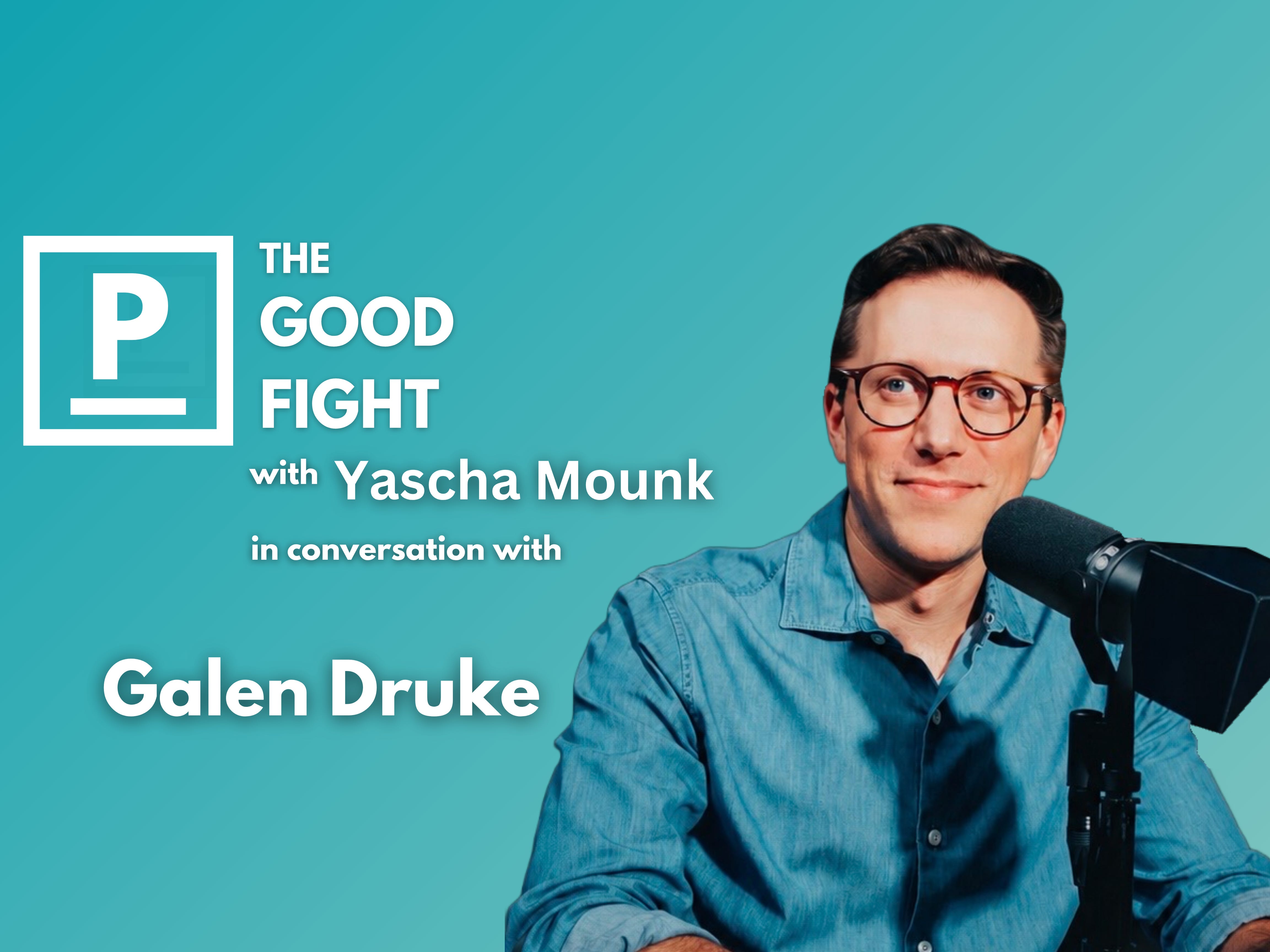
Galen Druke is the founder and host of “GD Politics,” a leading nonpartisan podcast and Substack that explains politics with curiosity, rigor, and a sense of humor. He also co-hosts the “Still Counting” podcast alongside Nate Silver and Clare Malone.
In this week’s conversation, Yascha Mounk and Galen Druke discuss whether Democrats are headed for a blue wave in the 2026 midterms, why the Senate map remains an uphill climb even in a favorable national environment, and what the persistent unpopularity of the Democratic Party tells us about its challenges going into the next election cycle.
This transcript has been condensed and lightly edited for clarity.
Yascha Mounk: I’ve followed the midterms at the headline level. I look at the various polling averages now and then, and I look at some of the prediction markets. Midterm elections are usually good for the party that is not in the White House. This year it looks like, on the generic ballot, Democrats are doing particularly well. Should we be expecting a huge blue wave? Are Democrats going to win the House? Might they even win the Senate?
Galen Druke: I think the base case expectation should be a blue wave. If you look at the generic ballot today, which is asking Americans whether they would prefer Republicans or Democrats to control Congress, Democrats lead by about nine percentage points. That would be a blue wave under basically any scenario. In the House, certainly the expectation should be that Democrats win.
In the Senate, of course, only a third of Senate seats are up for election every two years. This year the map is particularly Republican-friendly, in the sense that Republicans are defending quite red turf. The battlegrounds we’re talking about in this cycle are places where Donald Trump beat Kamala Harris in 2024 by 11 to 13 points—Texas, Iowa, Ohio, Alaska. This is not terrain that under any other circumstance would be competitive for Democrats.
I think we have to be able to hold two things in our minds at once. There is a backlash to Donald Trump—his approval rating is somewhere around net negative 23, which makes him historically unpopular, less popular than he was going into the midterms in 2018, less popular than Biden was going into the midterms in 2022. In fact, less popular than any president we have data for going back to the beginning of the modern polling era. That’s really bad. At the same time, if you see an environment where Democrats are favored by nine percentage points, but the baseline partisanship of the states we’re talking about in the Senate is more like R plus 10 or even R plus 13, that gets Democrats close, that gets Democrats competitive, but some other things have to go right for them as well—for example, having good quality Democratic candidates or bad quality Republican candidates. I think that’s the baseline for what people should expect.
Mounk: Let’s stay at the national level a little bit, and then over the course of this conversation I also want to dive into some of these particular races and dynamics.
In terms of the general numbers, I feel like there may be some reasons to think that the polls are even underestimating the magnitude of the Democratic win, and some reasons to think that the elections may turn out to be a little bit closer than we’re thinking at the moment. Let me throw a little bit of each at you and help us puzzle through which of these we should take seriously.
One reason to think that we might be underestimating the magnitude of this is that these waves tend to build. Massachusetts seems like a very obviously Democrat state that’s always going to vote for a Democrat. But if you’re in a national environment like in 2009, in which there’s a huge backlash against Barack Obama and the start of the rise of the Tea Party, Democrats are capable of losing a Senate seat in Massachusetts, particularly if they don’t have a very good candidate. In the same way, you’re looking at these races in places that have always broken the hearts of Democrats—can we really pull off something like Texas? Could we win somewhere like Kansas? I’d normally say of course they can’t, but in a big enough wave, perhaps we could.
The second argument goes a little bit in that direction as well. Historically, Democrats have always been disfavored in midterms because the Republican Party was mostly the party of highly educated and affluent people, and highly educated and affluent people tend to vote much more consistently and reliably. So in lower salience elections, Republicans had a built-in advantage. That has mostly changed and transformed—presumably posters are aware of that—and I don’t know what your assessment is of whether the models have fully incorporated that change. Perhaps we might be underestimating Democratic turnout and overestimating Republican turnout for midterms specifically.
On the other hand, you can say midterms are referenda on the sitting president. Donald Trump is deeply unpopular—I believe that part of the polls. But normally, when the governing party becomes unpopular, the opposition becomes a lot more popular. The image of the Democratic Party continues to be really, really bad. So perhaps people will sit out the election, or they won’t quite be willing to vote for Democrats for that reason.
So those are some reasons to think perhaps it’s going to be an even bigger Democratic majority than we think, and at least one reason to worry that the wave is going to turn out to be smaller than we think. Do you think any of this stuff matters?
Druke: I think a lot of it matters, and it matters at different levels of the analytical process. One is: do we expect that the polls are underestimating or overestimating one party or another? In general, we should expect polling errors. Historically, in midterms like this, we see that at the national popular vote level in the House, there’s an average error of about three points. When you look at statewide races for governor or Senate, the average error is four or five points.
As somebody who uses the polls a lot and is in some ways a defender of the polls, it’s important to impress upon people that polling error is not unique—it doesn’t mean that the scientific method is totally broken. It’s just something we should absolutely expect when we’re sampling a broad public, and there are lots of different factors that could cause the polls to be off in one direction or another.
To add a little historical context to polling error: during the Trump era, we have seen that in presidential elections, the polls have underestimated Republicans three times in a row at the presidential level. We have also seen in the two midterms, 2018 and 2022, that the polls were very accurate—they got really close to the result. We have also seen, for example, in 2025, an off-year election, that the polls underestimated Democrats. In Virginia and New Jersey last year, Mikey Sherrill and Abigail Spanberger, the Democrats who ultimately won the governorship of those states, were underestimated by the polls.
Mounk: So why is that? Is that to do with the idea that the models somehow assume Republicans are relatively good at getting voters out in these off-cycle elections or midterms, and that has changed? Or is there some other reason for this? That seems like a systematic bias in the polls—not systematic towards the left over the right, but there’s some kind of pattern to this.
Druke: I think it ultimately gets at the fact that the coalitions have been divided along what you suggested—educational lines, and also engagement lines. People who pay more attention to politics, college-educated people with a bachelor’s degree or higher, tend to pay more attention to politics, tend to trust institutions more, and tend to answer pollsters more reliably. In a national presidential year, when you have somewhere approaching 63 to 65 percent turnout of eligible voters, you’re getting a much broader cross-section of the American public than in a midterm year or an off-cycle year. Pollsters have difficulty reaching the broad electorate that turns out in a presidential year, specifically people who vote for Donald Trump who are less engaged in politics.
We hope you’re enjoying the podcast! If you’re a paying subscriber, you can set up the premium feed on your favorite podcast app at writing.yaschamounk.com/listen. This will give you ad-free access to the full conversation, plus all full episodes and bonus episodes we have in the works! If you aren’t, you can set up the free, limited version of the feed—or, better still, support the podcast by becoming a subscriber today!
If you have any questions or issues setting up the full podcast feed on a third-party app, please email leonora.barclay@persuasion.community
Those same people that the pollsters miss in a presidential year are less likely to turn out in a midterm or off-cycle year, which means that missing them in a poll becomes less consequential for how accurate the poll may be. To be clear, pollsters have not solved this problem. You can weight to make sure you get the right number of Republicans. You can weight to make sure you get the right number of Trump voters. But what you can’t ensure is that you get the right people who are swinging or intend to vote for Trump or whoever. Even if you weight for “did you vote for Trump in the last election,” we know what the margin was—you want to make sure in the sample that Trump is winning this quote-unquote sample by 1.5 points, because that’s how much he won the popular vote by. Even then, you can’t guarantee that you’re getting the people who are going to turn out this time, the people who might be changing their minds this time.
Mounk: A lot of low-propensity voters who swung hard for Trump in 2024 because they were very disgruntled with the Biden administration, including on things like cost of living, may precisely now be activated and swing to the Democrats.
Druke: Yeah, and a couple of things may be happening there. Even if you don’t swing towards the Democrats as a 2024 Trump supporter, maybe you’re pissed off enough to not turn out. You said that Democrats are still quite unpopular—that’s true, and that means there’s a pretty steep hill to climb to get from voting for Trump in 2024 to maybe voting for Democrats in 2026. So there are a couple of options: you can not turn out to vote at all, or some people are going to say in polls that they dislike the Democratic Party and still vote for a Democrat anyway, because they’re using Democrats as a tool to punish Republicans, not as an endorsement of any particular worldview.
Mounk: Let me ask you this as a question: what is the makeup of the people missing from Democratic approvals? There are some people who are just very conservative—they’re never going to approve of Democrats, easy. There are people who should be approving of Democrats at the moment, given how unpopular Trump is, and who are not. It’s the differential between what the average rate of approval for the opposition party is when a sitting president is that unpopular, and the current rate of approval for Democrats.
One hypothesis about this group is that these are people who are more progressive than the average Democrat, and they don’t like the Democrats because the Democrats are too moderate for them. A second hypothesis is that these are people who are very comfortable with the ideological direction of the Democratic Party, pretty straight down the line in terms of political views, but who just find that the Democratic Party doesn’t fight enough for them. The third is that these are people who are more moderate than the Democratic Party, or perhaps more conservative than the Democratic Party, but who don’t like Trump because they think he’s doing a terrible job for all kinds of relatively obvious reasons—to them, the Democratic Party is just far too far left for them to like. Do you have a sense of how this group is splitting?
Druke: I think there’s a fourth option which runs through all of those buckets: people don’t like losers. We see this time and time again—when a party loses a big, high-profile presidential election, people sour on that party. A lot of the people who disapprove of the Democratic Party right now—to put this in context, approval rating for the Democratic Party is somewhere between net negative 10 and net negative 20-something, depending on which polls you’re looking at, so it’s about as unpopular as Donald Trump—a lot of those people may be people who will vote for Democrats, have voted for Democrats, will vote for them again, but are pissed off that the Democratic Party lost to Donald Trump.
A lot of voters don’t think in such ideological terms as we do. There are certain impressions, like: Democrats are weird, they’re too woke, maybe they fight for people at the margins of society but they’re never really fighting for normal people like me. I think that’s a pretty common view of the Democratic Party. It might not be that they’re too far left or too far right per se, but when I look at the Democratic Party, does it feel like a party that represents people like me, or does it feel like it’s representing an elite, a professional class, a particular gender, a particular race, a particular part of society?
I think people have gotten the impression—particularly the roughly 50 percent of voters in the middle who have swung hard towards Trump, which is to say not poor, not rich—that the party doesn’t really represent them, because the party has spent a lot of time talking about the economic plight of the poor and the cultural predilections of the rich. So if you’re somewhere in the middle, just trying to have a stable life and maybe supporting some economic populist policies—a higher minimum wage, better healthcare, things like that—but you don’t share the same cultural predilections as the left elite, you may not like their posture overall towards the country, even if Democrats are saying things you like on the economy.
I don’t think it’s just one of those things. There probably are DSA people or Democratic socialists who say the party is not left enough, but looking at the polls, it’s frequently in the single digits—the number of people who say that the Democratic Party is not far-left enough.
Mounk: That’s a very important point, because both in the media discussion in the United States, and certainly in the view that Europeans have of the political situation in the United States—I’m in Europe at the moment—the assumption is that the political center, in any meaningful sense, has totally eroded, because voters are no longer in the political center, because there’s nobody who is politically moderate. What people really want is for the Republican Party to be in the hands of Donald Trump, and for the Democratic Party to be in the hands of AOC. The reasoning goes: if the Democratic Party is way less popular than we would expect it to be, given the unpopularity of Donald Trump, the reason for this must be that they haven’t embraced the politics of AOC.
Now, I think my audience is not going to be surprised that I’m somewhat skeptical of this, and I don’t think your audience will be surprised that you’re somewhat skeptical of this either. But give us some of that evidence. When you’re asking voters, “Do you think the Democratic Party is too far left or too far right?” as a general question to the voting population, only in the single digits do people say that. So why is it then that the energy often feels to be with candidates like AOC, like Zohran Mamdani, like the candidate in Michigan whose full name is Abdul El-Sayed?
Druke: There’s a lot of important context here, which is that we’re coming off a Democratic primary season in which people feel like the Democratic Socialists are ascendant. I want to keep that in perspective. Today there are two members of the Democratic Socialists in Congress—Rashida Tlaib and AOC, just two. At the beginning of the next Congress, likely because of this primary season and DSA victories, it will likely be seven. That’s not quite a takeover of the Democratic Party, even if progressives or further-left candidates have had some high-profile victories this cycle.
Mounk: It’s worth noting that in this cycle—I looked at one kind of measure of this, though I don’t know how accurate this metric is versus others—in about forty-three competitive races between mainstream Democrats and either very progressive or explicitly DSA candidates, about thirty-four of them were won by the more mainstream Dems. Understandably, it’s a much bigger news story when an upstart challenger to the mainstream wins a primary, but it’s not actually the case that the most progressive candidate won in a majority of the primary races. Is that broadly accurate, you think?
Druke: That’s broadly accurate, and it’s even more the case that these further-left candidates have difficulty winning outside of territory that is already deep blue. If you compare it to the Tea Party in 2010—after that election there were 45 Tea Party-associated lawmakers in Congress. So if you want to draw parallels, I would say the Tea Party, at this point in the process at least, was far more successful than Democratic socialism is today in America.
The other thing to keep in mind is who participates in a Democratic primary. It’s only about 20 percent of the eligible electorate, so you’re getting the preferences of the most ideological, most politically engaged, most enthusiastic part of the electorate. Look at Maine, for example—you got this sense that Graham Platner is the Messiah in Maine, he’s so popular, there’s so much grassroots support and enthusiasm. That’s because everyone’s referring to Democratic primary polls. You get to the general election, and Susan Collins has a positive favorability rating in Maine—she’s net plus three. Troy Jackson, Graham Platner’s replacement, is net negative eight. And I think today Graham Platner is net negative forty-something in terms of approval.
In a primary season, it’s easy to get carried away, because the voting public is a small subset of America more broadly, and the party is, in particular, at its most ideological, most engaged, and most likely in this moment to be voting for more extreme candidates. This isn’t always a bad thing—I’m judgmental in the sense that it’s just not representative of the American public, and that’s important to keep in mind. But there are also angry Democrats who feel the Democratic Party has not been responsive to them, in the same way that there were angry Republicans who felt the Republican Party had not been responsive to them in the 2010s. That’s how parties work, especially when you have a two-party system where people can’t just create a brand new party. If you’re pissed off and you’re participatory in that party, you have the right to show up and make your voice heard.
Mounk: What is the actual evidence here? There’s this argument progressives often make that the reason Democrats keep losing is that they’re too moderate, too establishment—if only we nominated candidates like AOC and Mamdani all up and down the country, we would actually win. I think in the specific case of AOC and Mamdani, those two candidates are not just very far left, they also happen to be quite charismatic, and that certainly matters. But when you actually look at the track record of relatively more moderate establishment candidates in competitive House races or competitive Senate races, versus more progressive candidates in races that matter—because obviously, if you’re running in a D+40 congressional district, or running for mayor in a D+40 city, you can afford to be very progressive and you’re not going to be in danger of losing to a Republican—but when we’re talking about the Senate races and House races that will determine control of Congress in November, what is the evidence over the last ten years about whether this argument by progressives, that they’ll be better at winning in those races, holds any water?
Druke: It simply doesn’t hold up. Lakshya Jain at The Argument, the founder of Split Ticket, has done really good work on this—what he calls “wins above replacement.” How well does a particular candidate perform above and beyond a replacement-level Democrat or replacement-level Republican? He finds there’s about a four-point advantage to being a quote-unquote blue dog Democrat over being a progressive Democrat, over many different cycles.
The same thing happens on the Republican side. It’s kind of ironic that the same people who believe progressives perform better across the board in elections don’t necessarily believe that more extremist right-wing candidates, or more out-of-the-norm right-wing candidates, would also do better. You see the same punishment for the more ideological, more MAGA-aligned candidates. Republicans overall have done worse in nominating high-quality candidates over the past ten years than Democrats have—Kari Lake, twice in Arizona. Those were winnable races for Republicans, but they chose these charismatic, populist, too-far-right candidates—Blake Masters, Doug Mastriano. It goes on and on.
Those are statewide races, I should say, and generally Democrats have nominated statewide candidates in competitive races who have fit their states better, especially in those battleground states. I think Abdul El-Sayed will be somewhat of a test to that in Michigan—he’s more out-and-out progressive. He’s not a Democratic socialist, but he’s very much aligned with AOC and Bernie Sanders. For somebody who’s not really engaged in the specifics, they may not be able to tell the difference. And then there’s Troy Jackson in Maine, who is also pretty out-and-out progressive, and who replaced Graham Platner as the Democratic nominee.
Mounk: I want to go into some of the specific races in a moment, but let me propose a three-pronged theory of American politics that I just thought up while listening to Galen. Three simple facts.
Number one: very obvious in the background—the electoral system strongly encourages a two-party system. I don’t think it guarantees a two-party system; I think the two-party system could break down under certain conditions. But the fact that in congressional and senatorial elections you have a majoritarian political system, where the single candidate that gets the most votes gets elected, provides a very strong disincentive for people to vote for third parties and minor parties, because that’s basically wasting a vote in a way it wouldn’t be in a proportional system. Very straightforward point.
Second point: the primary system often produces quite extreme candidates in each political party. Because only about 20 percent of people participate in Democratic or Republican primary elections, as you were pointing out, Galen, those people tend to be much more politically engaged and much more ideologically extreme on both the Republican and Democratic side. Then, in part because of gerrymandering, a lot of people in Congress today are more worried about the primary as a threat to their job than about the general election, which also gives them incentives to move to the extremes. So what we end up with is a Democratic Party that I think is significantly to the left of the median voter in the United States, and a Republican Party under Trump that is far to the right of the median voter. Now, the corrective mechanism for this should be that the most extreme party is punished, because they keep losing elections to the more moderate party. But that’s not happening, because both of these parties have gone towards the ideological extremes. I don’t think we’re equally far from the median voter, but we’ve both drifted away from the median voter at the same time, so they’re each sort of saving each other.
Third, this is the prong I’ve just added to the previous two while listening to you, Galen: if the penalty for being ideologically extreme is four points, that’s significant—certainly significant enough that if you’re trying to take back control of the Senate, you’d be well advised to pick a blue dog Democrat rather than a progressive Democrat. But it is not prohibitive; you can overcome a four-point penalty. So to speak to El-Sayed in Michigan: Michigan is more or less a toss-up state, perhaps R+1 or R+2. In a blue wave environment, it might be D+7 or D+8. If you drop four points, because that’s what you drop if you’re below wins above replacement, you end up at D+3 and you take the Senate seat.
So it’s these three facts together: the electoral system that creates the two-party system, the primary and gerrymandering dynamics that push parties to the extreme at the same time, and this four-point penalty in the wins-above-replacement metric—which hurts, which matters, but which is not, say, a twenty-point penalty that would push the parties back towards the center. A four-point penalty allows both parties to keep making that mistake over and over again.
Druke: I think we’re mostly talking about ideology here, which is important. Sometimes pundits downplay it too much. I think voters do get a sense of who you are because of the way you talk about policy—they may not care about policy specifics, but they understand what kind of person you are based on how you talk about it.
I will say, though, that this understanding of Donald Trump in 2016 as far right is slightly complicated by how voters understood him at the time. On top of ideology, there are insider-outsider dynamics, and oftentimes when people are upset with an incumbent, being the outsider is a really powerful tool. Donald Trump got to put himself in the position of campaigning against both parties. Of course, he was trashing Democrats and Hillary Clinton, but he equally trashed John McCain, Mitt Romney, the Bush family, the Iraq War, free trade, and all kinds of Republican figures and Republican orthodoxy—that allowed him to set himself outside an unpopular two-party system in which people feel like politics is failing them. That’s not necessarily a policy position; it’s something of a different axis. Maybe that’s insider-outsider, which gets to a populism axis as well—the people versus a corrupt elite—especially when people felt like a lot of the gains after the 2008–2009 recession had gone to the top, and there had been, for some time, a hollowing out of the Rust Belt and places like that in America.
I would also say, beyond just campaigning against both parties, Donald Trump jettisoned the Republican Party’s least popular positions and doubled down on the things that were non-negotiable for Republicans. People have probably heard plenty about this at this point, but the way he basically said: no, we’re not going to privatize Social Security; we’re going to keep funding Medicare at the same levels; I want a better healthcare plan than Obamacare. He also said he was going to eliminate the debt and deficit. But he doubled down on something that was non-negotiable for Republican primary voters, which was immigration, while actually moderating on the things that made the Republican Party less popular with the general voting public.
I think it’s sometimes the case that primary voters are just ideological and will vote for the more ideologically extreme candidate. I don’t think history necessarily shows that that’s always true. I think it’s probably even more true in congressional elections than presidential elections, where the primary electorate becomes a lot bigger. Even in 2016, Donald Trump was not the Tea Party candidate—that was Ted Cruz. We saw Republicans nominate John McCain, even after the Tea Party began, then Mitt Romney, and then jettison Ted Cruz for Donald Trump, who seemed kind of out there but was not ideologically extreme in the Tea Party sense of “we’re going to privatize Social Security and cut all benefits.”
What are Democrats going to do now? I think there are certain litmus tests that a Democratic hopeful in 2028 has to pass—it might be on Israel-Palestine or something like that. But I think they probably have plenty of leeway in some of the areas Democrats care less about. I think a successful 2028 Democratic nominee could moderate plenty on immigration. Somebody like James Talarico has already said Biden’s policies were a failure.
Mounk: Let’s get back to the primaries at the end of the conversation. I want to get a sense now of what your best estimate is for the midterms. We’ve talked about the general expectation based on generic polling, and some of the factors that might complicate it. Can we confidently say the Democrats are going to win the House of Representatives in November?
Druke: I would be pretty surprised at this point if they did not win. Currently in the generic ballot, they lead Republicans by nine percentage points. I said the average polling error was three percentage points in this type of race, and that’s in either direction. Democrats could overperform by three percentage points, be at eleven or twelve, and all of a sudden we’re talking about a tsunami. But if the polls are overestimating Democrats by three percentage points and they win the House popular vote nationally by six, they’re still winning the House. It’s also because the hurdle to win the House is quite low—even after the gerrymandering shenanigans throughout the past year, the number of seats they have to win is in the single digits. If you look at my colleague Nate Silver’s forecast right now, Democrats have better than a 90 percent chance of winning the House. I think people feel pretty clear about the direction the House is headed in. I think the Senate is a little more debatable.
Mounk: One more question about the House, and then we’ll move to the Senate. There are always questions about gerrymandering—there’s obviously been a huge gerrymandering war. There are often gerrymandering wars in American politics, but there’s been an off-cycle gerrymandering war, which is unusual and very bad. Why do these efforts at gerrymandering not undermine your confidence in the prediction? In the end, did the Republicans really gain something significant from their attempts to engage in this extra gerrymandering in between census years?
Druke: They certainly gained—they just didn’t gain enough to overcome what is a strong preference for Democrats, or at least a strong preference against Republicans. In a presidential year, or a year where things are a lot closer, this kind of stuff could matter. In 2028, 2032—well, by 2032 folks will have redistricted again—but this kind of stuff could matter. We’re talking about six or so seats that now favor Republicans. Some of those seats were drawn in addition to where they already were, and some were drawn in the Rio Grande Valley in South Texas, relying on shifts among the Hispanic population that happened in 2024 that I don’t think we’ll see replicated in 2026.
When you look at what we call crosstabs in the industry—underneath the top line, how do people feel about Democrats and Republicans, you can see who’s moving: white voters, white non-college-educated voters, Hispanic voters, young voters—we’re seeing some of the biggest shifts towards Democrats this cycle among Hispanic voters and young voters. A lot of those areas in South Texas where Republicans drew districts to advantage them are plurality or even majority Hispanic. So I think there should be less optimism there for Republicans about picking up those seats. This is not to say that gerrymandering doesn’t matter.
Mounk: Let’s say a word here about how gerrymandering works, which most of you probably know, but I think it’s worth spelling out. Generally speaking, the idea is that instead of having obvious, geographically contiguous districts where historically cohesive communities all vote for the same representative, you draw the districts in such a way that you stuff a lot of the voters for the other party into a few districts. You have to put them somewhere—you can’t disenfranchise people altogether—but you’re saying we’re going to have some districts that are 90 percent Democrat, and then lots of districts that are 55 percent Republican. That way you can maximize how many electoral majorities you get out of the number of votes you expect to receive in the state as a whole.
Now, of course, the problem with this is that a gerrymander—I think gerrymander is already a stupid term, but it might turn into an even stupider term—can become a “dummander,” where the idea is that you’ve drawn all these districts, like in the Rio Grande Valley, expecting them to be 55 percent Republican, but then suddenly you’re in a D+12 political environment, and you end up with 49 percent of the vote in a bunch of those districts—the gerrymander has actually backfired. Do you think we’re on the path to that happening in November?
Druke: We’re not on the path to that happening, in the sense that Republicans have pushed the map so far that they’re going to, I think, lose seats overall in Texas. I just don’t think they’re going to gain the five that they hoped they would. I think they might gain two, they might gain three, they might not gain any. But I don’t think they’ve pushed it so far that it’s going to backfire, unless we’re looking at some kind of end-of-times event for the Republican Party. It just might not have accomplished all that much. And again, this isn’t just for this cycle.
Mounk: One of the reasons it didn’t accomplish all that much, of course, is that Democrats in California and elsewhere then followed suit, gerrymandering their own states, or the states over which they themselves had control.
Druke: Democrats are more hamstrung, because in more blue states there are laws that prevent this kind of stuff—more nonpartisan redistricting commissions and things like that. Even if it doesn’t matter this cycle, that doesn’t mean it doesn’t matter—it could matter in the next cycle. Republicans certainly benefited themselves in a way that is outside of the norm when it comes to redistricting practices. It may just not be the difference-maker this cycle. That doesn’t mean it doesn’t matter at all.
Mounk: So you’re reasonably confident the Democrats are going to win the House, when you take all of these different factors into account. Obviously there’s no gerrymandering in the Senate. What do you think is going to happen there? Democrats need to pick up a number of seats—I think at least four—to get to 51 senators and win a majority, when only a third of the Senate is up for election, and in a year where the map is mostly in Republican territory, which insulates them a little bit. Nevertheless, it seems like some of your esteemed colleagues, like Nate Silver, think that Democrats might be able to pull it off. Tell us about your best estimate here.
Druke: Nate’s estimate right now is that there’s a 58 percent chance Democrats win the Senate. I think forecasting the Senate in an environment like this is tricky, because we have the map that you just described, we have the generic ballot at D+9 at this moment—it could still fluctuate a little bit—but we also have very different types of terrain and very different candidates.
Look at a place like Maine, which voted for Kamala Harris by seven percentage points, but the most recent New York Times/Siena College poll showed Susan Collins, the Republican incumbent, leading by three. She has a well-established independent brand in the state and can outrun her party significantly, especially with the college-educated suburban set that Republicans have been underperforming with. She’s a particularly strong candidate who can outrun the environment, so the environment is not determinative the way it is in the House.
Let’s move to Texas. You have Ken Paxton, a Republican who was impeached by his own party for fraud, basically.
Mounk: There’s an amazing little campaign video by James Talarico showing a time when Ken Paxton stole a pen.
Druke: A Mont Blanc pen—like a thousand-dollar pen—from somebody, and it’s caught on video.
Mounk: He was going through security at a courthouse, and some lawyer had left his Mont Blanc pen in the little box you put things in as you go through the metal detector, and Ken Paxton just picked it up and ran with it. It’s about as attackable a candidate as you can get.
Druke: Ken Paxton is so unpopular among Texans—I think his favorability rating is like 20 points underwater. As we were talking about with the primaries, Republicans had John Cornyn, an incumbent with his own brand, who was not the most popular but probably popular enough to win a general election. They threw him out and put in Ken Paxton—the Republican primary voters did. Now he’s fighting for his life. Right now, in the polling averages, James Talarico leads Ken Paxton by three and a half points in Texas, and Troy Jackson, the Democrat in Maine, leads Susan Collins by only two and a half points. If you told somebody two years ago that Democrats would have a better chance of winning Texas than Maine, you’d think, “What happened?”
Mounk: This is where candidate ideology and quality does seem to matter.
Druke: Absolutely. Candidate quality matters. The other thing that’s really interesting is that Maine and Texas could hardly be more different in terms of their demographic makeup. Maine is the oldest state in the country, and it’s very white. We see in the polling that some of the smallest shifts between 2024 and 2026 have happened among older voters and white voters. The biggest shifts have happened among Hispanic voters and young voters. Texas, I believe, is the second-youngest state in the country, and it has either the largest or one of the largest Hispanic populations in the country as well. So you have candidate quality issues, and you also have demographic reasons to expect Texas to be a lot more swingy than Maine. That’s why forecasting this type of thing can be quite hard.
Every state has its own unique circumstances, demographically and in terms of candidates. I don’t think somebody could confidently say—even based on those numbers from Nate Silver’s forecast of fifty-some percent—that you can reliably believe Democrats are going to win the Senate. I think it will be a tricky fight, and it’s going to depend on a lot of different factors.
Mounk: A side question here: for a lot of the 2010s, Democrats in particular seemed to believe—and I think Republicans actually also seemed to believe, in a way that was quite damaging—that demography is destiny, that white voters were much more Republican, non-white voters were much more Democrat, and so as the country became more diverse, Democrats would naturally start to win elections. That was based partly on a misreading, and perhaps to some extent an accurate reading, of the book The Emerging Democratic Majority by Ruy Teixeira and his co-author. He warned the party that they were adopting too simplistic a reading of that book, but people leaned into it a lot. I think that’s the source of, among other things, the Democrats’ defeat to Trump in 2016—the inability to read that kind of political mood.
The 2024 election seemed to really drive the last nail into the coffin of that theory, because so many Hispanic voters, and a significant number of Asian American and African American voters, shifted to Donald Trump—he did so well among young voters compared to how other Republican candidates had recently done, and so on. Now you’re saying you’re seeing a lot of Hispanic voters shift to the Democratic Party, along with young voters. Presumably, from what you’re saying, the 2026 midterms are going to be a lot more demographically polarized than the 2024 presidential election. What’s our best read on what’s happening here? Is it that the true degree of racial polarization by vote is just somewhere between 2024 and 2026, and it’s going to oscillate between those extremes? Or is it that a lot of the most reliable voters for the Democratic Party are still older African American voters, and a lot of the most reliable voters for the Republican Party are still older white voters, and a lot of the other voters are just much more swingy, and so they jump back and forth in different ways? What’s the ten-thousand-foot view of how to think about this?
Druke: I think it’s a combination of several of those things. One is a kind of “last in, first out” dynamic from the Republican coalition. People who just swung over to the Republican coalition, or to vote for Trump, who have not been voting for Republicans reliably for years, are self-evidently less partisan. We know there’s a set of Hispanic voters, for example, that turns out relatively reliably—they vote, but they don’t feel a strong allegiance to one party or the other.
We now see a world where—the caricature of a swing voter in America used to be an older white couple in New Hampshire going through the pros and cons of each candidate. I think swing voters are better thought of today as people who are a little bit less engaged in the political process, who pay less attention to political news, and so don’t have that instinctual partisanship that the fifteen to twenty percent who get spotlighted on cable news and Instagram and Twitter have. It’s people who aren’t participating in that, and don’t feel those intense, strong emotional ties to one party or against one party, who are some of the swingiest voters in American politics today. I would say young people fit that bill as well, in a slightly different way—they don’t have developed voting patterns yet, so they’re still figuring out how they want to identify. As you get older, people generally become less swingy, or at least that’s what you see in the data.
Where does this all net out in terms of racial polarization between the Democratic and Republican coalitions? We should not expect that 2026 is the new baseline, because it’s simply a different electorate. Increasingly, less-engaged voters, who are less likely to show up in a midterm election, are also a bit more Republican or Trump-aligned, or have been during this past decade, and are more favorable to Trump. So there’s going to be somewhere around 15 percent of the 2028 electorate—maybe even more—that doesn’t show up in 2026, and that will make a big difference when the electorate swells again in 2028.
I’ll point to one historical example. In 2020 we saw a significant shift to the right among Hispanics, but it seemed like there had been a little bit of a rebound, that it wasn’t so bad, that it was leveling off. Then in 2024, you just see an absolute drop-off. In total terms, Hillary Clinton won Latino voters by somewhere around 35 to 38 percentage points in 2016. Kamala Harris won them by three to five percentage points in 2024. It’s a massive swing. If you looked at 2022 as an important indicator of where the trajectory was headed, you would have been totally wrong, because it was just a slight leveling off before bottoming out. In the same vein, I wouldn’t overinterpret the results in 2026 to read something more broadly about the Hispanic electorate, or even the young electorate.
Mounk: Tell me a little bit about what we should expect in the thing to which everybody’s attention is going to turn the moment the midterms are over: the 2028 presidential election and the primary season for that. I’d say that on the Republican side, there is a kind of received wisdom—not of who the candidate is going to be, but of the idea that Donald Trump is going to determine who that candidate is going to be. If Donald Trump says it’s JD Vance, JD Vance is going to win. But if, for whatever reason, Donald Trump decides Marco Rubio is it, then Marco Rubio is most likely going to take it. Do you think that’s right? Do you think Republicans have a one-man selectorate for the 2028 presidential nomination?
Druke: I think it’s hard, because a lot could happen over the next two years. As I said, right now Donald Trump’s approval rating is net negative 23. There’s a world in which the bottom truly falls out, and we’re seeing, you know, George W. Bush-level numbers, where he could be closer to net negative 30 or worse. In that case, I still think he’s the most influential person in the Republican Party, but things get a lot more complicated, because other people have stronger incentives to get into the race as well.
Donald Trump is already quite unpopular and still had plenty of sway in this past Republican primary cycle, and I don’t see that going away. If Occam’s razor says Donald Trump is the one-man selectorate for 2028, that makes the process relatively straightforward in the Republican primary, but it makes it extremely complicated for Republicans in the general election. Because at that point—there would have to be utter peace in the Middle East, gas is $2.50, AI turns out perfectly, the stock market is booming, we have full employment, and interest rates have fallen to the point where mortgage rates are no longer above seven percent—there are a lot of things that would have to go incredibly well. I think that an unpopular president who is still the most influential person in the party, and is seen as choosing his successor, but is ultimately deeply unpopular with the broad public, puts either JD Vance or Marco Rubio in a pretty crappy position to run for president in a general election. If that remains the dynamic, I don’t envy the person who then has to run in the general election.
Mounk: On the Democratic side, there’s no one-person selectorate. The most influential Democrat is probably still Barack Obama, but he’s unlikely to put his finger on the scale, certainly early in the process. It feels like 274 candidates are going to run—in actuality, about 74 candidates are going to run. What’s your sense of the favorites? What’s your sense of who might be overhyped?
Druke: I’m torn, because if you listen to the online discourse, for example, Kamala Harris is definitely overhyped.
Mounk: It’s worth noting, for people who may not know this—correct me if I’m overstating this—that in basically every primary poll, she’s leading.
Druke: Yes. On one hand, that would lead me to believe that a lot of that support is name ID—people know who she is, she’s familiar to folks, and no campaign has actually started yet. Those numbers would fall significantly once a campaign actually did, or once somebody else’s did. But there’s also still a key part of the Democratic primary electorate that is older Black voters. It’s not as determinative as I think many people would suggest. In the Democratic primary, about 20 percent of voters are Black, about 20 percent are Hispanic or other, and about 60 percent are white. Black voters are oftentimes more coalesced around one candidate, whereas white voters are not. You see more leftist white voters who prefer Bernie Sanders or AOC, and more moderate white voters who might like a Josh Shapiro or a Jon Ossoff, and you have the resistance libs who might like Gavin Newsom. So there is power in bloc voting, which could be good for Kamala Harris if the rest of the electorate is really splintered across the different candidates.
My instinct is that she’s overhyped, but I don’t want to put her possible path to the nomination too much to the side. A lot of people have been comparing 2026 to 2006, in terms of Democrats’ overperformance and a backlash to an unpopular war, a second-term president, and so on. If we stick with that parallel, 2028 is fertile ground for a brand-new face. Even AOC will, by the time 2028 rolls around, have been a high-profile figure in American politics for a decade. Kamala Harris will have already been vice president during a very unpopular Democratic tenure in the White House. Gavin Newsom was basically running a shadow campaign in 2024, and has been out front doing a podcast and all of this stuff—people know who the guy is. Barack Obama’s strength in 2008 was that he had very little record; people didn’t know much about him other than that he gave a great speech at the 2004 Democratic Convention and that he opposed the Iraq War.
Mounk: I was going to say—if you’re thinking of the profile of a young senator who is well known but not yet truly nationally famous, probably with quite low negatives because people just don’t know that much about him, who is still able to introduce himself to the nation but has some dynamism behind him—I don’t want to overstate the similarities, but Jon Ossoff comes closer to that than most others.
Druke: He also stayed out of the mix mostly in 2020, when Democratic candidates were taking a whole host of unpopular positions, like decriminalizing crossing the border and defunding the police—things I don’t think you want a general election candidate to have a history of, as a Democrat. He stayed out of that mix, so he doesn’t have that record. He’s also about to, if the polls are true, win Georgia—a state that voted for Trump in 2024—by eight to ten points, potentially. He’s also raised more money than God—somewhere above seventy million dollars, I believe; I could be slightly off, sixty or seventy million dollars the last time I checked—and he’s not, according to the polls right now, in a particularly competitive race. That’s also helpful for him, that his Republican challenger has his own host of scandals and isn’t particularly popular.
Somebody with not too much of a negative record, coming off a big victory in a purple-to-reddish state, who’s raised a lot of money—and if we’re to believe that the Israel-Palestine issue has become more of a litmus test in a Democratic primary, he has broken with his party to some extent on arming Israel. Maybe there’s some trust he can engender by being both a Jewish senator from a Southern state who also questions Benjamin Netanyahu, and can be the person who marries the two different sides and makes everybody feel comfortable—something he can navigate more deftly than somebody else.
Mounk: You’ve mentioned some of the big candidates and the most obvious insurgent candidate—Jon Ossoff is at the moment the person who has the most chatter among those who aren’t the super obvious names, like the governor of the biggest Democratic state, or the former vice president and last presidential candidate for the Democrats. If you had to pick two or three real long-shot candidates that don’t seem absurd to you—people who aren’t usually in the conversation, but who either might run, are thinking of running, or have declared that they’re running, who, if things really line up for them, might go the distance—who do you think that would be?
Druke: Tucker Carlson. I don’t even know if he would run as a Republican at this point, but I think that would be a real wild card in the race, because he has a certain credibility that doesn’t rely on Trump. If he ran as a Republican, it could really frustrate things for somebody like JD Vance or Marco Rubio.
Mounk: While we’re on the Republican side—what about my tinfoil-hat theory of Donald Trump Jr.? We have an election in Brazil this weekend in which Jair Bolsonaro, despite having a very good option for the Brazilian right in the relatively popular right-wing governor of São Paulo, chose his own son Flávio instead. People thought, well, that’s absurd, and that’s going to cost them the election, and we’ll see how it goes—but he’s slightly odds-on to be the next president according to betting markets. Of course, you see that with Fujimori in Peru, and with many, many countries, where populists in the end trust their own child more than anybody else. I know there’s no real science to that. It doesn’t look like Donald Trump is building up his son in the way that he would need to, but do you think there’s any chance of that happening?
Druke: Chance? Sure. But it’s hard for me to imagine, especially in an environment where voters increasingly say their top issue in politics is corruption. That feels like voters would be allergic to that—not just Democrats, but independent and maybe swingier Republican voters as well. I don’t usually like to theorize on what the motivations of somebody like Donald Trump are—I mostly look at how the public reacts to him. But if the goal is to get rich, avoid the ongoing prosecution that started in 2022, and pardon yourself and all of your family members, he can just do that in 2028. Don Jr. doesn’t have to be president—they can just ride off into the sunset with two billion dollars or whatever.
If there’s a world in which Donald Trump feels prosecution is so likely that he really wants his own blood in office—again, it’s hard to get inside his head—but if the goal was to avoid prosecution and secure the bag, he can theoretically do that without Don Jr. becoming president. We’ll see how it all goes down, but either way, I just don’t think Americans would go for that.
Mounk: What about black swan candidates on the left?
Druke: Black swan candidates on the left—I guess AOC at this point doesn’t really count as a black swan candidate…
Mounk: While you’re mentioning AOC, I was going to ask you about that. If you think that, at the very least, strong ideological supporters of political parties are getting very impatient with the establishment and want to take an ideological swing—something we’ve seen in many political contexts around the world—AOC is very young, despite at this point being famous in politics for perhaps longer than would be ideal for her. She’s clearly charismatic, she’s been out there drawing big crowds opposing Donald Trump, and she seems to be showing some signs of ideological flexibility. I don’t want to overstate the extent of that, but she laughed off “woke” in a television interview recently as a mistake, which made quite a lot of waves. A lot of people are going to be looking at this and thinking AOC is the obvious person who could run away with it, if it’s not the establishment that’s going to win. You seem a little bit more skeptical about that.
Druke: No, I think it’s possible. In fact, I did a Democratic primary draft with Nate Silver, my former and now current colleague, last year, and I chose AOC first in the draft. With a Democratic electorate that may be very motivated by anger—anger at both Trump and at the Democratic establishment—she’s somebody who could embody a lot of that anger, and could potentially win a primary without having a majority at the start. If you have a strong core group of voters that carries you through the early states as other people drop out, you can grow that coalition and end up winning the nomination even without majority support out of the gate. There’s certainly a possibility there.
I think there are open questions about whether she ends up running, or whether she runs for Senate—does Chuck Schumer stick around, does she challenge Chuck Schumer? There are more questions than answers about a potential AOC presidential run right now, but she certainly seems interested—it wouldn’t shock anybody if she did end up running.
In terms of black swan candidates for Democrats, I think Democrats are a little bit less enchanted with the idea of a total outsider coming into politics the way Republicans were in 2016. In some ways, because Democrats are the party that believes more in government, even a lot of the outsiders they’ve supported in 2026 primaries—or even the more progressive populist types—are people with actual government experience. Abdul El-Sayed, as much as he is maybe a populist left candidate, went to Columbia, was a Rhodes Scholar, is a doctor—
Mounk: I was randomly at a fundraiser for Abdul El-Sayed fifteen or twenty years ago—a long, long time ago—because he’s good friends with a grad school friend of mine, who kind of dragged me along to this fundraising event. At the time, he had clearly schooled himself in the rhetoric of Barack Obama, and was portraying himself as this kind of Obama-esque candidate for some somewhat minor Michigan office—I forget exactly what office he was running for. But that is not the equivalent of a total outsider coming into politics a year before an election.
Druke: Right—he’s not like the owner of My Pillow or whatever. And not to malign small businesses—as a small business owner myself, I think that experience is great experience to have as a potential candidate, and so do many voters. You can see that in the polling, in terms of what qualities they value in a candidate: one of the highest is small business owner, one of the lowest is podcast host. So there we have it.
I think that even when Democrats reach for somebody outside the establishment, they’re oftentimes not reaching for somebody who is so outside the establishment that they have no government experience at all. Which makes me think of black swan candidates who are already operating within the system, but who people may just not be thinking about right now. One could potentially be, say, if James Talarico wins in Texas—maybe all of a sudden he thinks, “This could be my moment.” Somebody who wins a race in 2026 unexpectedly on red turf could be a kind of black swan potential that I think Democrats would be more attracted to than, say, Dwayne “The Rock” Johnson.
If you have not yet signed up for our podcast, please do so now by following this link on your phone.
Email: leonora.barclay@persuasion.community
Podcast production by Jack Shields and Leonora Barclay.
Connect with us!
X: @Yascha_Mounk & @JoinPersuasion
YouTube: Yascha Mounk, Persuasion
LinkedIn: Persuasion Community
Listen to this episode with a 7-day free trial
Subscribe to Yascha Mounk to listen to this post and get 7 days of free access to the full post archives.


