



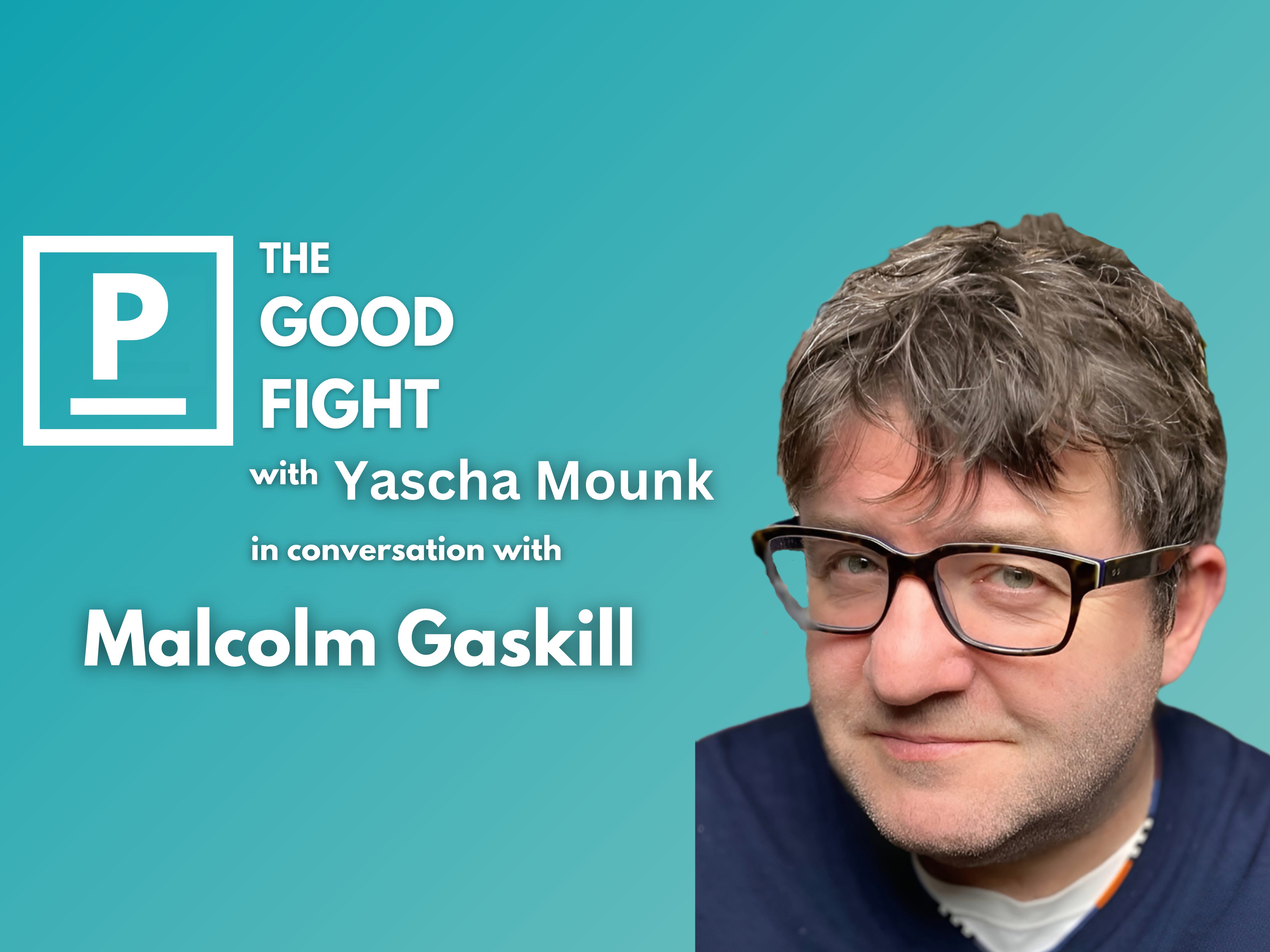
Malcolm Gaskill, Emeritus Professor of Early Modern History at the University of East Anglia, is the author of seven books, including Witchfinders, Between Two Worlds, and The Ruin of All Witches.
In this week’s conversation, Yascha Mounk and Malcolm Gaskell discuss how premodern people understood the boundary between the natural and supernatural worlds, why historians are right—and wrong—to complicate the Enlightenment’s story of progress, and what the persistence of superstition tells us about human nature.
This transcript has been condensed and lightly edited for clarity.
Yascha Mounk: I’m really looking forward to this conversation, in part because I always look forward to conversations where I feel like I learn new things, and this is a topic I don’t know that much about. Obviously generalizing over different places, different times, different individuals—what is the nature of the supernatural beliefs people had for a lot of history before “the Enlightenment”, the rational age? And what do we tend to get wrong about it?
Malcolm Gaskill: In the modern age, we tend to draw sharp distinctions between what we think is rational and irrational, natural and unnatural. If we went back 500 years, we would find varieties of opinion, skepticism, disagreement, and degrees of credulity—perhaps more than we might expect from our ancestors. But we would essentially find a kind of consensus that seems alien to us today.
The consensus is that their world—their visible, tangible world—was much more porous to the unseen world. People didn’t always understand mysterious forces; in fact, a state of puzzlement or bemusement was probably most common. But there was an assumption that there was an invisible world beyond this one, and that there was a relationship between daily life, existence, and some kind of world that existed beyond. That was a basic assumption people had, and it shaped all sorts of engagement that we would broadly call religious, or even superstitious. Essentially it was a relationship between the seen and the unseen, the tangible and the intangible, and the sublime.
Mounk: Part of what characterizes our beliefs today is that we’re quite tempted to believe in all kinds of supernatural, superstitious things, but we check ourselves. When we see a dark shadow at night, we might think for a moment, “gosh, that feels like a ghost,” and then say, “ha, silly me—that’s obviously not what it is.” If we look into the sky and didn’t realize there was going to be an eclipse, we think, “wow, that’s a pretty spooky natural phenomenon,” and then we think, “let me check whether there’s some kind of explanation for this.”
If you didn’t have that kind of mental filter, presumably every time you see something scary out of the corner of your eye, or something happens in nature you don’t have an explanation for because you can’t Google it, you’d naturally come up with stories about what might have caused it.
Gaskill: It’s an evolutionary advantage, in many ways, to try to make sense of chaos. But that often means getting it wrong—looking for patterns in things that aren’t there. There’s a condition called pareidolia, which is really where you join up the dots to make a picture where no picture exists. The mind always imposes patterns on strange, totally natural phenomena that aren’t necessarily understood, and out of them makes stories that are meaningful.
Going back to our late medieval ancestors, they didn’t make those stories out of everything. There was an acceptance that there were natural phenomena—extensions of God’s creation that weren’t direct providences, just things about nature that weren’t completely understood—and there wasn’t a constant need to impose some weird supernatural interpretation on them. This comes into witchcraft accusations too, where people often assume our ancestors didn’t understand so many things about illness and disaster, so they blamed everything on witches. That turns out not to be the case. There is a more rational sense to our ancestors than we might imagine, given the way our benighted forebears were produced by Enlightenment philosophes and rationalists into the 19th century, who wanted to force this difference between them and us so as to make us feel better.
Mounk: Let me push you a little on that. I think there are different levels, or different kinds of description, of what rationality might entail. I certainly think our ancestors were about as smart as we are—they had very similar mental faculties, just less knowledge. There were many parts of the natural world they didn’t understand, and they were raised in a much more religious world, where, as you said, the boundaries between the visible world and the invisible world were much more porous. So I agree that they had reasoning faculties broadly similar to ours, and exercised them. It’s not clear to me that we can get from that claim to the idea that they were somehow less superstitious, or believed in the supernatural any less.
There’s a story I learned in graduate school—I’ll keep it brief—about an anthropologist doing fieldwork, I think in the mountains of Ghana. He wants to be taken to see the rainmaker, but has to spend many months there before they trust him. Finally they take him—he crosses a desert, climbs a dangerous mountain—and he asks, “how do you make it rain?” The rainmaker says, “I have a secret stone. If I turn it a particular way and say a particular incantation, most of the time the next day it rains.” He asks to see the stone, and the rainmaker shows him a child’s marble, saying there’s only one of these stones in the world, it’s unique, and so on.
We hope you’re enjoying the podcast! If you’re a paying subscriber, you can set up the premium feed on your favorite podcast app at writing.yaschamounk.com/listen. This will give you ad-free access to the full conversation, plus all full episodes and bonus episodes we have in the works! If you aren’t, you can set up the free, limited version of the feed—or, better still, support the podcast by becoming a subscriber today!
If you have any questions or issues setting up the full podcast feed on a third-party app, please email leonora.barclay@persuasion.community
Later, back in the city, the anthropologist acquires another marble, asks to be taken back to the rainmaker, and says, “look what I brought you—here’s another one of these stones.” The rainmaker is astonished—he thought there was only one. The anthropologist asks, “well, do you think it’s going to work?” The rainmaker thinks for a moment and says, “I don’t know—shall we give it a try?”
This was presented to me by Richard Tuck, who was leading the seminar, as a response to a classmate of mine who was arguing that means-ends reasoning is just a Western construct. It isn’t—this rainmaker has means-ends reasoning. He’s not an idiot; he’s capable of intelligent thought, he has a concept of one thing having a causal impact on another, he even has an empirical mindset: let’s see whether, if I do this, it rains tomorrow or not. What he doesn’t have is a scientific method, and a separation of the visible world from a non-visible one.
So what I easily buy is that our ancestors reasoned critically about phenomena in the world, but were still so steeped in a totally different thought-world that there’s a stark distinction between mainstream beliefs today—setting aside the other kinds of superstitious and religious belief that still exist today, which we can talk about—and the mainstream world then.
Gaskill: It is. There are a couple of things in that. One is the critical thinking required to distinguish between the likelihood of something being totally natural versus the imposition of a demon or an angel.
The other is that it’s very situational. This is where, in a lot of the so-called post-secular scholarship about these phenomena, emotions come in. People’s beliefs—a bit like your story, which is embedded in a very specific situation, a dialogue, an encounter between cultures—don’t float in the air. It’s easy to talk about belief systems and sets of ideas, but a lot of the time these are lived practices. One of the things anthropologists would often do—I think they’re perhaps more sensitive now—but think about someone like Evans-Pritchard going out to the Azande in Africa in the 1930s: really, it’s about trying to reduce everything they believed to functions. He was right, up to a point—these beliefs were hard to describe in the abstract, but you could see them in what people did. They weren’t inferior forms of reasoning; they were extremely embedded in culture and practice.
Sometimes what these anthropologists found—going back to your story—is that the peoples they studied were so baffled by the idea that someone was trying to fit these things into some kind of intellectual template that they had a bit of fun with them. One of the things anthropologists were slow to understand is that these people had a sense of humor, and realized they could play along.
So if we think of these only as sets of ideas and beliefs—belief systems—we slightly miss the point. We need to think of them as embedded in real-life situations and in emotions. Some of our own ideas and feelings—I’ll speak for myself, I won’t speak for you—that we’d espouse confidently and publicly might waver a bit under emotional pressure. It goes back to the old “no atheists in a foxhole” idea. We see this throughout the 20th century: men in battle become more superstitious. So people who, in daily life, wouldn’t hold these ideas, had feelings connected to them that were latent but surfaced because of the particular emotional stresses of the situation. I do agree with you—it’s just another way of thinking about these ideas and beliefs, as practices, as feelings and emotions, rather than codifying them the way anthropologists often wanted to.
Mounk: That I buy. Let me say something more general for a moment. I think there’s a broader historiographical tendency to complicate the easy distinctions we draw, and sometimes I worry it’s a bit of a historian’s idée fixe—partly because you want to rebel against the generation before you, and partly because historians love when things are complicated. The Dark Ages, it turns out, weren’t so dark; things were actually quite good. Secularization—well, in fact, today isn’t really secular, the continuity is much bigger than the discontinuity.
I’m always torn about those, because I think there’s a caricatured view of the Dark Ages as a miserable time of benighted people having terrible lives, which misses a lot of what’s interesting, fascinating, and valuable about those centuries. At the same time, if you compare how long people got to live, the condition of servitude a lot of people endured, and the extent to which the knowledge of the ancient world had been lost—with the rediscovery of these forms of reasoning, the Renaissance, and later the Enlightenment, not yet having happened—something about the short formula “Dark Ages” is not entirely wrong.
It seems to me that when it comes to these questions of how similar or how different the world of belief is, in the era before the Enlightenment and perhaps before the Renaissance, there’s a similar dynamic. I agree that “these people were stupid, superstitious morons, and today we have these great enlightened people who would never fall for anything like that” is far too simplistic—first, because those were people with our natures and our intelligence, not stupid morons, human beings trying their best to make sense of their condition the way we do today, and second, because there’s a lot of weird belief and superstition, modern-day witch hunts and so on, around today too.
So I buy all that. And yet something in me rebels against the idea that there are no distinctions at all. The faculties of the human mind have, by and large, not changed—the mixture of incredible intelligence and venality that characterizes human beings today also characterized us as a species 500 or a thousand years ago.
The other thing you’ve alluded to—I may be getting my history of religion wrong, but I think this was originally Feuerbach’s idea—is that we tend to ascribe to God the faculties we wish for ourselves, and perhaps, more broadly, that God fills a psychological need for us. When we’re really scared, we cling to superstitious practices and beliefs to reassure us. That was true 500 years ago, and it’s true if you’re in a foxhole today, and it’s true whenever the world is scary and you don’t quite understand what’s going on in politics or society. That seems true today too.
So I buy the similarities. And yet it does seem to me very different to have a world in which all the authorities, secular and ecclesiastical, interpret everything through religion and belief in the supernatural, where everything is imbued with symbolic importance—versus a world in which, much as our human nature might tempt us toward that, the authorities pride themselves on not doing it, and we have a scientific method.
Gaskill: There’s simplification in both directions. A grand narrative that’s politically inflected, polemical, even propagandist—think of fascist narratives of history in the 20th century, or communist simplifications of history—these are highly tendentious versions, simplifications with a particular end.
We can go in the other direction too—importing backwards the idea that Newton was “a scientist” unlike anybody else, or importing back the idea that most people were kind of benighted peasants who were all stupid. This comes back to context. Historians do like to complicate things, but that’s not a bad thing—good historians, anyway, try to get between those two extremes: that our ancestors are just like us, or that our ancestors are totally different. It’s largely situational.
When one looks at witchcraft trials, and at the behavior of juries, they’re very discerning. There are different layers and degrees of rationality, and a bedrock of belief they don’t really have the intellectual wherewithal to challenge. There used to be a debate—I know it’s still going on—about whether there were actual atheists in the Renaissance, because it was supposedly impossible to hold that thought, to really believe there was nothing beyond. I never bought that. I always thought it was possible.
Mounk: Tell us about some of those witch trials. This is obviously meant to be a caricature, but I tend to think of the Monty Python sketch—“she’s a witch, she’s a witch,” and immediately the crowd rushes to drown the person, and then she drowns, and I guess she wasn’t a witch. There’s this image of an obviously stupid, idiotic process that everybody gets on board with. You describe the reality as much more complicated and subtle than that. So what did a witchcraft trial actually look like?
Gaskill: Most of the time there were no witchcraft trials. There may well have been suspicions within a village, but the assumption in that Monty Python version is that as soon as you couldn’t explain something, or there was someone you didn’t like, you found out the nearest witch, and there was no legal process—you chased them to the nearest tree and they were hanged, and that was it. Everybody felt an emotional release, and then you got back to normal until the next cow or chicken died, and then you found somebody else, or someone else you didn’t like.
It’s so far removed from the truth. I’ve spent the last 30 years telling people their myths about witchcraft are not right—not because I’m a natural killjoy, but because it misses the opportunity to understand other ways our forebears’ mentalities worked. Typically, there is a bedrock of belief in witchcraft, but most people had no direct experience of it whatsoever. There’s a point where this falls off the written record and we can’t be absolutely sure, but the written records we do have—which are actually copious for the 16th and 17th centuries—give us a pretty good view of the number of witch trials: probably about 110,000 across the 16th and 17th centuries. That seems like a lot for a crime we’d think imaginary, but it’s far fewer than you’d often read. From the Enlightenment onward, the figures got bigger and bigger—they went up into the millions.
Mounk: Also, by the way, against a population far, far smaller than today’s.
Gaskill: Infinitely smaller. The number of people who actually lived—not just the population at one time, but across, say, 1400 to 1700—is absolutely enormous. The number of witch trials is really very small, and very variegated over time and place.
Mounk: 110,000 doesn’t strike me as very small. I don’t want to nitpick, but 110,000 is a lot.
Gaskill: It’s a lot for a crime you and I would agree was imaginary, that people couldn’t possibly have committed. But it’s much smaller than people often imagine. There’s a kind of illusion, I think, between the idea of the Holocaust in the 20th century and what was happening before that—the numbers creep up into the millions and it feels like a very organized thing, a kind of technocratic genocide, which the Holocaust, in the 20th century, really was. But the witch trials are much more patchy. There isn’t a big central authority driving it. Within nations, typically, the central authorities are the restraining forces. The really bad witch hunts happen not because of the strength of law, but because of its weakness in that area.
So it does go against the prevailing narrative we’ve inherited about what the witch trials meant. What those stories have typically done is made our ancestors look stupid, venal, and weak. Whereas actually—taking England, which I know best, though not exclusively—you really have maybe a thousand witch trials across two centuries. That’s far fewer than people assume. It always surprises people that a thousand is a lot, but it also surprises them that you’re going to get 500 convictions out of that—500 executions for a crime that didn’t exist seems like a lot. But in half those cases, jurors stood there and said, “we don’t know,” and didn’t want to hang somebody for a crime they weren’t absolutely sure of, because the evidence wasn’t strong enough for the conviction needed to send someone to the gallows.
Mounk: I don’t know how extensive the record is on the trials that led to conviction versus the ones that didn’t. If you were defending, what kind of argument would you make? Is the prosecution’s case something like: she cursed this family, somebody heard her curse this family—here’s the witness who says, “yeah, I heard her curse her family,” and then three days later the youngest child fell ill and died? And the defense would say—what would they say? “If she didn’t curse them, there’s no evidence of that,” or, “she was seen in the woods collecting dark materials,” and the defense says, “she would always go there to get firewood”? Am I imagining something too muddled?
Gaskill: You are. There is no defense—not before the 18th century. In fact, typically the accused didn’t even get to say anything, because they weren’t expected to speak on oath about themselves—they weren’t on oath. Sometimes they were allowed to say something, and they’d just say, “I never did any such thing.” But it’s not the modern adversarial system. Quite apart from anything else, it’s all over incredibly quickly. The speed of it, I think, sometimes works in favor of the accused, and sometimes it doesn’t.
Mounk: I’m trying to move away from my memory of the Monty Python scene—“she’s a witch, let’s burn her”—and you’re telling me, well, actually there’s a trial, and half the time—but the more I learn about it, the more I feel like I’m getting back to the Monty Python scene. Perhaps there’s—I don’t actually know when British judges started wearing wigs, perhaps that’s later too—but there’s a theatrical nature to the court proceedings. It sounds like there’s some random accusation read out, then a very brief process that doesn’t seem to involve presenting evidence in any structured way, and then the jury somehow comes to a decision. It sounds like a coin flip.
Gaskill: No, it’s not a coin flip. The English legal system is built on an amateur principle—it is, really, even into the 19th century. There’s a lot of resistance in English culture to professionalism of any sort. It’s one of the reasons it was hard to introduce the police force in the 19th century—people thought you shouldn’t pay good citizens to enforce the law.
Mounk: I thought you were going to say it’s one of the reasons Boris Johnson became prime minister.
Gaskill: That’s another area we could go into another time. Corruption is inherent, and they sought to limit it by not paying people to do things. The judges are the only professionals in the system—they’re based in London, they ride out regularly on circuits, and “deliver the jail”: all the accused criminals who’ve gathered there over the last six months are delivered from the jail. That’s why they rattle through the cases—not just witch trials, but whatever’s coming their way. A clerk reads what’s called a jail calendar, a list of names, and people are constantly brought through the dock. So there’s a kind of farcical, almost tragicomic amateurism to all this, but within it there’s this strange discernment, this unexpected skepticism and hesitation.
I think what the jurors feel is an abhorrence at the idea that people might engage with the devil to harm their neighbors, and they may well hold that bedrock assumption that it’s possible. But when they see this before their eyes, I think they, and magistrates, often think, God, this is just neighbors at war, and really you should shut up and go home. We don’t know how many cases were brought before a magistrate—just some bloke interrupting his dinner, a bang on the door, two neighbors standing there, “what is it now?” We don’t know how often he said, “you two really do need to live with each other, and she’s not a witch, look at her, she’s just a pathetic old woman.” It’s a shame we don’t have that record, because I firmly believe that kind of critical thinking, in that particular situation, knowing the personalities involved, was prevalent. It may even have been typical.
Mounk: Right—“this person is just a troublemaker, they continually accuse people of all kinds of things, they’re just querulous, shut up and go back home.”
Gaskill: I really think so. It just doesn’t leave any records.
Mounk: They do have very common characteristics. There’s nearly always a huge tension between religious visions of the future. In southern Germany, it’s often conflict within very small city-states for religious and political dominance. It isn’t theological as much as what they would call themselves “confessional states”—who’s going to be in charge, and what is their confession? Are they Lutheran, Catholic, or what? What religious politics are they going to impose on the whole of their territory, and how is that going to define them? Within southern Germany, in the era of the Reformation, there’s this very intense conflict between these states, and within them, and that produces a kind of toxic energy, a toxic set of emotions, which results in an atmosphere of the possibility that these areas are under a kind of demonic attack, and that it’s existential to do something about it. That characterizes Salem, Massachusetts, in the 1690s, as well.
But it also tends to be that these witch hunts burn themselves out quite quickly. Then there’s a moment of reflection, a restoration of order, because witch crazes are seen as emblems of disorder and chaos. In some of those cases in southern Germany, there are so many people being sucked into this vortex of accusation that there’s a moment of clarity afterward—what on earth are we doing? There are even cases in early 17th-century southern Spain where local people think they’re doing the work of the Inquisition, because they feel the devil is abroad, and they start rounding up accused witches, penning them up, waiting to be congratulated by the officials of the Inquisition, who come round and say, “what on earth are you doing? Let them go.” And they’re rather shame-faced, and they do.
So the historians, I think, looking back on the crazes—and they are exceptional, the exceptions that prove the rule, the rule being restraint—look back on them as symbols of weakness, religious disorder, and weaknesses of governance. That’s what happened at Salem, and it happened in England in the 1640s. England only has one really intense witch hunt, and during it the characteristics were civil war, disruption of the normal law courts, a heightened sense of religiosity, the feeling that England had been backsliding in religion and that Puritans needed to come forward. Young men took matters into their own hands. All those things made that witch hunt possible, but it burns itself out very quickly. In the very first witch trial, in the summer of 1645, you already find dissenting voices in the courtroom—not saying witchcraft doesn’t exist, but saying, hang on, does that testimony really stand up? Can we really execute someone on that basis?
Witch finders—professional witch hunters—always aim to be charismatic. They want to go amongst people and say, look, you probably have your doubts, let me galvanize you, let me lead you through this. Witch finders work precisely because people are naturally hesitant—they’re not sure whether this is witchcraft or not, or they don’t have the confidence to go to law because they feel they won’t be believed.
Mounk: Very interesting. We’re going to skip over a couple of centuries very rapidly here—Enlightenment, age of science—finally we’re all good rationalists who would never engage in witch hunts, who have banished superstition to the weird fringes of our society, where people dabble in tarot cards or horoscopes. What’s wrong with that picture?
Gaskill: It’s such an attractive picture, and it’s a kind of fable we tell ourselves, because it makes us feel like we’re the children of the Enlightenment, able to push that stuff into our background. Of course, that arc of progress into the 19th century was hugely broken by the First World War. Symbolically, one of the things it said was that maybe the age of reason and progress, and industrialization, had led to this—and this is often characterized as a moment not just of slaughter, but of a kind of collective madness.
The First World War also created—well, the myth of a lost generation, but also millions of grieving families who couldn’t deal with their grief the way they might have in an age of enlightenment, an age when spirits and things had been laid to rest. This is where you get the huge rise in the popularity of spiritualism, and indeed in all sorts of religions and practices we’d consider New Age—Buddhism, for example, really takes off in the 1920s, because somehow the old patriarchal forms of organized religion and the churches that had so stood behind the armies of the First World War seemed to have gotten it wrong.
So there’s this disruption in the confidence in that arc of progress, and I think we’ve been living with it ever since—and of course it goes into the Second World War. I think we still want to tell ourselves—and, going back to your earlier point, historians aren’t always these loose relativists about everything who say, well, medieval medicine was just different. No, it wasn’t just different—it was worse. You can make those kinds of value judgments. Nobody wants to be operated on by a medieval surgeon consulting the phases of the moon before making an incision on the operating table. That’s not fun.
But at the same time, I think the things we’ve wanted to suppress in ourselves can surface at moments of extraordinary societal and emotional pressure, and the First World War was certainly one of those. There’s also something about class and education in this—not just the forced suppression of these things within ourselves. Large parts of Western Europe remained relatively unchanged in terms of people’s reliance on harvests, the rhythms of life, the reliance on the seasons. I used to live in a village north of Cambridge—I lived there in the 1990s—and in the 1920s, the beliefs in witchcraft and magic in that village, only ten miles north of Cambridge, were almost completely unchanged from the 17th century. Why? Because people were uneducated, and the rhythm of their lives hadn’t really changed at all. They had the belief in maleficent witchcraft, in counter-magic, the idea that livestock were under attack. It’s extraordinary, but there it was.
Mounk: Whereas today one might argue that the villages around Cambridge may well be rational, whereas the fellows and faculty of Cambridge appear to be less and less so—but that’s a different point.
Gaskill: Well, I do have things to say about that too. I’m not part of Cambridge University anymore, so I couldn’t possibly comment. I think the world has changed. But there is the capacity to act in a mad, collective, emotional way. To take an example like Brexit—Brexit wasn’t a rational thing. Going back to Boris Johnson, and David Cameron—there were lies told about what this meant and what was happening, which people believed because they were very emotionally attached to a version of Britain that had existed during and after the Second World War. That weakness was exploited. In a sense, it conformed to many of the characteristics of superstition.
Mounk: That’s where I get off board a little. It’s interesting—perhaps you’re seeing the glass half full and I’m seeing it half empty, or the other way around, I’m not sure which way to put it. I recognize that in our society today we have a real attraction to superstitious beliefs—people talking about horoscopes get enormous audiences on TikTok and Instagram, and there’s a kind of new spirituality among a lot of younger people. But there’s a question about how seriously people really, deep down, take it. Do they engage with horoscopes as a kind of fun indulgence, or do they actually let it guide their lives in the same way?
By and large, when we’re talking about Europe, at least, and probably North America, people don’t let horoscopes choose their partners, and they certainly don’t consult them before a doctor performs an operation. Perhaps if you meet somebody you like, you look at the horoscope and get a little titillation, thinking about whether you’re well aligned or not. Perhaps if you really believe in horoscopes quite a lot, and you’re already in a fight with your boyfriend anyway, and the horoscope says he’s no good for you, you use that as an internal reason to say, you see, I really should break up with him. But I think the number of people who fall deeply in love with somebody they’re excited about, but don’t go for it because the horoscope says they’re the wrong person, is probably quite limited.
I agree there are these various forms of spiritual and superstitious belief people have—perhaps they don’t want to live on the thirteenth floor of an apartment, or sit in the thirteenth row on an airplane, or they wake up on Friday the thirteenth and think, ooh, got to be a little careful today. But even for the people who engage in that, it’s a little at the edges of their lives—which I think is different from, as you were saying, the doctor who consults the phase of the moon before doing an operation.
And then there’s this kind of metaphorical application of all this to our political adversaries or enemies, which I think is quite different. First, I was against Brexit—partly because I think, for all its flaws, the European Union is on the whole something sensible, and because, having grown up on the Continent, being among other things a German citizen, and having gone to university in England, having studied history at Cambridge, the idea that I could no longer move to Britain whenever I wanted, and feel welcome there the same way, was personally upsetting to me. But I just think that saying the people who voted for Brexit were superstitious, in the same way that people who believed in witchcraft are superstitious, that they weren’t being rational, flattens a distinction between people’s political values—the ways they might care about sovereignty, or have genuine concerns about a democratic deficit in the European Union, or the sense that they don’t really have control over migration, and that there’s too much migration too fast, and so on. All of which you can disagree with—you can say a lot of people regret the vote for Brexit given that a lot of what was promised didn’t come true, you can say there were falsehoods cited in the campaign—but to simply dismiss it as “people voted for Brexit because they’re superstitious”?
Gaskill: No, I agree with everything you’ve just said. I don’t think voting for Brexit was irrational. I think some of the evidence put before people was misleading, and they bought into it uncritically because it tended toward the way they already wanted to go. The idea of getting out of Europe is just an old-fashioned, jingoistic, little-Englander, xenophobic attitude that goes back generations, and I think it just touched that nerve. My father voted for Brexit, my father-in-law voted for it—it’s not like it’s divided our families. I don’t think they’re stupid; these are clever people. And I think, with the change of government, we might even be steering back toward the possibility—we’re told a majority of the population now want to rejoin the European Union. That doesn’t make me think, “look, see, you idiots, you got it wrong.” I think it just means the emotional complexion of the Brexit and post-Brexit era has steered back in another direction.
Maybe the thing is we’ve had a lot of evidence in the last ten years about economic growth, or the lack of it, which we can actually make decisions on. I just don’t think there was the evidence base to leave the European Union, but there was a very strong emotional, nationalist feeling, and nationalism doesn’t really care a lot about facts—what it cares about is inflaming, empowering stories. That’s what I think we had. So I wouldn’t characterize it quite that uncharitably. Any Brexiteers listening in the United Kingdom—I hear you, I understand you, I don’t agree with you, and I hope you think that maybe it’s time to try it the way we tried it before, and that really wasn’t quite so bad.
Going back to something you said before we got into Brexit—the difference between the symbolic, the metaphorical, and the literal: going back to anthropologists, I think sometimes they wanted to find myth and metaphor in sub-Saharan Africa, whereas actually these things weren’t as metaphorical, or as literal, as the anthropologists wanted them to be. They could be either. People could perfectly well tell a story, some origin myth, that was just a form of entertainment. There was an expectation that things needed to be literal or metaphorical that got in the way, whereas really it doesn’t necessarily need to be either.
This idea of—call it paradox, or cognitive dissonance, or aporia, whatever you want to call it—is true in 17th-century England, and you could find it true among the Azande of Africa: that you can think two things at once, that they can coexist. There’s another anthropologist, Nils Bubandt, a Danish anthropologist who wrote a book called The Empty Seashell—an absolutely fantastic book, about an island called Buli in the Pacific, where witchcraft is very sinister there precisely because it’s absent. That’s the paradox—it’s not because there are witches everywhere, it’s because people sense them peripherally but don’t actually have any direct experience of them.
So, again, we think about the ancients, we think about the myths, and we think, well, that was their religion. It could be—but actually, the possibility is that these are just symbolic stories that communicate moral truths, not actually about how the gods created the universe, and they could hold those two things together simultaneously, or depending on the context. I think that’s one of the things that’s hard to grasp—that they were working in a different kind of framework. It wasn’t just the ideas themselves that were different or similar.
In the rest of this conversation, Yascha and Malcolm discuss superstition in the present day and the complexity of human behavior in times of collective madness. This part of the conversation is reserved for paying subscribers…
Listen to this episode with a 7-day free trial
Subscribe to Yascha Mounk to listen to this post and get 7 days of free access to the full post archives.


