

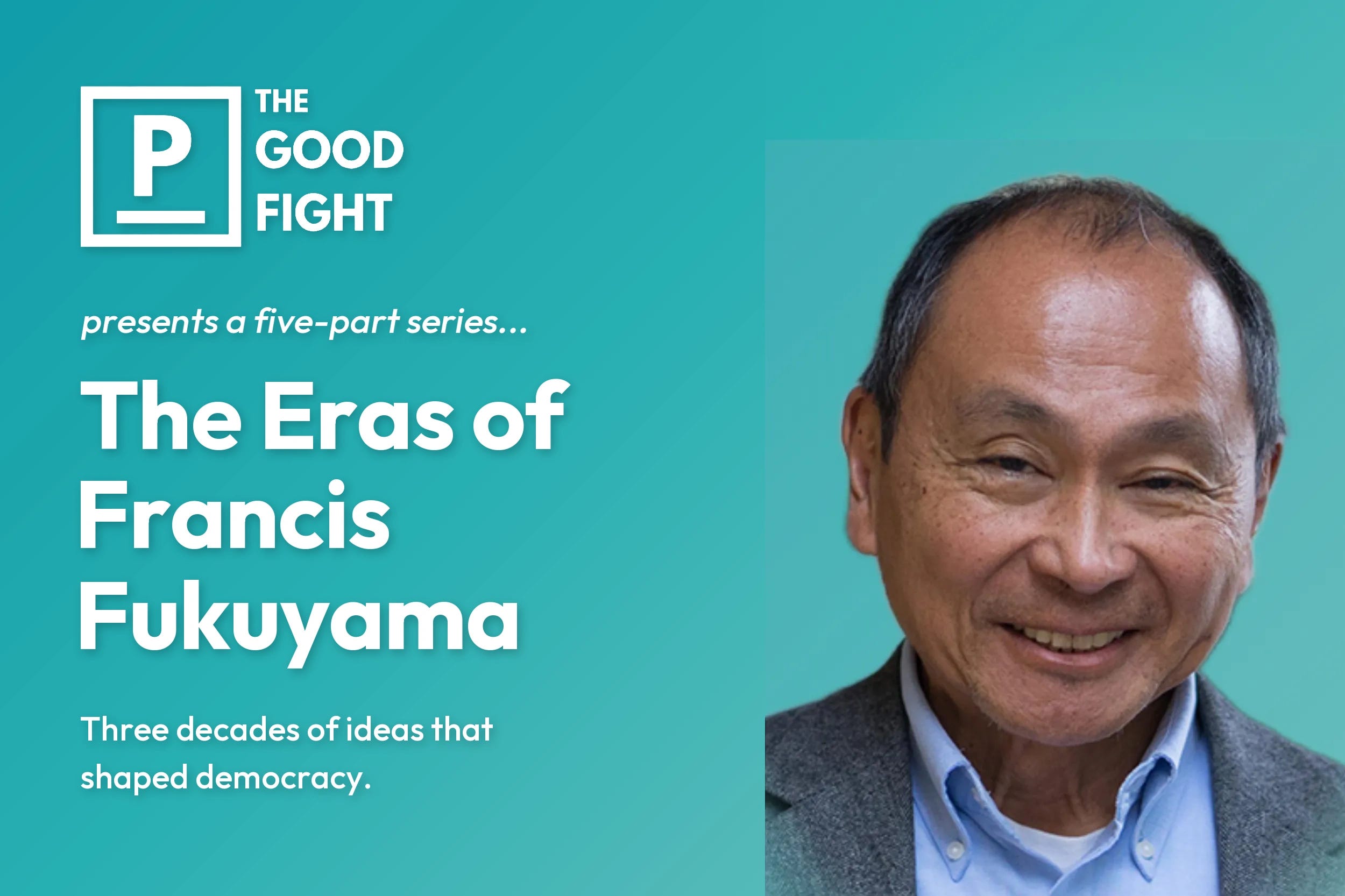
Francis Fukuyama is the Olivier Nomellini Senior Fellow at Stanford University. His latest book is In the Realm of the Last Man. He is also the author of the “Frankly Fukuyama” column at Persuasion.
We have a treat for you today! To mark the publication of Francis Fukuyama’s memoir In the Realm of the Last Man, we’re launching a multi-part series about h…
is intellectual eras. Here, Francis Fukuyama reflects on his life, from his family’s experience of Japanese-American internment, to surprising family secrets discovered in letters, to the political and social fallout after changing his mind about the Iraq War.
Enjoying this discussion? In an event exclusively for readers of American Purpose and Persuasion, Yascha Mounk will be interviewing Francis Fukuyama about his life and thought at 5pm on Sunday, September 6 at The Abbey Centre, London. Find out more and get tickets here. Paying subscribers of Persuasion and American Purpose can access a code for a free ticket here.
And, if you’ll be in Oxford, UK on Friday, September 4, Francis Fukuyama will be in conversation with Nigel Warburton about his memoir—learn more and get tickets here.
We’re delighted to feature this conversation as part of our series on Liberal Virtues and Values.
This series, made possible with the generous support of the John Templeton Foundation, features content making the case that liberalism has its own distinctive set of virtues and values that are capable not only of responding to the dissatisfaction that drives authoritarianism, but also of restoring faith in liberalism as an ideology worth believing in—and defending—on its own terms.
This transcript has been condensed and lightly edited for clarity.
Yascha Mounk: Francis Fukuyama, welcome back to Good Fight. I always look forward to talking to you, Frank, but today I particularly look forward to it, in part because we’re together in person, which is a real treat, and in part because you’ve written a wonderful book called In the Realm of the Last Man , which is, I suppose, an intellectual memoir. Is that how you describe it? It’s answered many questions that I’ve had in the back of my mind about you, and it’s raised lots of new questions.
We’re going to be doing a whole series of conversations in which we go through your work chronologically and thematically and really dive into different themes of the insights that you’ve had over the course of years and decades. But we thought we would start with a more personal conversation. Tell me a little bit about your childhood. You grew up in the East Village of New York City. Tell me about your parents and the atmosphere you grew up in.
Francis Fukuyama: Well, I’m a Sansei, a third generation Japanese American on my father’s side. My grandfather reportedly came to the United States around 1905 to escape impressment into the Imperial Japanese Army at the time of the Russo-Japanese War. It turned out that I went to a private school, Riverdale, in New York City, in middle school, and probably 90 percent of the students there were Jewish, and their grandfathers had left Russia in order to escape impressment into that same war. So we all met in New York.
My father was born in 1921 in Los Angeles, and his mother, my grandmother, was a picture bride who was sent at age 20, all by herself, on a steamship to Los Angeles to marry a man that her parents had arranged for her to marry, that she had never met before. So my father grew up in Los Angeles. They were all interned during the Second World War after Pearl Harbor. That really disrupted their lives. My grandfather ran a hardware store, Fukuyama Hardware, in Little Tokyo in Los Angeles, and built up something of a community leadership position in the Japanese American community there. But that all was swept away after Pearl Harbor.
Mounk: It struck me how you describe those years of internment, both in terms of how your family thought about it and how you, obviously born after the war, thought about it, compared to the trials and tribulations of the pioneers who came to California to build America. You obviously talk about those periods with real pain. It disrupted the lives of your father’s side of the family in very deep ways. But you somehow don’t speak about it with bitterness. I was very struck by the tone with which you described it.
Fukuyama: Yeah, it’s interesting, because I think that, in a way, my family’s story was very typical of many immigrants to the United States: they faced so many opportunities once they got to the United States that they weren’t bitter. Part of it was also a Japanese cultural thing, because the first-generation immigrants were still culturally quite Japanese, meaning they were used to bending to authority, not questioning things.
After the war, their children grew up much more Americanized and began the redress movement, which pushed the United States government to actually apologize and pay restitution to the people who had been interned. This required a Supreme Court decision, because the Supreme Court in 1944 declared in the Korematsu decision that this was constitutional, but a later court said that was wrong and rescinded that decision.
This was part of what I had regarded as the success of the civil rights movement: that by the 1960s, at least on a formal level, the United States had really rectified the kind of racial injustices that were built into its legal structure. But unfortunately, I don’t think that’s a lesson that was internalized by a lot of people, because now the U.S. government is doing very similar things to people that it believes are undocumented immigrants—not giving them due process, sweeping them off the streets, sending them to foreign countries without any kind of finding that they’re actually in the country illegally, and so forth. So maybe we haven’t made as much progress as I had hoped.
Mounk: Your father and your uncle were very young men at the time of internment, and their fates diverged at the time, both personally, and in some ways perhaps they took different political attitudes to the crisis of World War II. Tell me about how your father experienced those years and how your uncle experienced those years.
Fukuyama: The family was Christian—or at least my grandmother was Christian already in Japan. My father actually wanted to be a minister, studied to be a minister, and was very liberal. He was very uncomfortable during World War II with the kind of nationalism that the war had stirred up. Later on, he worked for the national office of the Congregationalist Church, which was then called the United Church of Christ, and was very much a liberal in all respects, especially with regard to the civil rights movement.
We hope you’re enjoying the podcast! If you’re a paying subscriber, you can set up the premium feed on your favorite podcast app at writing.yaschamounk.com/listen. This will give you ad-free access to the full conversation, plus all full episodes and bonus episodes we have in the works! If you aren’t, you can set up the free, limited version of the feed—or, better still, support the podcast by becoming a subscriber today!
If you have any questions or issues setting up the full podcast feed on a third-party app, please email leonora.barclay@persuasion.community
My uncle, I don’t think, had a particular political point of view, but unlike my father, he didn’t get a scholarship to study and escape camp. The way he escaped camp was by volunteering for the US Army. He was sent to the China Burma Theater, I think because he could speak Japanese and could help interrogate Japanese prisoners.
Mounk: He met Madame Sun Yat-sen.
Fukuyama: Yeah, he befriended Madame Sun Yat-sen. The nationalist government had decamped to Chongqing. I assume that’s where they met, because that’s where the nationalists were at that time. And she herself was this unbelievable character. She was the red sister of three sisters, the oldest of whom married the richest man in China, the youngest of whom married Chiang Kai-shek.
Mounk: She became the first lady of the Republic of China, which is to say, of Taiwan.
Fukuyama: Right. But the middle sister, the red sister, was actually a communist agent who helped the Chinese Communist Party, Mao’s party, that was still fighting in the south, maintain connection with the nationalist regime. And that was the woman that my uncle developed a rather close relationship with.
Mounk: You quote from the letters, which I guess retain some amount of ambiguity but strongly hint at other things.
Fukuyama: We’ll never know, unfortunately, because my uncle never spoke about this to anyone in his family.
Mounk: You didn’t have as close a relationship with your uncle, though you describe the time in Paris when you hung out, but you were not yet aware of those letters. How did you discover them?
Fukuyama: Well, I actually have a German cousin by marriage. He was sent to Berlin in 1945. He ended up working as a buyer for the U.S. Army after he left the military, but he met a German woman, Krista. They got married, and her niece ended up taking care of her after my uncle passed away. He passed away fairly early, so she returned to Germany. I got a message, an email out of the blue, saying, “Are you the nephew of Hiro Fukuyama?” It turned out she was sitting on this trove of correspondence, and she passed it on to me, along with a beautiful Leica III that my uncle had acquired in Germany around the time that I was born.
Mounk: It’s remarkable. So we’ve mostly talked about your father’s family. Your mother’s side of the family came to the United States much later.
Fukuyama: Yeah, and it was a very different social background, because my father’s family were basically just peasants—farmers in Fukuoka prefecture. My mother came from a very aristocratic family. Her father was a very distinguished professor and public intellectual. He was sent to Germany before World War One to learn German. He acquired Werner Sombart’s personal library and brought it back to Japan. He was a professor of agricultural economics, but was also very much on the left in Japanese terms in those days. He was a good friend of Kawakami Hajime, a poet and writer who was a Marxist and was jailed by the military in the 1930s. He was one of the founders of the economics department at Kyoto University, and later became a university president. So it was a very different social situation on the two sides of the family.
Mounk: Tell us a little bit about the kind of intellectual and cultural atmosphere of your childhood. You were raised, I suppose, really as a man of the left. Your father was a religious man, but a liberal and a pacifist. You grew up in New York in the 1950s and 1960s, in a heavily Jewish private school. I assume that this was a pretty progressive environment. Tell us a little bit about your childhood, and at what point did you start to take an intellectual interest, or perhaps a political interest, in the world?
Fukuyama: Well, I went to private schools my whole time in New York, because at that time the public schools, unless you could get into Stuyvesant High, just weren’t up to snuff. I was kind of a typical liberal. My father was very much involved in the civil rights movement. It turned out later I met Cornel West, who had run for president last cycle. He actually knew my father and spoke very highly of him, because he and his church were very much involved in pushing for civil rights. At that time I went along with that—I was a kind of conventional liberal of the 1960s. That all started to change only when I went to college, because I got a scholarship to something called Telluride House at Cornell. And then I fell under the influence of a Straussian student, Allan Bloom, and that really changed my politics quite dramatically.
This was in the wake of the big Cornell crisis in 1969—or I guess it was the spring of 1970—when the student union was taken over by the Black Students’ Union, who were armed with long guns, bandoliers, and ammunition. People don’t understand how turbulent that period was, with campus protests against the Vietnam War, against racial injustice, and so forth. This led to a lot of professors, like Bloom, getting threatened, physically threatened, by these left-wing students. He thought that the administration of Cornell had not done enough to protect academic freedom, so he resigned and got a position at the University of Toronto. I caught the last course he ever taught at Cornell—he commuted back to teach a seminar on Plato’s Republic, and that was my first introduction to political theory.
Mounk: To what extent, at that point in your education, did you really have a kind of star-studded education? You had this first seminar on the Republic, really a first encounter with great books. You were part of the Telluride program, a very intellectual environment. What did you study at Cornell? What did you major in at that time? When you came to the Department of Government at Harvard, where you did your PhD—which is where I did mine as well—I think you’d only taken one class in political science ever in your life, perhaps none at all. Tell us a little bit about your undergraduate years, because at the time you were as interested in literary questions from postmodernism as you were in political theory, let alone international relations or comparative politics.
Fukuyama: Well, even in high school I was deep into the humanities. I tried to read philosophy and great works of literature, this sort of thing. I ended up caught between two poles. Leo Strauss’s students had a particular way of reading great books, which I still take very seriously. But at that moment French postmodernism hit America—this was around 1972, 1973.
Mounk: Cornell was one of the centers of this, right? You experienced Michel Foucault coming through when you were an undergrad.
Fukuyama: Michel Foucault stayed at Telluride House, where I was living.
Mounk: He stayed there for a while and then disappeared for a while.
Fukuyama: Yeah, he had a little party with a bunch of students there on the weekend that he was there. But when you’re 20 you have no idea what to take seriously, and French postmodernism seemed like the cutting edge of modern intellectual discourse. So I was seduced by that, to the point where, at the end of my college days, I decided to go to France. I actually attended the lectures of Jacques Derrida, Roland Barthes—these luminaries of French intellectual life. I applied to graduate school at Yale, to the Comparative Literature Department. At that time their stars were Paul de Man and Geoffrey Hartman. De Man would later be unmasked as having had a Nazi past in his native Belgium, but at that point he was like one of the great avatars of this new French intellectual wave.
But in the time that I was in France, I actually started reading some of the books of these people—Derrida’s De la grammatologie—and I just decided that this was all bullshit.
Mounk: Tell me a little bit about your time in France. Presumably it was the first time you were living abroad. You spent about a year there. You had good enough French to follow these lectures in French. How did you go from arriving there enchanted with these ideas and taking them very seriously—presumably thrilled that you were at the epicenter of the most important intellectual developments in the world, at least in the humanities, at the time—to concluding that it was, to quote what you just said, bullshit?
Fukuyama: Well, it took a while, thinking carefully about what French postmodernism represented. It was actually a culmination of what Strauss himself had described as the crisis of modernity. That was the central idea of Leo Strauss: that Western philosophy began with Plato and Aristotle, an attempt to use reason to understand the world and the most important questions in it. But by the late nineteenth century, early twentieth century, Western philosophy had found itself in a crisis, because that tradition of rationalism had culminated in thinkers like Friedrich Nietzsche or Martin Heidegger, who basically said there is no such thing as truth. There’s this famous aphorism in Nietzsche’s Will to Power—that there’s no truth, there’s only interpretations—and it opened the door to a kind of radical relativism.
French postmodernism was basically just an epilogue to all of that: deconstructionism meant that, well, you think Shakespeare or Goethe are great writers with great wisdom, but they don’t understand what they themselves are saying. Foucault would say they reflect a larger power structure that is oppressive, and so forth. It struck me that this was deeply hypocritical—that if the Christian God is dead, that opens the door to almost anything, including things like fascism, and Nietzsche was of course accused of being one of the godfathers of national socialism. But I guess the thing that struck me about all these French intellectuals is that they were all Stalinists—they were all on the hard left.
Mounk: While you were at Cornell, you had a conversation with Julia Kristeva, one of the important figures in postmodernism, who was explaining to you that actually Stalin had gotten certain things right.
Fukuyama: No, she said there was a certain point to Stalinism. It just struck me that they were all hypocrites. They weren’t serious about their relativism.
Mounk: So partially you were disgusted by that because you didn’t like Stalin, but partially the point you’re making is that they’re claiming that we need to dismantle all of those grand narratives, but they actually rather unthinkingly stuck to the grand narrative of the orthodox left at the moment—that as long as you’re far enough on the left, you must be a good person of some sort.
Fukuyama: That’s exactly right. And that’s the point at which I had arrived at Yale, after having spent this time reading all this stuff and thinking about it. Literally the first or second week I was there, I said to myself, I can’t do this—I just can’t take this stuff seriously. I actually befriended Paul de Man somewhat. I decided I would write a Straussian analysis of Rousseau for him, and he gave me an A. He said, “Well, this is in some way completely wrong, but also completely right.”
Mounk: One of the things I’m struck by, in intellectual biographies more broadly, is that we’re often shaped by the paths we didn’t take as much as by the paths we took. You had the full scholarship to do a PhD at Yale in a prestigious department. It can’t have been an easy decision at that time to leave that. It might have felt at the time like a failure—you’d made these plans, gotten these scholarships, and it turned out you were wrong about what you wanted to do. How long were you at Yale? How did you make that decision? What did you do in the interstice between that and when you went on to Harvard?
Fukuyama: Well, it wasn’t that hard a decision, because many of my friends and colleagues had actually stayed in the Straussian track and had become students of Harvey Mansfield at Harvard—the one famous conservative professor in the Harvard government department.
Mounk: He was a very charming and funny man. The story about him, which may be apocryphal, is that when he got tenure, there was a little party thrown for him, and the first thing he said was a toast: “I can say it now—I’m a conservative.”
Fukuyama: Yeah, that’s right. I studied with him, and a lot of my friends had gone to study with him, so in a certain way it was more like returning home rather than making this radical break with what I had planned to do. But you’re 21 years old, you have no idea what to take seriously and what not to. In any event, I got into Harvard under false circumstances, because one of the other Bloom students, who was already an assistant professor there, said, everybody wants to study political theory—just say you want to study national security, because nobody wants to do that at Harvard. So I misrepresented my interests on my application. I said I wanted to study national security. I got in under false pretenses, and then when I got there I said, actually, national security is pretty interesting, and that’s what I ended up writing my dissertation about.
Mounk: I think if anybody wants to go do a PhD in a political science department today, I’d give the opposite advice: claim that you want to study political theory. The structural problem when I was there—and I assume it was already true when you were there—was that you would spend the first two years taking all kinds of different classes, and there was a distribution requirement. So even if you wanted to take most of your classes in political theory, you were kind of forced to take a field seminar and field survey in comparative politics, a field survey in international relations, and so on. It sounds like you did that, and along the way discovered that alongside your interest in political theory, which obviously deeply shaped your work, you had an interest in those other fields. Who were the most interesting and fascinating figures in the department at that time? Who taught that first class in international relations that got you interested in that area?
Fukuyama: It was a man who became a colleague of mine when I got to Stanford, Steve Krasner, who taught the first introduction to IR theory class that I took. But I remember, when I visited Harvard while I was thinking of making the transition, you’d go to the government department and at that time you’d see these greats in political science: Sam Beer, Edwin Reischauer, Adam Ulam, Samuel Huntington. It was like a catalogue. They weren’t literally Nobel Prize winners, but they were kind of the gods of political science. I thought to myself, wow, this is really where I want to be. I took international relations with Krasner, and I actually ended up writing my dissertation with both Adam Ulam, the Soviet specialist, and Nadav Safran, the Middle East specialist, on my committee, and I wrote a thesis ultimately on Soviet foreign policy in the Middle East.
But I did two fields in both ancient and modern political theory, because I’d had five years of Attic Greek at that point, so I could actually read Plato and Aristotle in the original, and it wasn’t a burden for me to do those fields.
Mounk: What were the big debates in international relations at the time, and how did you come to focus on the Soviet Union’s relationship to the Middle East in your dissertation? What was the argument of your thesis?
Fukuyama: Well, this was the late 1970s, and then early ’80s when I finally got my first job after graduate school. At that point there was a complicated relationship between the United States and the Soviet Union, because on the one hand Henry Kissinger was pushing for détente and arms control. You’d already had Willy Brandt’s opening to East Germany and the Soviet Union—Ostpolitik. But you also had a deepening Cold War, because the successors of Leonid Brezhnev, like Yuri Andropov, were much more radical and aggressive. You had Soviet clients working with the East Germans and the Cubans in Africa. It seemed like there was a real wave of authoritarianism sponsored by the Soviet Union happening simultaneously even as we were negotiating with the Soviets on strategic arms limitations. At that time I fell in with a group of pretty hawkish people who said it was this Churchill narrative—that England slept while Hitler gained power, and this scenario was unfolding in the 1980s.
Mounk: So in the early 1980s you thought that the Soviet Union was a very big threat, that it continued to be expansionist in a very aggressive way. Obviously the Afghanistan war started not long after, so there was strong reason to think that. How did you go from that position in the early 1980s to concluding, before the fall of the Berlin Wall and certainly before the collapse of the Soviet Union, that the ideological project of the Soviet Union had basically exhausted itself?
Fukuyama: Well, I was at the Rand Corporation. That was my first job—well, not actually my first. I served in the State Department in the first Reagan administration, and then after that went to Rand.
Mounk: Take a step back—your family is full of professors, all of your friends are PhDs and, by that stage, I imagine, assistant professors and so on. You’re trying to escape becoming a professor. Why and how do you end up at the State Department? How do you end up going to Rand?
Fukuyama: Well, it was a typical kind of youthful revolt. I didn’t want to follow in the footsteps of my father, who was at that point a professor at Penn State. So I decided I wanted a more active, policy-oriented career. Having abandoned this completely humanistic approach, I now wanted to do something much more practical, and that’s why I went into the State Department. Rand at that time had this incredible reputation as the original think tank, where many basic strategic ideas were formulated, and that’s where I wanted to work, and that’s where I got my first job.
Mounk: Southern California is quite a different vibe from New York where you grew up and Cambridge, Massachusetts where you spent a lot of your time in your twenties.
Fukuyama: I wrote a book—my least read book—one I published in 1999 called The Great Disruption. In a way, California, when I arrived there, was at the peak of the Great Disruption, meaning everyone I knew at Rand was divorced or getting divorced. There was this big upheaval in the nuclear family. You had increasing numbers of single-parent families, rising crime, because there was a big crime wave that really began in the 1970s and didn’t peak until the late 1980s. A lot of things were going on there. But for me in Southern California this was great, because you were freed from all these conventional expectations of social behavior. Joan Didion has really written about this in the most perceptive way—that people come to California thinking that this is where they’re finally going to find freedom, and they indulge in it, and they realize that actually a lot of that freedom is illusory. But that was the atmosphere that I felt when I first arrived in Santa Monica.
Mounk: Tell me about your personal life at that point. You arrived single, and I think you got married not that long after.
Fukuyama: Well, it took a few years to find my current wife, Laura. We’re about to celebrate our fortieth wedding anniversary, so it was pretty stable after that. But yeah, it seemed like Southern California was a land of sexual opportunity, one that I never got to take advantage of as fully as some other people, but that was part of the hopefulness at that time.
Mounk: All right, let’s get back to the intellectual track. In the early 1980s, you’re writing in Commentary magazine, arguing, in your dissertation and elsewhere, that the Soviet Union continues to have these grand expansionist ambitions and that this is a threat the United States must take very seriously. By the spring of 1989, you published a famous article—we’ll discuss it and the book that came out of it in much greater detail in a future episode of the series—on the end of history. Obviously you’re still taking the Soviet Union seriously at that point as a geopolitical force, but there is a real change in outlook. So how did your thinking evolve between those two points in the 1980s?
Fukuyama: Yeah, that was simple. The Soviet Union changed. Gorbachev appeared on the scene with glasnost and perestroika. One of the things that I still don’t quite understand is that if you’re an intellectual, you actually ought to change your views depending on changes in the real world. One of the striking things was that you had a lot of hardliners who simply distrusted the Soviet Union—nothing there could possibly shake their view that this was the evil empire. And yet you had this guy saying, no, we ought to have freedom of speech. We ought to pull our troops out of Eastern Europe, and so forth. In the face of that, I said to myself, this is really different.
Gorbachev gave a speech at some point—I was part of this group at Rand that was studying Soviet politics—and he said the essence of socialism is competition. I immediately called up one of my Straussian friends who understood the idea of the end of history, and I said, if Gorbachev could say that, then history is over. There’s no more conflict between the United States and Soviet systems, because he’s accepted the idea of market capitalism. It’s very hard to describe the transition that occurred in 1989. They negotiated a conventional arms agreement that had been deadlocked for years, because Gorbachev basically conceded all the points that we had been demanding. Then there was this movement in Eastern Europe—Hungary and Poland both moved towards real democracy. At that time, the amazing struggle was between people who simply did not recognize that this was happening and people like me and my friends at Rand who said, this is just one of the most amazing things that’s ever happened in our lifetimes, and we have to figure out how to take advantage of it.
To puff up my own reputation a little bit: in May of 1989, after the Hungarian and Polish initial openings, I wrote a memo saying, look, if Eastern Europe is democratizing, it doesn’t make sense that East Germany is going to remain the Stalinist bastion in the middle of all these transitioning countries. Therefore we need to think about German unification. Every German expert in the State Department said I had no idea what I was talking about.
Mounk: I may have the details wrong, but the center-right German newspaper Die Welt would always put “German Democratic Republic,” East Germany, in square quotes, as a way of showing that it’s not a legitimate entity. I believe it was in the spring of 1989 that they finally said, okay, we’ve kept this up for 40 years, this is getting silly, we’re dropping the square quotes.
Fukuyama: I attended a NATO planners meeting where all the planning staffs for the NATO countries met in the south of France the last week of October 1989, and the German representative got up and said, “Germany will never unify in my lifetime.” This was around October 28, 1989.
Mounk: Tell me a little bit about the publication history of that article. It appeared, I think, in the spring of 1989. Did you send it in to an editor you’d written for before? Did they commission it from you? Did word get around that you had this interesting idea, and someone came to you and said, we have to write it up?
Fukuyama: Well, at that point Allan Bloom had moved to the University of Chicago and the Committee on Social Thought, and he and my friend Nathan Tarcov, another professor of political theory, invited me to give a lecture in a series on the decline of the West, because they always had this very pessimistic view of the future of liberalism. They asked me to lecture, and I said, okay, I can lecture, but it’s going to have a very different tone, because I want to talk about the victory of the West. It was in the winter of 1988, 1989, that I composed that essay, arguing there just seemed to be a trend—you had the growing Chinese opposition that would lead to Tiananmen Square, you had the democratization of Eastern Europe—and that’s when I decided to write the article about the end of history.
I gave that lecture in Chicago sometime that spring. At that point there was a new magazine called The National Interest, an Irving Kristol creation. The first editor, Owen Harries, met me in Los Angeles and asked if I had anything he could publish. I said, yeah, I’m going to give this lecture, and I can give you this article, entitled “The End of History?” with a question mark at the end. That was the origin of it. I had at that point moved to the State Department—I was no longer at Rand—so it was published when I was actually a State Department employee. It caused a sensation, because the Bush administration, the George H.W. Bush administration, had just come into power and nobody knew what their foreign policy was going to be. They looked at this and said, this is the definition of the new policy. George Bush himself didn’t want anything to do with the article, because that was too dramatic a change, but that was the conditions under which it was published.
Mounk: Tell me a little bit about the personal experience of that. You obviously have been a high achiever from a very young age—getting a place in this distinguished scholarship program at Cornell, going on to do a PhD at Harvard. At that point you were working in the State Department, you’d been around, you were a distinguished person, but you were not, I believe, at that point a publicly well-known person. You’d written for the public, but you certainly weren’t a household name. The publication of this article, in a newly founded magazine that was making its reputation but was not yet famous, catapulted you into the absolute center of debate about political matters around the world. It achieved a level of virality that we associate with the internet age, well before the internet age. When did you first realize that this lecture—one that I’m sure you were proud of and thought was a distinguished contribution—was going to have such an impact, and what were those months and years like?
Fukuyama: Yeah, it all happened very quickly, in the summer of 1989, when that issue was published. As I said, everybody was trying to interpret the new administration and what it would be, and I immediately got all of these requests for interviews, which I really couldn’t accept at that point.
Mounk: You’re in the State Department, right? You’re not supposed to go around mouthing off about all kinds of things.
Fukuyama: Right. It led to a lot of controversy—people denouncing the article, people supporting it, and so forth. It was a very odd time. I remember being on an airplane that summer—there was an article about me in Time magazine, and the person next to me on the airplane was reading that article about me. There’s a Woody Allen movie—I think he’s in a line with Marshall McLuhan.
Mounk: He’s in line with somebody—I believe in Annie Hall—in front of him in the line for the movies, mouthing off, saying really stupid things and citing Marshall McLuhan. And really McLuhan himself steps out and says, “You’re an idiot.”
Fukuyama: I wanted to say to that guy, “That’s me! Don’t you see that’s me?”
Mounk: So you went from somebody who had an important position, a distinguished figure in a certain kind of circle, to this celebrity, being written about in Time magazine, becoming very quickly an avatar of some kind of idea and the center of this debate. How did you think about reshaping your life around that? One thing you obviously did was go on to write a much more detailed version of that piece, a version that in certain interesting ways is something different from the article we’ll discuss when we get into it. How did that impact your life and career?
Fukuyama: Well, first of all, it freed me from worrying about future employment, because I got a book contract that at the time seemed incredibly generous. So I wrote the book, The End of History and the Last Man. That started me on a different path, because I had basically a year to write the book. I took six months to read and then six months to write, and I produced the book in that time. It demonstrated to me the value of writing books, because it forces you to actually think about things, to read a lot of things that I had not bothered to read previously—a lot of philosophy that I sort of knew about but hadn’t really paid all that close attention to. But actually the important break, I think, was after the first book. It got on the bestseller list and was a successful book. My publisher, Erwin Glikes, at Free Press, said, okay, what do you want to write now? I said, what do you mean, what do I want to write now? He said, yeah, you should write a second book. That’s the moment where this light went on in my head—I said, I can write about anything I want at this point. If you’re a young academic, you can’t do that. You’re going to be scrambling for tenure, you have to do something methodologically in line with your particular sub-discipline. You have really no freedom to escape those kinds of constraints. But all of a sudden I was in a position to write a book about anything I wanted. I didn’t have to stay in political science. I was always very interested in the question of the relationship between culture and economics, and I said, okay, I want to write about that. I could never have done that in a university at that age. That was the freedom I got at that point, and it’s something I’ve treasured ever since, because I could move across disciplines to talk about a lot of topics I had not been professionally trained to think or write about.
Mounk: I remember having a similar moment, well before I knew that I was going to be able to make a living from writing. A friend of mine looked at me and said, do you want to be a writer? I had never thought of that as a job category somehow, but I guess I would like to. I really didn’t know that I would be able to make that work. But I remember that setting the kernel of, oh, that would be wonderful—to not have the obligation to contribute a particular set of scholarly articles in a particular subfield of a subfield, but simply to be able to think about what is most interesting at the moment, what can I write about. So how did you use that freedom in the 1990s? We’re living in a transformed world, the Soviet Union was disintegrating and finally fell formally, it was obviously a very optimistic moment. What were the questions you were asking yourself, and where did you hang your professional hat during those years?
Fukuyama: Well, I didn’t hang it anywhere, actually. I just took time off to write the End of History. Then I went back to the Rand Corporation as a consultant, not as a full-time employee, because I needed some source of day-to-day income. I just started thinking about a lot of different subjects, some of them related to my Rand work, but a lot of them things I was just interested in. I found that I could actually teach myself about a lot of different fields that I really hadn’t spent any time studying. My second book, Trust, was in certain ways more successful than The End of History, because a lot of people read it. It turned out that my editor was right in titling the book Trust, because trust is one of those things that has no negative connotations—every corporate CEO wants to develop trust, every political leader wants to develop trust. Thinking about that issue forced me to read a lot of sociology, for example. I had avoided sociology as a field because that was my dad’s field and I didn’t want to do what he was doing. But it turned out that he had a collection of classics of social theory—Weber, Durkheim, Tönnies, and so forth. I cracked them open for the first time trying to write that book, because that actually gave me much more insight into the phenomenon of trust than the political science I had been made to read and study in graduate school. It was the realization that I could actually wander across disciplines and teach myself enough not to sound like a complete fool when I was talking outside my home discipline, and that was a tremendous liberation subsequently.
Mounk: I want to pick up on the thread of your relationship with your father for a moment. He was a liberal and a pacifist. You grew up in that milieu, and then at a certain point were associated with ideas that were seen as more conservative. You had a phase where you tried to provoke him a little bit, in a way that perhaps young conservatives today might try to provoke more progressive parents or teachers or professors. But you say that perhaps you’ve finally ended up more similar to your dad politically than you may have anticipated for parts of your life.
Fukuyama: Yeah, that’s fast-forwarding a lot to the present moment. I took a certain pleasure in provoking people on the left. I really regret that now, because you see this happening with all the “owning the libs” MAGA types who want to say ridiculous things just to get their political opponents annoyed with them. So I indulged in a little bit of that.
Mounk: I’ve known you for a number of years, but obviously not for most of your life—it’s hard to see you having really been a jackass in that kind of way, as a personality type. You don’t seem like somebody who was ever an angry provocateur.
Fukuyama: I think this is a big trap, and I’ve seen this happen to individuals I’ve known. Dinesh D’Souza is like the classic case of this. He was the editor of the Dartmouth Review, this conservative paper at Dartmouth, and he got people upset by saying, at that time, outrageous things, and then you spend the rest of your career trying to outdo yourself, to say yet more outrageous things. That’s a trap. It seems to me that if you’re a serious intellectual, it’s one you really don’t want to fall into, because you have to keep exercising as balanced a judgment about things as you can, and make your career around that rather than simply feeding a kind of extremism that ultimately results from that sort of spiral.
Mounk: Well, we’ll get to the end of the arc eventually, but another key turning point for your intellectual development was the Iraq War. Rightly or wrongly, the idea of the end of history was taken by some as a kind of inspiration for, or proof of, the idea that democracy is destined to triumph around the world and that perhaps we can help that process along a little bit. At least at the beginning, the neoconservative movement in foreign policy was in some complicated way associated with your ideas. There are different renderings of what the Iraq War was really about, but on the most idealistic version of it, it was to say: if we look at this region, which is deeply troubled and poor and suffers from terrible political leadership, and we’re able to bring democracy to one of the core countries in that region, that can be a model for others to emulate, and they too can become democratic. Wouldn’t it be wonderful if these hundreds of millions of people were actually able to profit from the peace and prosperity that would come with that? I can see why there would be a very tempting set of ideas on the heels of the collapse of the Soviet Union and all of the progress of the 1990s. What relationship did you stand in to those ideas at the time, and how did you come to think that the Iraq War was a deep mistake?
Fukuyama: Well, there was a Sovietologist named Ken Jowitt who once made the comment that the neoconservatives pushing for the war were like Leninists, and I was more like Marx, in the sense that Marx thought that the proletarian revolution would come as a result of internal economic forces that would push things along, whereas Lenin wanted to use force and power to get to the utopia. I think that was probably right. My view about the way democracy originated really did stem from these internal historical processes that nobody could really control, and yet you had this group of pretty radical people wanting to use not just American economic and cultural power, but American military power, to get to that end. I just thought that was a big mistake. I do think military force is justified in certain circumstances, but not as a way of actually getting to democracy. In fact, this discredited the whole idea of democracy promotion, because people said that’s just an excuse for American intervention everywhere. The actual story of that was complicated, because it did involve breaking with a lot of my neoconservative friends, in a way that had fairly long-term consequences for my friendships and relations with various people.
Mounk: I’ve seen that with people who were deep in the conservative movement and were willing to go along with Donald Trump. I think a lot of them ultimately landed on their feet and recreated new friendships and new professional relationships. But for many of them it involved people who had been the best man at a wedding, or the bridesmaid, or the best friend from college, no longer speaking to them. I imagine that for you there were a number of bitter breaks in friendships at that time as well—at the time of the Iraq War, not at the time of Trump.
Fukuyama: Well, I guess one of the things I’ve come to realize over the years is that human rationality actually isn’t all that rational, and that a lot of the opinions you hold are held for social reasons. People that you like and are old friends of yours believe a certain thing, and so you don’t really think through whether that’s a justified belief.
Mounk: You echo each other’s views over coffee while you’re also catching up about your private life and the New York Knicks.
Fukuyama: In this case it struck me that a lot of what my friends were advocating just didn’t make any sense at all. So you’re making not just an intellectual break, but a social break, because a lot of my old neoconservative friends stopped talking to me and got really mad, and we’d have confrontations if I met them in person, this sort of thing. But one thing I felt at that time—I was already a professor at SAIS, and I was established, I had tenure. They couldn’t do anything to me. There is a certain freedom that comes once you’re confident in yourself. If you’re in your twenties, as a young intellectual, you’re not free, really. You’re a slave to all of those people around you who can either make or break your career. Harvey Mansfield once said, “Once you get tenure you can hoist the Jolly Roger.”
Mounk: Well, this may be the first time in this conversation that I’ve profoundly disagreed with you, because it’s not clear to me that people with tenure are always braver than people without tenure, or that academics are braver than people outside of academia.
Fukuyama: I’m not saying this is a general pattern, but it does make possible a much more decisive break with your friends once you have that kind of social security.
Mounk: Economic security. I wonder about a different interpretation—this is a question I nearly asked you earlier, but it spans both facets. It strikes me that a lot of intellectuals don’t like to think very much, and a lot of academics don’t either. It may be that many of them are attracted to the world of ideas at some point in their lives—perhaps in their late teens and early twenties they really do enjoy searching for their own intellectual identity and searching to answer the big questions. But a lot of the time, once you have your basic set of coordinates, your basic set of answers, your basic set of methodological skills that you apply in some field of academia, you really stop being curious. What you described earlier—this great stroke of luck that after the deserved success of The End of History, you were able to say, what do I want to write about next?—a lot of people might find that scary.
When the world changes, as it did through the events of the late 1980s in the Soviet Union, they think, I don’t want to rethink the way I think about the world. That seems scary. I’m going to stick to what I’m thinking. When their friends and acquaintances and people they respect professionally go off into some weird ideological direction, they don’t want to think, what if all of my friends are wrong? It’s easier to go along. So the question about your life is: what is it to lead the life of an intellectual, and how do you preserve those virtues of actually being curious about the world and being willing to rethink it? I think you’ve done that a number of times, including in response to the rise of Donald Trump and questions about the internal contradictions of democracy that we now face.
Fukuyama: Yeah, well, it’s a question of risk-taking. Everybody’s got a certain level of risk they’re comfortable with, and a lot of people may think heterodox thoughts, but they actually don’t want to upset their friends or their position.
Mounk: Why are you taking more risks? You don’t strike me as a degenerate gambler, or somebody who’s very risk-taking in your private life.
Fukuyama: I do ride a motorcycle, and I’ve had four accidents since I started. But you’re right, I’m not that type of person. I don’t understand that myself. I’ve just been willing to do this. One issue is that a lot of times people who wander from their native field to another field don’t do a good job at it. They simply don’t understand how they can sound serious when they’re not talking about something they’ve studied their whole lives. I see that a lot with economists who try to wander into politics and talk about political institutions or history—they’re just very naive and don’t understand how to do that. There is a real risk, when you wander in that fashion, of not being taken seriously. But somehow I managed to get away with it.
Mounk: Let’s get back to your father in this political moment. The last ten years have been shaped by the rise of Donald Trump in the United States and the movement of populism more broadly, by the fact that democracy seems to be a lot more embattled in its homeland than we might have anticipated. For you, it has meant not just a definitive break with a part of the right that has gone along with Donald Trump, but perhaps a certain kind of reorientation of your political outlook. I’d be intrigued, for example, to hear whether you consider yourself today on the left or the right, or neither, or whether you find those categories unhelpful. But I do want to end our conversation with your remark that perhaps you’ve come to be a little bit more similar to your father than you would have anticipated for much of your life.
Fukuyama: I think again the real world intervened. In my reconstruction of the past twenty years, the first decade of the twenty-first century saw two big disasters. One was the Iraq War, the other was the financial crisis, and both of these arose out of certain conservative ideas—the Iraq War from the use of military power to advance democracy, the financial crisis from this faith in the efficiency of free markets. Both led to disasters. It seemed to me, again, like: why did I change my mind about the Soviet Union as Gorbachev appeared? Well, when you have two conservative ideas, in economics and in foreign policy, that lead to disasters, you’ve got to rethink whether those conservative ideas are correct or not. That’s the process I went through in those early years of the twenty-first century.
Mounk: Well, this is really an appetizer for a whole series of conversations we’ll have. I’ve learned a lot about your life and your biography from this conversation. I’m really excited to dig into the different phases of your work and grapple with the ideas in them. Thank you.
If you have not yet signed up for our podcast, please do so now by following this link on your phone.
Email: leonora.barclay@persuasion.community
Podcast production by Jack Shields and Leonora Barclay.
Connect with us!
X: @Yascha_Mounk & @JoinPersuasion
YouTube: Yascha Mounk, Persuasion
LinkedIn: Persuasion Community


