



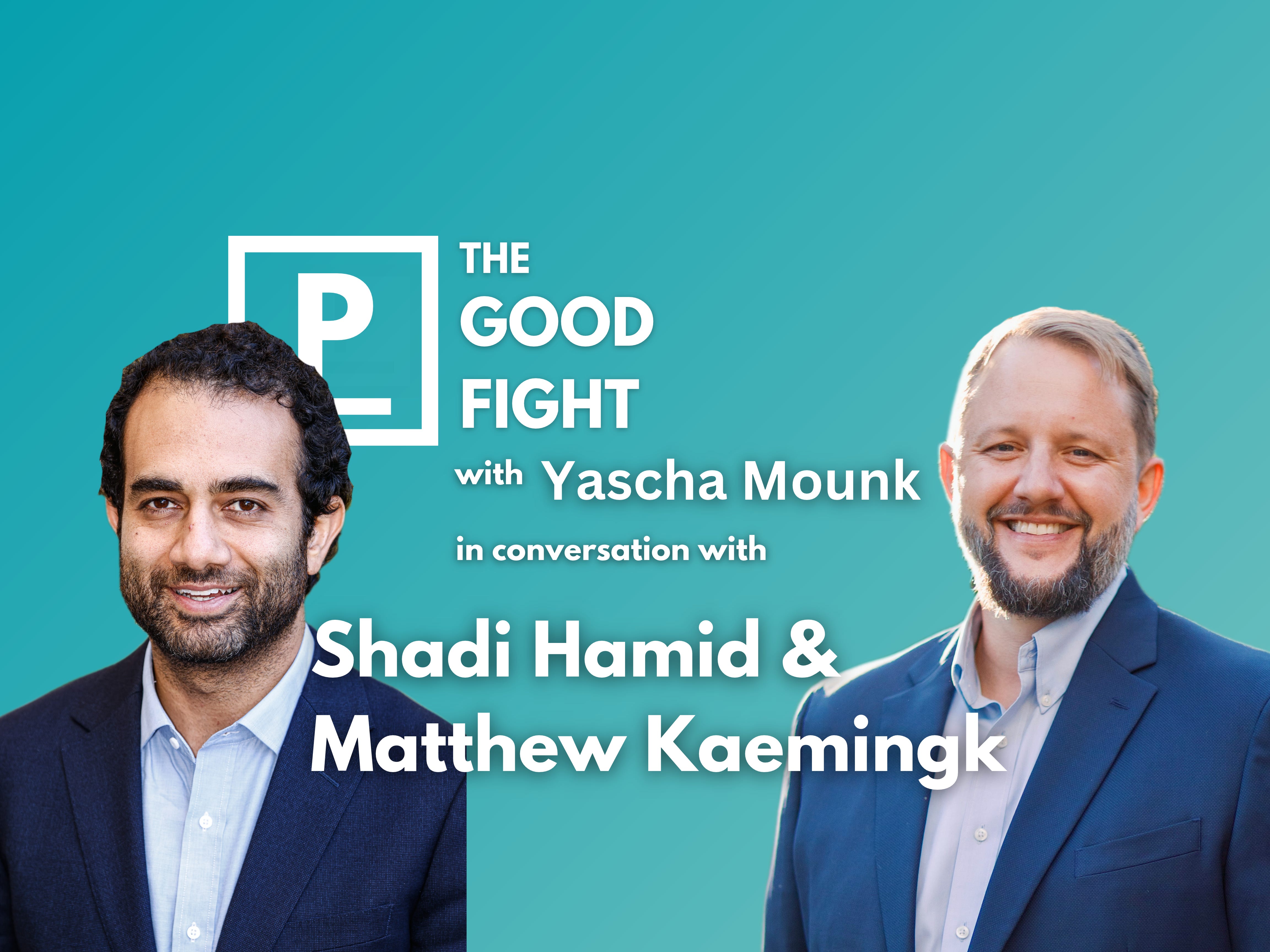
Shadi Hamid is a columnist at The Washington Post and a senior fellow at Georgetown University’s Center for Muslim-Christian Understanding, where he co-directs the Faith and Future of Democracy Initiative. He is the co-author, with Matthew Kaemingk, of Can Religion Save Democracy?: How More Faith—Not Less—Can Heal Our Public Life.
Matthew Kaemingk is Professor of Public Theology at Theological University Utrecht and a senior fellow at Georgetown University where he co-directs the Faith and Future of Democracy Initiative.
In this week’s conversation, Yascha Mounk, Matthew Kaemingk, and Shadi Hamid discuss why the decline of religion has turned American politics into a kind of holy war, whether the Democratic Party can make room for voters with traditional religious convictions, and how secular European societies should accommodate their conservative Muslim minorities.
Note: This episode was recorded on September 29, 2026.
This transcript has been condensed and lightly edited for clarity.
Yascha Mounk: I’m really interested to talk about your new book. A lot of people are blaming religion for a lot of problems in the world. When you look around the world, you see religious wars. When you look at people who are intolerant within Western democracy, sometimes it is people who have deep religious faith who may be threatened by people of other religions, or think that they may lead people to the wrong beliefs. You’re saying that religion is actually very important for democracy, and that, in fact, the decline of religion is maybe one of the reasons for the problems we face today. Give me the argument.
Matthew Kaemingk: I’ll jump in on this one. I think the big-time argument here is, democratic theorists for many years imagined that the more rationality. Fundamentally, religion was a problem for democracy, that it was divisive, and that as we walked away from our religious institutions that divided us—that was the belief—we would become more cohesive as nations, we would come together. What we’re finding in the United States, which is our context, is that’s just not the case, that polarization has grown as religious identity has diminished.
There’s a variety of reasons for this, which we posit. But one of the primary things that we’re looking at here is that while in the past people found their identity and their purpose and meaning in religion, as they walk away from religion, they are increasingly finding their identity in politics, in sort of tribal political identities. These political identities provide them with a sense of meaning and purpose. It also tells them who the good guys are, who the bad guys are, and there’s a bit of a spiritual thrill in political warfare that you can find. With this post-religious loneliness and disaffection, it has drawn people into a form of politics that’s almost apocalyptic, in which people are constantly saying, “This right here is the most important election of our lifetime.” So what we’re touching on in the opening of this book is this paradox at the heart of secular democracy: that as politics becomes more secular, it is actually becoming more religious. It’s having a sense of holy war to it.
Mounk: What do you mean by that? There’s a different argument made by Eitan Hersh that politics has become a kind of sport, where we have this kind of attitude towards that, like we’re cheering on a football team? Is that sort of what you mean, where we have these kinds of quasi-religious attachments to particular political figures or movements?
Shadi Hamid: Well, I think that maybe the starting assumption here that we’re operating under is that all of us have a religious impulse. If you believe in God, then presumably God instilled within us a desire for transcendence. It’s only a question of how that yearning or longing is expressed. If it’s not going to be expressed through traditional religion, it will then be expressed in other ways, through politics. So when we say that politics is becoming more spiritual, it means that these kinds of deep passions and longings are being pushed into something we don’t think they should be pushed into. We don’t think politics should be the place where you find or search for your deepest longings and yearnings. That can be dangerous. Politics can’t really contain that level of intensity.
Mounk: Let me try and understand this claim. Eitan Hersh calls it political hobbyism. He says that there’s a kind of politics that’s like a form of hobbyism, where it takes the space in your life that a different kind of hobby, or an allegiance to a sports team, may have done. Rather than responding rationally to politics, or trying to accomplish rational means within politics, rather than saying, “I’m trying to defend my economic interests,” or “I have some kind of value and I’m trying to promote it,” you’re really saying this is the content of my life, it’s the focus of my activities.
Is the claim you’re making similar, but somewhat parallel, in the sense that when you go to church, or you go to mosque, or you go to synagogue, what you’re hoping for is some kind of transcendence? What you’re hoping for is a promise of deliverance, a promise of salvation. If you lose your religion, then you might invest all of those hopes into politics. You don’t just want politicians to solve the problems of Social Security, or to avoid stupid wars—you want them to make you feel part of a world-historical movement. You want to recognize in the next political candidate the Messiah. Is that the claim you’re making?
Hamid: Yeah, that is, I think, part of what we’re arguing. So the energies are being transferred, and people are finding their full identity in politics, and we don’t think politics is really the right thing for that. Politics should be a little bit more mundane. It shouldn’t be about the ultimate.
I think that you see this in other parts of the world too, and it’s not just an American thing—the rise of the far right in Europe. When people lose that kind of cultural background of Christianity, it’s sort of like a “be careful what you wish for” thing. You think that losing religion will make you more rational, but in fact it just leads to these energies being transferred elsewhere in dangerous ways. That could be expressed through white nativism, ethno-nationalism, ultra-wokeness on the left.
I think it makes sort of intuitive sense that if all you have is the here and now, and you don’t believe in an afterlife, you don’t have that longer time horizon, then you’ll invest more of your energy in a kind of immediate gratification in politics, because that’s all you have. Whereas a religious person can kind of be like, “Well, we tried our best in politics, things didn’t work out. At least I have my religion, my faith, my community.” They have hopes for salvation, and they have that deeper institutional architecture that they’re part of. So politics doesn’t have to give them everything.
Kaemingk: I can sympathize with the argument that politics is becoming a hobby, or politics is becoming a sport in which you cheer for things. I think for people who are perhaps lonely or bored or looking for community, politics can provide that sort of hobby outlet, or that sports outlet. But again, we’re arguing it’s something more than that. It’s not just a hobby—it has a certain spiritual vigor, and it really does feel much more like a holy war, in which the stakes are ramped up to the nth degree. Yes, politics does deal with serious things, but there seems to be a spiritual intensity that is only increasing as religious identity goes down. That’s interesting to us.
Mounk: What element of religiosity do you think it is that had these positive features? I can think of at least three that have implicitly or explicitly come up in the course of this conversation. The first is simply that the church, the mosque, other forms of religious institutions had an institutional quality—they’re institutions. That means they follow a particular kind of doctrine, that they have authority figures, that they involve sermons—they involve an authority figure speaking to the people listening and giving them kind of moral guidance. All of that constrains people’s views and ideas in various ways, which may be unhelpful when it comes to a gradual acceptance of homosexuality, which may have been an impediment for a long time, or something like that. But it can also be very helpful when it comes to impeding people from jumping onto all kinds of terrible beliefs, or all kinds of fads, all kinds of moral panics. So it may just be one of many forms in which traditional institutions that structure society and guide people have declined over the past decades.
A second kind of thing that you may be talking about is a kind of quietism—that if you are secular, if you don’t believe in God, you think that the here and now is the only thing there is. An injustice isn’t tolerable, because if you suffer your whole life under an injustice, there’s no recompense for it afterwards. Whereas if you believe in an afterlife, if you believe in heaven and hell, then you might think, “Well, that’s not great, and part of my conception of religion” is perhaps to fight against these kinds of injustices. “But you know what? If I live a good life, I’m going to go to heaven.” So somehow you can tolerate injustice more, which may have some bad consequences, may have some good consequences, because it doesn’t make politics like a holy war, as he said.
Then the third may just be a kind of psychological interpretation, where you’re saying people just have a need for some kind of feeling of transcendence, for some kind of feeling of being in the presence of a divine. If religion is not going to give you that, then you’re going to invest that into the exciting primary campaign of Barack Obama, or into the claim of Donald Trump to be a godlike figure who alone can redeem American politics. You get these kinds of moments of intense enthusiasm, some perhaps better justified than others, that then lead to deep disappointment and anger, and an unwillingness to see the flaws of your own candidate and so on. Is it all three of those? Is it one or the other? Did I miss any out?
Kaemingk: There’s so much more, but I think you touched on a number of really important ones. Let’s start with something the three of us would agree on, which is idolatry. Our faith traditions don’t like idols. For those people who are not religious at all, an idol is taking something of normal life and lifting it up to godlike status. As simple and ancient as a belief as that might feel to listeners, it has tremendous political consequences: for people who want to avoid idolatry, you want to be very careful about making the mundane aspects of life ultimate.
We hope you’re enjoying the podcast! If you’re a paying subscriber, you can set up the premium feed on your favorite podcast app at writing.yaschamounk.com/listen. This will give you ad-free access to the full conversation, plus all full episodes and bonus episodes we have in the works! If you aren’t, you can set up the free, limited version of the feed—or, better still, support the podcast by becoming a subscriber today!
If you have any questions or issues setting up the full podcast feed on a third-party app, please email leonora.barclay@persuasion.community
That is really what we’re talking about when we’re talking about political conflict—you take an election and you say, “This right here is the most important election.” Or you take a politician and you say, “This politician right here can save our country.” Or, as Obama would say, “We are the people that we’ve been waiting for.” That is one of the fundamental gifts of traditional monotheism: that it radically secularizes politics, in the best way, that Judaism, Islam, and Christianity take politics down three notches—or at least it should. That’s a really important aspect.
Hamid:I think that the point you raised, Yascha, about the afterlife—we have a whole chapter in the book called “The Case for Hell,” where we try to bring hell back, hopefully in a helpful, constructive way. The point there is, we’re not arguing for quietism, although obviously some religious people can end up there. You should do the best you can to make the world more just, but you probably won’t be able to achieve full justice or full accountability. You’re still going to have dictators and bad leaders who do awful things, and at some point it’s going to be beyond your control. But there is some kind of solace in knowing that there is going to be a final accounting in the next life—that Donald Trump, or pick your least favorite leader in the world, or dictator. Not having to have a final victory in the here and now can be liberating. It allows us to chill, ideally, and be more relaxed about our politics.
It’s no accident that the most destructive movements of the twentieth century were largely secular. The communist dream was one about literally achieving heaven on earth, and you can sort of understand why that impulse would be there. If you have an atheistic ideology, it would make sense—if you can’t have heaven in the next life, why not try to achieve it in this life? I think the kind of argument we often hear, that religion is the primary cause of violence—it is really worth remembering that the twentieth century is a century of secular ideologies killing tens of millions of people: Mao’s Cultural Revolution, Nazism was anti-Christian at its core. The list goes on, and we don’t think those things are an accident.
Mounk: To be fair, there have also been very extreme religious movements, including in the recent past, from Al Qaeda to the Iranian Revolution and so on.
Hamid: Yes, of course. But I think that’s relatively well known—that there are religious extremists, that’s a risk that can happen. We’re not saying that religion is always good. But if we look at the kind of broader picture of the twentieth century, I think oftentimes secularism gets a pass, and I just think it’s worth noting that secular ideologies have been very destructive too.
Mounk: No, I think that’s fair, and I think the point that both fascism and communism were deeply secular ideologies, and that they did the most damage in the twentieth century, is very well taken. I wonder what your notion of human nature is, and to what extent that notion is itself a religiously inflected one, or whether my secular listeners are able to get on board with it.
Earlier there was a kind of hint of saying, “If we have a longing for transcendence, then that must be because God wanted it to be there.” Is it possible to put your point about human nature, and the role that religion plays in speaking to those aspects of human nature, in a way that my secular listeners will agree with, that I will potentially agree with? Or do you think that you have to in some way be a person of faith to get on board with the anthropology that is at the basis of your book?
Kaemingk: Not at all. I think that there are many arguments that we’re making here that are very accessible to those who would describe themselves as secular. Basically, that human beings are longing for meaning—they’re longing for some kind of story about what the world is, what’s going on in the world. They want to belong to a group. You yourself have written a lot about the tribal nature of human beings, that we want to belong, and that helps us articulate what the good life is, the bad life is, who the good guys and the bad guys are. All of that, I think, is very accessible, whether you describe yourself as religious or secular.
What we are trying to push on for those who would describe themselves as secular is that they too live by some sort of faith or code, whether they’ve examined it or not. One of our important encouragements for those who describe themselves as secular is that democracy is filled with diverse faith commitments, and they too are a part of that—they have not transcended faith. One of the more dangerous things that we argue about the secular citizen is that sometimes they can believe, “I have transcended all of these religious minorities. I have become enlightened, I have become woke,” and they can sort of look down on their fellow citizens and diagnose all of their problems because they have transcended them. So that would be our push, or our gentle encouragement.
Mounk: Yeah, there’s different versions of that point. My favorite one is from Tom Lehrer, in the song “National Brotherhood Week”—the introduction to it, where he says, “It’s very important to love your fellow human being. And there’s some people who do not love fellow human beings, and I hate people like that.” I think Jonathan Haidt has a version of that in The Righteous Mind, where he talks about all the people with “Coexist” stickers on their cars, when he teaches at UVA in the 2000s, and the deep hatred of anybody who doesn’t have a “Coexist” sticker, or something along those lines.
Let me set out my understanding of human nature as it relates to this, and it makes me sympathetic to your argument, for perhaps it doesn’t get me all of the way there. My sense is that human beings have evolved over time to cooperate with the in-group, but also to be capable of significant cruelty towards the out-group. When you look at the most heroic acts of humans, the most beautiful feats that humans have accomplished in our history, it is often in the service of some kind of in-group, or indeed in the glorification of the beliefs of the in-group, including secular, including religious music and works of art and so on. When you look at some of the most heinous things that human beings have done, it has nearly always been because they were being done to somebody considered an out-group.
I think when you look at the history of the world, and particularly European history, there is a strong argument that religion often does terrible damage. For thousands of years, a lot of the worst wars and civil wars and forms of persecution and exclusion were on the grounds of religion. It’s tempting, as some of the “four horsemen of atheism” did in the 2000s, to say that is because of religion—religion is the but-for cause of these conflicts. If religion hadn’t existed, we wouldn’t have had the terrible wars between Catholics and Protestants in 16th-, 17th-century Europe, for example.
Well, I think that if you have the view of human nature that I’ve come to embrace over the course of my life, it’s a little bit more complicated than that. Because I think religion is one of the kinds of things that can structure the conflict between in-group and out-group. In societies in which religion is the primary thing that structures the conflict between in-groups and out-groups, you often get terrible forms of religious conflict. We’re aware of that in the Christian world, we’re aware of that in the Muslim world, but it’s true of every religion. Buddhists often have a reputation as a very peaceful religion, but in some of the societies, like Myanmar, where there’s deep divisions between Buddhists and non-Buddhists, you have pogroms perpetrated by monks in Buddhist robes. So this is clearly something that every religion is in some way capable of.
Now, I also think that in the absence of religion, that instinct of human nature wouldn’t have gone away. When I had Sam Harris on the podcast, we had a great discussion, and I pushed him on this, saying, look, for thousands of years of European history, religion inspired people to do terrible things, as well as some good things, of course. But in the absence of religion, it may have been a proto-form of nationalism, or it may have been “my village against yours,” or it may have been something else entirely. The question of whether religion inspired peace or conflict in that time is this incredibly complicated counterfactual question about what would have taken the place of religion—if it hadn’t been there, what would have filled that void? Would it have been comparatively better or comparatively worse? I think answering that question is basically impossible. Where do you agree with me here? Where do you disagree with me here, Shadi?
Hamid: I think that it’s likely that people would have still found ways to fight each other in the absence of religion. I think you’re exactly right that, because religion was the primary currency and the primary identity, then naturally religion is going to play a role in conflict in the pre-modern period. But before the Abrahamic faiths, people were in regular conflict. Then, as we mentioned, in the twentieth century, with the decline of religion, people found ways to kill each other more efficiently and in a more destructive way.
I think we have to be very careful about drawing the causal link between religion itself and conflict, and the very essence of conflict. But I think that when we’re talking about the modern period, we have to switch the analysis a little bit, because we’ve moved so much in the other direction of secularization. So now religion plays a little bit of a different role, in tempering the excesses of secularization.
Kaemingk: Okay, I just want to cut in here real quick on two things. One thing, Yascha, I’d love to add to your analysis there: not seeing religion always as the primary influencer, but sometimes as the follower—that authoritarian leaders throughout history have been very good at manipulating religion for their political purposes or their economic purposes. As much as I would love religion to be a very powerful force, it is often a follower. Even in those “wars of religion” in Europe, many scholars have looked back upon that history and seen that actually, in large part, what was going on there was a contest of different power brokers within Europe who were able to manipulate and use Catholic and Protestant tensions for their own political ends. I would commend the book The Myth of Religious Violence by William Cavanaugh, who specifically looks at those wars of religion, because those are so commonly used by European secularists as the case for why religion can’t be a part of public life, because Europe was torn apart by “religion.”
The second thing I would say here is: when it comes to in-group and out-group tensions, which you talk about, and I completely agree with you that’s core to human nature—then the next question we have to ask is, if we are tribal, and if that tribalism is never going to go away, the question is not how do you get rid of tribalism. The question is how do you develop a form of tribalism that is capable of some level of hospitality, some level of patience, some level of generosity with outsiders. What is that technology for dealing with the outsider?
Our argument is that Islam has spent centuries thinking about that question, and Christianity likewise, and Jews likewise have thought for centuries about how you deal with outsiders. The sort of history that the only thing Muslims and Jews and Christians have been thinking about is how to excommunicate people is just a terrible history. These are moral communities that have been thinking hard about how to stop a war, or how to reconcile someone that they have excommunicated. Even earlier you talked about a church with a sort of religious leader providing a moral vision—well, I would just say that a church is so much more than that. Within a church, you have a lot of democratic processes going on. It’s very rare to have an authoritarian church; it’s actually quite much more common for a church to have a group of elders that are meant to check the pastor, to hire and fire the pastor. You have a wide variety of ways inside of your church to have its own polity of democratic discourse and debate.
Similarly, within a mosque—these are what Alexis de Tocqueville would call the schools of democracy. If you look at the primary charities in the United States that are focused on refugees and immigrants, as much press as there is about Christians who don’t like refugees and immigrants, all of the primary charities are the Catholics, the Lutherans, the Evangelicals. They are the ones who are taking in the refugees, who are feeding and clothing them and finding them jobs. So there are these moral communities within our democratic life that are thinking about that question that you’re asking, which is how can a tribe become somewhat interested in outsiders? This is critical to democracy.
Mounk: I think that there’s a version of that argument that I, as a secular person, find attractive, and a version of that argument where you have to do some more convincing of me. The version of that argument that I find attractive is that we have this tendency towards dividing ourselves into in-groups and out-groups. One of the dangerous things—my colleague Lilliana Mason at Johns Hopkins has made a version of that point—is when all of our identities become overlapping.
Not only do I have Jewish heritage—I’m not religious—and Shadi is Muslim, but also I’m a Democrat and Shadi is a Republican, and whatever the seven next things are. And so there’s just nothing that the two of us have in common, and so we just see each other as enemies. Whereas in a more healthy polity, we might have some things that sever us and some things that bridge us at the same time. So I have Jewish heritage, Shadi is Muslim, but also we both happen to vote for the same political party, and also we both see ourselves as public intellectuals with a certain kind of inclination towards an open mind and talking earnestly with people who might have different points of view.
What allows us to retain civic friendship, even as we have some of these important salient differences, is where we have important similarities on other things. So what you might say is that religion plays an important role in that respect—that in a society in which nowadays, actually, the main division, according to who’s happy to be friends with whom and so on in society, is no longer race, though it’s obviously an important one; is no longer class, though it’s obviously an important one; is often partisan identity, where parents, at least in opinion polls, are more likely to say “I’m going to be upset if my daughter marries a Republican” if they’re a Democrat, or a Democrat if they’re a Republican, than they are to say “I’ll be upset if my daughter marries somebody of a different race.” Religion can be one of the things that is cross-cutting and cross-partisan.
Now, unfortunately, religion in America tends to be quite racially segregated, most of it. But when you look at the Catholic faith, when you look at some of these Protestant congregations, they’re very multiracial. Islam, by its nature, is quite multiracial, including in the United States. So it can be one of the important things that is a counterbastion to just “I’m a Democrat and I hate Republicans,” and that clash between these two factions that Madison tried to avoid in Federalist No. 10 is not totally defining our country.
So I, as a secular person, have a lot of sympathy for the ways in which religion can be a bridging identity between people who otherwise have many dissimilarities, in a way that helps against all of these identities collapsing in on each other and completely separating us. That comes easily to me. Is religion different in nature than other kinds of things that might accomplish that? Is it just helpful because it’s one more thing that does that? I think you want to make a claim that goes beyond that.
Kaemingk: Right. The Washington football team, or the New York Giants can bring the city together in some really beautiful way, but it’s not the same.
Mounk: Yeah, and by the way, I don’t want to dominate, but my mom hates sports, because she associates sports with a collective enthusiasm of a form that she—understandably, given her history—associates with fascism and communism and so on. To her, crowds of people cheering something on feel dangerous. Whereas to me, I see that precisely as a healthy outlet for something that might otherwise find an unhealthy outlet.
Kaemingk: Yeah, we’ve seen beautiful ways in which sports have brought things together, but I think, for Shadi and me, religion is categorically different from cheering for a sports team. It’s wonderful that religion can bring people together as well, but I think the categorical difference here is that I go to church not because I’m a fan of Jesus—I go to church because I fundamentally believe it’s true, about the whole world, and I orient my whole life towards it. I think sometimes democratic theorists—and you might hold to this, Yascha—believe that, okay, yes, we can have all of these tribal identities, but it’s important we not take any of them very seriously. Because if we have a belief that we take really seriously, then we will be dangerous, then we will be violent. So it’s okay for Shadi to be a Muslim as long as he doesn’t take it too seriously—because if he takes it too seriously, then he won’t be a good democratic citizen. I think that’s a contention that we would really want to push on.
Hamid: I would just add something, Yascha, about the bridging nature of religion. I think what’s unfortunate now is that religion is mapping onto partisan divides. If you meet a white Christian person who’s outward in their faith, you can probably guess that they’re going to be Republican. If you meet a white liberal, or a white secular person, they’re probably going to be a Democrat.
One thing that we kind of touch on in the book is religion—the left and progressives should not concede the religious ground to the right. It should be more of this bridging capital that all Americans can share. I think one of the unfortunate results of the Democratic Party becoming less hospitable to people of faith is that religion and partisanship are now closely associated, and that’s dangerous for our democracy.
Mounk: What do you think it would take for Democrats to become more hospitable to people of faith? I’d be interested, in that context, to hear about your views on somebody like James Talarico, who I don’t know that much about. I mean, I obviously follow the news and have a sense of him as the Democratic candidate for Senate in Texas. He seems to have an actual chance of flipping Texas—there’s supposedly a chance for Democrats to flip Texas every year, but this year is likely to be a particularly blue wave, and the Republican Senate candidate is particularly unappealing. So he may in fact win the Senate race.
I’ve heard very different things about him. He is, I said, a pastor, a very religious person, but who grew up in a kind of very progressive form of Christianity. In his past, in 2020, when everybody said things that we now want to forget, he has invoked religion to justify political positions in a way that, my understanding is, many Christians actually found to be off-putting. One argument could be that, a little bit like Graham Platner was kind of the upper-middle-class voter’s idea of a working-class person, I’ve heard that James Talarico is sort of the secular man’s idea of a progressive Christian, but that actually that would make him even more off-putting to many Christians. I’m aware that I don’t understand that world nearly enough to be able to assess whether or not that claim is true. But what do you think? Do you think that somebody who’s arguing for these pretty progressive positions on questions of abortion and trans questions and so on, cloaking it in that Christian language, is a way of reaching Christians, or in fact, is that just going to be off-putting? And if a Democratic Party wants to be more hospitable to people of faith, then it actually needs to at least be willing to tolerate, for example, within its tradition, within its tent, people who are strongly pro-life.
Hamid: I think James Talarico—some of his conclusions might be off-putting to more conservative Christians, but I think the major point here is that he’s comfortable speaking about his faith, and he seems genuinely sincere. I think that’s something that’s become increasingly rare in the Democratic Party. Just bringing that back as a kind of starting point: that it’s okay to bring your faith into public discussions.
For a party that claims to be the moral party, that has moral conviction and moral leadership, I think it’s difficult to express morality if you don’t also have a kind of religious language, or at least appeals to religious language. So I think it’s a good thing that Talarico is doing what he’s doing, and I would just hope that it spreads a little bit in the Democratic Party, if for no other reason than that we just need to have faith being something people are comfortable with on both sides of the aisle. Again, I think the point here is we’re not telling people that they have to believe. I think what we’re saying is that it’s important for people to accept that religion can play a positive role in our discourse.
So those are two separate propositions. You can be an atheist but still agree with us that religion can be morally inspiring. It can make people more civically engaged. Religion is associated with higher levels of happiness, of giving, of charity, of not cutting in line. There’s been a lot of studies on this that show the kind of positive elements of religion. So I think there’s a way to have a kind of practical, consequentialist approach to this that is separate from the question of belief.
Mounk: Do you think that, to put it slightly deprecatingly, and that may not be fair, sort of dressing up the Democratic Party platform in the language of a devout man is going to be enough to broaden the Democratic Party’s appeal among people who are religious? Or do you think it will take, if not a change in the stated positions of the Democratic Party platform, at least a kind of willingness to embrace, within the broader tent of the party, people who have clearly diverging opinions on questions around abortion, around the participation of trans people who’ve gone through male puberty in female sports—whatever other issues you might want to talk about—that have a high religious salience to some religious people, at least.
Kaemingk: I would say that religion is prickly and strange as a social and political force, and the modern political party does not appreciate things that are prickly and strange. They want candidates that will fit in with the party platform, and that’s an issue for Republicans and Democrats to deal with. Historically, I would say that the Republican Party has been more comfortable with the prickly and strange nature of religion and religious actors within their big tent than the Democratic Party. The one sort of exception to this would be the Black church in the Democratic Party—you have Barack Obama singing “Amazing Grace” in public in a way that other white Democrats would not quite be able to pull off.
With James Talarico, my concern is that he is too smoothly a Democrat. He doesn’t have—he’s not strangely Christian. His Christianity just falls perfectly in line with the Democratic Party. Similarly with Mamdani and other Muslim candidates within the Democratic Party, they fall very smoothly within the Democratic Party. Shadi and I might have a little disagreement on this, but I’m just concerned with the sorts of Muslims who are promoted within the Democratic Party—they tend to have fallen in line with the Democratic Party platform. I would love to see the Democratic Party elect a Muslim who openly has Muslim views on gender and sexuality.
Mounk: What do you mean by Muslim views on gender and sexuality?
Kaemingk: Well, I’ll have Shadi define what those things are, but I would just say, confidently, they don’t fit in perfectly with the Democratic Party’s party line. For the Democratic Party to say, “Look, we respect real disagreement within our party, and Islam—we don’t just want to tokenize Muslims who wear a headscarf, but who actually have meaningful religious convictions—and we have space in our party for differences on questions of gender and sexuality.” They don’t, right now.
Mounk: I love some drama between co-authors on the podcast. Shadi, do you wish to denounce your co-author?
Hamid: No, I think Matt’s bringing up an important point: that there’s been a kind of ethnicization of Muslims. To be an American Muslim in public life now, it’s kind of an identity marker instead of a container of faith or religious conviction. I like Zohran, and I like Abdul, but it is interesting that they don’t really talk about the content of their faith as much. They emphasize the fact that to be Muslim means to be marginalized, or to be victims of Islamophobia, or that it’s about being a minority in America similar to other minorities.
But there are orthodox views in Islam that are limiting sexual freedom in some way, that are not accepting of the full panoply of transgender activism, the arguments that are made on behalf of that—especially, as you mentioned, Yascha, in sports, that kind of flashpoint. So I guess that’s concerning to me: that Muslims are sort of accepted in the Democratic Party only insofar as they accept the Democratic Party’s positions on gender and sexuality. I would like to see people like Abdul and Zohran pushing a little bit and adopting more, maybe let’s say, socially conservative views on certain moral questions, and that might actually help them in expanding the electorate, appealing to a larger number of voters, especially in a place like Michigan, where someone like Abdul El-Sayed has to appeal to disaffected Republicans and independents.
Mounk: To what extent do you think they hold those views? I don’t want to claim that either of them is misrepresenting their true beliefs, but of course every politician does in certain ways. I would be surprised if Zohran held those more conservative views, in part because of his upbringing and the kind of bubble of Columbia University and the heart of New York City, and his mother being a Hollywood movie director and so on. I’d be less surprised if Abdul held some of those views but decided, out of political calculation, that he can’t loudly speak about them. But I don’t know, Shadi, whether you have a view.
Hamid: Yeah, I think you’re right about Zohran. But I think Abdul is a little bit of a different case—someone who did grow up in a more religious family, and in the context of Michigan, where religious conservatism in the Muslim community is sort of the norm. Abdul has given a couple of interviews where he’s alluded a little bit to maybe having more socially conservative views on things like porn and gambling and so forth. But it seems to me that he’s pulling back, that he’s being very careful, and he’s so concerned about alienating members of the progressive base that he’s just not willing to go there. My sense, and also kind of knowing people who know him, is that he does have that in him. But look, you never know exactly what’s in people’s hearts. I do think that it would be nice for the Democratic Party to be a bigger tent when it comes to these moral questions.
There’s really no reason the Democratic Party has to be the secular party, and it wasn’t always that way. Forty, fifty years ago it was quite different, where there were still white evangelicals in the party, and famously Jimmy Carter was one of them. So this is really a kind of recent phenomenon of the last several decades, and it’s just a major missed opportunity for Democrats. They’re narrowing their tent when they need to enlarge it.
In the rest of this conversation, Yascha, Matthew, and Shadi discuss the different attitudes to religion in Europe compared with the United States, how to balance conflicting values, and whether religious people really are happier. This part of the conversation is reserved for paying subscribers…
Listen to this episode with a 7-day free trial
Subscribe to Yascha Mounk to listen to this post and get 7 days of free access to the full post archives.


