



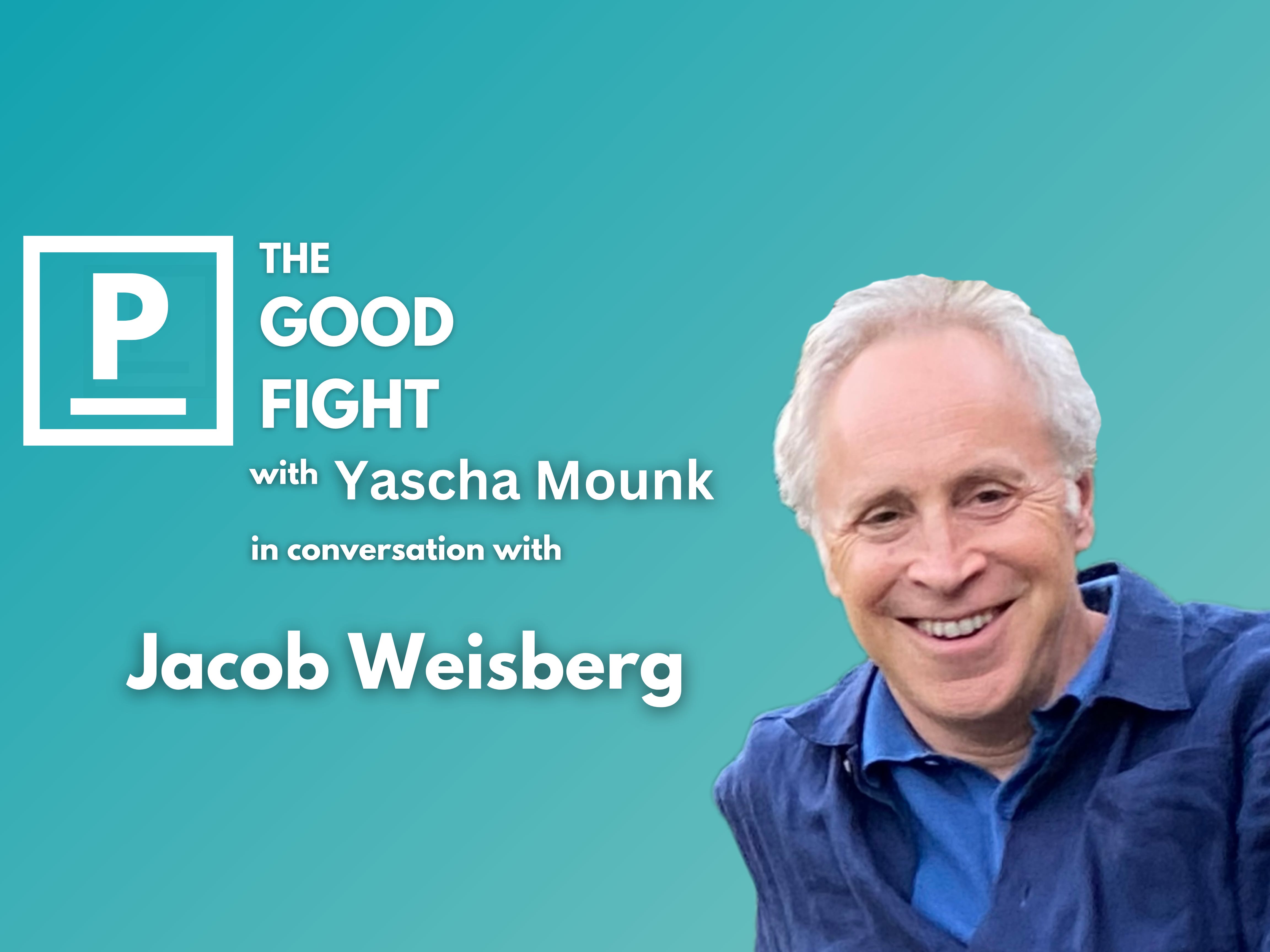
Jacob Weisberg is the co-founder of the podcast company Pushkin Industries. He serves as Chair of The Committee to Protect Journalists and is a regular contributor to the New York Review of Books. His latest book is Profiles in Cowardice: A Study of Collaboration in the Trump Era.
In this week’s conversation, Yascha Mounk and Jacob Weisberg discuss why American institutions proved far less resistant to Trump in his second term than his first, what figures like Jeff Bezos and Brad Karp reveal about the social nature of courage and cowardice, and whether Harvard’s response to the Trump administration could become a turning point for institutional resistance.
This transcript has been condensed and lightly edited for clarity.
Yascha Mounk: There’s a famous book by John F. Kennedy, which I must admit I’ve never read, called Profiles in Courage, in which he profiles all of the various people that he admires and who he thinks have bettered America and perhaps the world with their courage.
You have inverted the premise of this for a book that speaks more naturally to our own historical moment, Profiles in Cowardice. Is this a moment of cowardice in our national history?
Jacob Weisberg: Well, I think so, and just to spend a minute on Kennedy because it is a really interesting book—it’s a book about the Senate. And John F. Kennedy as a young senator, I think, was really troubled by his own failure of courage. He’d been a war hero, and everyone knows the story of PT-109, how he rescued his fellow sailors, and his physical courage was unquestionable. But when Joe McCarthy was running rampant, JFK took a dive in the Senate on the vote to censure him. He was in the hospital for his back. He got out of voting. He never said how he would have voted. He never stood up to Joe McCarthy.
My read on it is that he wanted to write this book to give himself more courage, to try to understand what courage in politics was. He wrote about eight senators going back to the early days of the Republic, not all of whom he would have agreed with on substantive issues, but who took important decisions against their own interests, who were willing to risk or sacrifice their political careers for principles, often constitutional principles, that they believed in deeply. I think it worked for JFK. The JFK of the Cuban Missile Crisis was someone who was morally courageous in a way that the JFK of the McCarthy era wasn’t. So the book is sort of a trope in Washington—people talk about “profiles in courage” when someone is willing to do something, which they very seldom are, against their political interest.
Mounk: Often even the ironic use of the phrase has become a bit of a trope, right? The Trump era is a series of “profiles in courage” because look at how cowardly everybody is being. This idea that courage today is in such short supply that you look at the United States Senate and say it’s a series of “profiles in courage,” as an ironic, knowing wink, contrasting this moment with that of Kennedy. It’s kind of a received idea today.
Weisberg: Yeah, and my book obviously isn’t just about the Senate. I look at a series of American institutions—institutions of civil society, law, academia, business and finance, tech, and then Congress, the Supreme Court, media, and so on. What really prompted me was that at the beginning of Trump’s second term, the first part of 2025, the contrast to Trump’s first term was so marked. In Trump One, people and institutions, by and large—it was a mixed picture. There was a lot of resistance to Trump at the institutional level. I focused on people in this book who were different in Trump Two than they were in Trump One.
Jeff Bezos is a very good example. In Trump One, Jeff Bezos was really an admirable character. Trump threatened him, tried to blackmail him, and actually caused tremendous financial harm to Amazon by taking away a Pentagon cloud computing contract. It was a $20 billion contract—I think it was the largest contract in the history of the US military—and Trump took it away from Amazon to punish Bezos for the coverage he got in the Washington Post. Bezos didn’t waver. He said the right thing, he did the right thing. In Trump Two, he was in Mar-a-Lago on bended knee, ready to capitulate. Even before Trump was elected, you knew it was going to be different.
That paradigm, I think, applies to so many people in institutions—certainly to Brad Karp, who I write about, the managing partner at Paul Weiss, in my illustration of what happened at the big commercial law firms. Same thing: in Trump One, he sent Paul Weiss lawyers to the airports in New York to try to help Muslim immigrants who might be denied entry. In Trump Two, he made a deal in five days to essentially give in to Trump’s unlawful demands, demanding a range of favors from them in response to things that were entirely within their rights to do as a law firm.
Mounk: I want to dig back into some of those particular people over the course of this conversation, but let’s think about what produces a moment of courage, and what produces an atmosphere in which people who are capable of courage in different moments end up not being courageous. One story you could tell is one of moral decline—that in the past people were courageous, they had principles, there was a kind of public spirit with which they grew up, and unfortunately we’ve lost that over time, and now everything is worse. It’s often tempting to think that, given how awful so much of our politics is.
But it’s interesting that at the beginning of the conversation you mentioned JFK being haunted by his failure of courage during the McCarthy era. And when you look at American history in those decades, you might say that there was quite a lot of courage in how to confront the Great Depression at a certain point. There’s a lot of courage during World War II—the greatest generation. Then there was this moment of complete dereliction of duty when people let McCarthy run wild, and then things got better. So clearly it’s not a secular story of fifty years ago, seventy years ago, things were much better and everybody was virtuous, and then over time it declined, because we see that kind of oscillation. We see the difference between the McCarthy era and ten or fifteen years later. We see the difference between Trump One and Trump Two. So what do you think made these people change so much between ten years ago and now?
Weisberg: I think courage and cowardice are social phenomena in the sense that they’re contagious and very context dependent. I wouldn’t discount the possibility that human nature is changing in certain ways, but I don’t think it changed drastically between 2016 and 2024. I think people look for cues from the people around them—their circles, their communities, their institutions. Trump was able to be much more dangerous and much more intimidating the second time around, partly because he had much firmer control of the government and of his own administration, and that includes internal dissent. There was really significant internal resistance to Trump from many of his own appointees in the first term—not in his second term. So he was a more dangerous character.
When people looked around, instead of seeing others standing up, they more often saw others giving in. And here’s where I think the leading institutions play such an important role. I would point to the universities as a really significant example here. There wasn’t such a powerful attack on the universities in Trump’s first term. In the second term, they went after the most prominent institutions. That’s why Harvard is so important to Trump, and so important in the other direction to the people resisting Trump—colleges and universities look to Harvard in particular, and if they see Harvard resisting, it makes them think resistance is possible. If they see Harvard on the verge of making a deal, they think, how could resistance be possible for us?
Mounk: That’s a strikingly deflationary account of what courage is from the perspective of human nature, which is to say that when people appear courageous, they’re also following social cues in all kinds of ways. The courage in 2016 looked courageous because people were standing up to the administration, but it actually didn’t take that much courage, because what people were doing was following the actions, incentives, and examples in their own social circle. So what looked like courage with regard to the Trump administration was actually being a follower, being a fellow traveler, within your own milieu. And what changed in 2024 was not that people were more courageous in 2016—it’s that the nature of the incentives changed, and therefore they acted differently.
We hope you’re enjoying the podcast! If you’re a paying subscriber, you can set up the premium feed on your favorite podcast app at writing.yaschamounk.com/listen. This will give you ad-free access to the full conversation, plus all full episodes and bonus episodes we have in the works! If you aren’t, you can set up the free, limited version of the feed—or, better still, support the podcast by becoming a subscriber today!
If you have any questions or issues setting up the full podcast feed on a third-party app, please email leonora.barclay@persuasion.community
Perhaps I’m overreading what you said a few moments ago, but that’s an interesting way of framing it: that courage is when you are following the moral incentives of your own close-knit social circle. It so happens that your own close-knit social circle is doing something that we morally approve of, whether for good objective reasons or just because we happen to be on that side—and those are different from the incentives you face in some other part of society. The political incentive is to go along with Trump, but the social and cultural incentives within your milieu are to stand up to him, and so you get 2016. Then those social and cultural incentives shift eight years later, and suddenly the people who looked courageous in 2016 no longer are. Is that the nature of your argument, or is that too deflationary about the nature of courage?
Weisberg: I think both things can be true. I do think, yes, what you just described is unfortunately how it works. There is more courage in resisting Donald Trump when he’s at a 32% approval rating than when he’s at 50%. There just is. When the stakes are lower and the consequences are less, more people stand up. If you want to reduce it or diminish it, you can point to examples of people resisting and say, well, they’re in a position to resist, they didn’t face the same harm—and that’s true. At the same time, these are ethical and moral decisions that individuals make, and I don’t think you can take away that component of it.
But if you look at it historically, internationally, the people who are real moral heroes—who are willing to sacrifice their lives for liberal principles, Nelson Mandela, Václav Havel—those people are really rare. You shouldn’t go through life thinking, well, if I were in that position, I would surely be one of them.
Mounk: One of the absurd things is the people who’ve always gone along with the majority opinion in every social circle they happen to be in, thinking, I would have been the only one to stand up to the apartheid regime, to the Nazis, to the communists, to whatever. It so happens that fifteen years ago my opinion was exactly that of my social circle, and seven years ago my opinion was exactly that of my social circle, and now it’s exactly that of my social circle. But because the opinion of my current social circle, rightly I think, believes that those were really evil things, I obviously would have courageously stood up to them. I guess it’s theoretically possible that it just so happens your deepest values are completely in tune with your society today, and you would have always stood up for those with the utmost courage. But probably, if you’ve never stood up to majority opinion at any point in your life, you might not have done that at the darkest moments of human history either.
Weisberg: You might be Dietrich Bonhoeffer, but luckily for you, we’ll never find out. We know that most people aren’t, and we’ve seen this process play out—the United States has partly gone through it in 2025 in a really intense way, as have other places. We know there are people who stand up, but we know most people don’t. I think we just have to recognize the reality that social context, political context, the amount of harm, and the incentives people face are really real. But what I try to do in this book is also tell eight individual stories—not eight people whose actions were determined by the social context, but people who made choices. I try to isolate the choices they made and put myself in their shoes, as it were, sympathizing to some extent, understanding that these dilemmas were hard, but asking why they, at these crucial moments, did the wrong thing as individuals.
Mounk: Let’s start with somebody like Brad Karp, and for those who are less versed in the seeming minutiae of the legal profession in the United States—I think it does have very deep political ramifications—what role did he play in 2016, and why is it that he deserves such a central place in your book? There are other people, like Mitch McConnell or Charlie Kirk, who have an obvious importance in the American political firmament. That’s less true of somebody like Karp. What is it about the fight over law firms that makes him an important case?
Weisberg: Well, first of all, Paul Weiss, the firm he ran, was tied up with the tradition of liberal jurisprudence more than any other. Going back to Brown v. Board of Education, it was the place that had many of the first African American lawyers, first women lawyers, and was involved in so many of the landmark civil rights cases, usually working on a pro bono basis. It has this history, and that’s part of how it’s attracted so many strong and important lawyers over the years. Brad Karp himself was recruited by Ted Sorensen, who coincidentally was the ghostwriter of Profiles in Courage—a famous Camelot figure, friend of JFK’s, liberal lawyer.
Karp always prided himself and the firm on having that tradition, which he thought was compatible with being a Wall Street firm, with having big financial business and partners who had an average salary of seven million dollars a year. They were able to pull that off until 2024 and Trump’s re-election.
Part of what was shocking about what Karp did was that undoubtedly he was under tremendous pressure—Trump was saying lawyers from Paul Weiss couldn’t enter government buildings, they were all going to be denied their security clearances, he was going to prosecute them for discrimination and civil rights violations. Essentially, if you say that a law firm is proscribed, that the president hates them, the administration hates them, they can’t effectively represent their clients in front of federal agencies. All of this was lawless. Law firms have the right to represent clients—their whole system is based on everybody having a right to a lawyer. Paul Weiss was undoubtedly going to win in court if it filed an injunction against the government. In fact, other law firms, like Jenner & Block, that did fight Trump’s executive orders prevailed very quickly and very convincingly.
What Karp decided to do instead was negotiate. He went down to the White House, met with Trump, and five days after the executive order, made a deal agreeing to provide free pro bono services to the administration, to forswear discrimination—which I don’t think they engaged in, but which they were accused of essentially practicing through affirmative action—and a range of other gobbledygook, apologizing for things they’d never done and that were kind of meaningless. It was a very public and very fast capitulation. I think it sent a signal through the legal profession: this is the new regime, this is the new order, you can’t fight it.
Mounk: Let’s get a couple more examples on the table and then I want to reflect on them. To take a very different example from the media: you profile Megyn Kelly, who—this feels like ancient history now—asked some tough questions of Donald Trump in a presidential debate in his first cycle. Trump insulted her in pretty colorful and sexist language. Kelly is clearly a very smart person, a very capable interviewer, and for a little moment she really was, in the eyes of many critics of Trump, a kind of hero—a conservative journalist who really stood up to him. Then she started to change her tune very radically over the course of the last years. How do you explain her evolution?
Weisberg: It’s a super interesting story. As you say, I think she was a real hero. This is a Fox News journalist in a Fox News-sponsored debate, and she decided that her responsibility as a journalist was to challenge Trump on his abusive language about women and his treatment of women. He hated that. She made him look bad in the debate, and he hated it so much that he essentially called out the dogs against her—Steve Bannon and others. She was deluged with threats. She had to have full-time security. Her children had to have security. People showed up in the lobby of her building in a menacing way. This is what Trump could do even as a candidate in 2015—directing a mob without saying go do this, but sending a signal to menace someone. It’s truly terrifying.
She stood up to that for a while, and then I think she made the calculation that she couldn’t survive it, certainly as a conservative journalist. She didn’t capitulate to Trump in 2016, but she made a sort of truce with him—she went and interviewed him in Trump Tower, asked some gentler questions, and he no longer was coming after her in the same way. But she was still, I think, a really admirable character, certainly in the context of conservative media.
She left Fox News, went to NBC, and her experience—as she describes it—around wokeness and the way she was treated by the liberal media, particularly focusing on some unfortunate comments she made about blackface Halloween costumes, which she defended in an offhanded way. I think she was wrong, I think it was offensive, but I don’t think it was a hanging offense. I think it was within the range of opinion and discussion, and NBC and journalism generally should have said there is room for someone with conservative views on a mainstream network commenting. They also should have seen that she was moving in a more centrist direction—she wasn’t a hard-line conservative, she was someone who’d been schooled on Fox News.
Her experience at NBC, as she describes it, was so bad that when she was fired and drummed out of there, she set up her own podcast, her own media network, and became hard MAGA. At a pivotal moment, she had Steve Bannon on her show and embraced him—a man who literally could have been responsible for having her killed or her family harmed. She said, I now realize that these tactics are necessary to defeat wokeness, to defeat the left. So the chapter is about how you explain that transition, how it happens. Part of it is the political explanation, I think.
Mounk: So what is the explanation? Part of the obvious question I have for those kinds of cases is whether people—you described her as making quite a cold-blooded calculation, right, to survive, I have to do this—and I certainly think that with a lot of the characters you’re talking about, some degree of cold-blooded calculation is involved. They seem to follow their interests, and probably looking at the way their objective interests lie is a better predictor of how most people are going to act than they seem like a nice person or they seem smart or that person is a bit of an idiot or that person seems a little bit craven. It turns out that a lot of people do end up going where their interests lie.
But I wonder to what extent they themselves would describe it, even to themselves, in an honest moment, in those terms. I get the impression that, with the exception of genuine sociopaths—which no doubt exist, and no doubt exist more in politics and perhaps in media than in most other walks of society—people want to be the hero in their own movie, and they’ll find some way to justify their actions, even if they are objectively following their own interests, in noble terms. Yes, I’ve had my criticism of Trump, and yes, there is really a problem with Trump, but it turns out that the threat of the things I experienced at MSNBC are so much worse that I am fully morally justified in striking this deal. Yes, I’m a little uncomfortable with it sometimes, sure, but that’s just what politics is—you’ve got to pick your side, you’ve got to pick the lesser evil. Is that what Megyn Kelly is sort of saying—that she’s really talking herself into actually, I took the morally right decision? Or do you think that at some level, when she looks in the mirror in the evening, taking off her makeup, she thinks, my network is doing great, but morally speaking, I’ve done the wrong thing?
Weisberg: To be good at politics, Yascha, is to be good at convincing yourself of the things that it’s useful for you to believe. With politicians, or people in politics, looking for this gap between what they really think and what they say is a sort of losing battle, because they may change a position that wasn’t the position they believed in, but they’re good at coming to believe what’s useful.
With Megyn Kelly, I think there’s a deeper psychological explanation, and I try to do this for a lot of the subjects of the book—to understand them at this personal level. It’s a story about bullying. With Trump, there are many stories about bullying, but she writes in her memoir about being bullied growing up as a girl, and how this affected her whole life, her ability to have relationships with other people. She swore to herself, as a result of this experience, that she would never be bullied and would never side with bullies.
I think that explains a lot of why she stood up to Trump so strongly in 2015—she saw this bullying behavior and hated it because she had experienced it. But what’s tragically happened to her is she’s become a bully herself. She’s now embraced the bullying. I think that’s a psychological pattern with bullying—you either figure out how to overcome it and recognize it, or you succumb to it. If you listen to Megyn Kelly’s show, which I did more of than it’s probably good for anybody, on a daily basis, what she is doing is bullying people, particularly trans people. It’s a fixation of hers. It’s not about the political debate over trans athletes or trans rights—it’s a vicious mockery, crude, nasty mockery of anyone who is trans. Also gay people, also different kinds of minorities. It’s really ugly. If you listen to it, and if you’ve read her memoir, you think, how did the person who had that self-knowledge become the person who’s now engaging in this behavior? I think that’s where you have to point to Trump’s coarsening effect on our political culture. Bullying—he’s introduced bullying as a kind of way of politics, a way of life. He’s modeled it, and he’s also made it the way to succeed for someone like her.
Mounk: We’ve talked in some depth about two people so far, Brad Karp and Megyn Kelly. Karp deserves your ire because of the way he folded to the Trump administration when they started exerting pressure on law firms. Megyn Kelly is a very obvious case because she has become one of the most influential pro-Trump voices in conservative media. George W. Bush is a slightly more surprising entry. Whatever feelings my listeners have about George W. Bush—I suspect some of my listeners rather like him, and many probably have deep reservations about him—he has not embraced MAGA. It’s quite evident that he doesn’t particularly like Donald Trump, and it’s quite evident that Donald Trump doesn’t particularly like or respect George W. Bush. There’s no love lost between them. Nor has he really caved to Trump in the way that Karp did, in one very specific thing. So why is it that Bush deserves to be on this list? Why does he have a chapter devoted to him, the way people like Karp or Megyn Kelly, or for that matter Mitch McConnell and others, do?
Weisberg: Part of what I’m doing in the book, Yascha, is calling people on their own principles. I think law firms have to stand up for the rule of law. I think journalists have to stand up for the principles of journalism. I think business people have to stand up for the free market and capitalism. I’m not saying those are exactly my views, but they’re their views. I think Bush stands for quite a few things that are very important. One is the idea of a non-MAGA Republican Party.
I wrote a book called The Bush Tragedy, which is immensely critical of him, so I’m far from an admirer of the George W. Bush presidency. I think it was catastrophic in a variety of ways. But there are things about Bush that I really respect. Around the twenty-fifth anniversary of September 11th—he unequivocally defended Muslim Americans after September 11th. There was a real backlash against Muslims in America, and Bush never wavered in saying Islam is a religion of peace. He got a lot of criticism from the right for doing that, but I think he did a lot to prevent retaliation against innocent Muslims in America. He championed PEPFAR, the HIV/AIDS program, which by most estimates has saved twenty-five million lives around the world—probably the most successful thing he did as president.
The Bush family, I think, stands for a Republican tradition that, though it’s not my tradition and though it’s flawed in a lot of ways, is at the center of a functioning American democracy as a two-party system—two parties that follow the rule of law, that accept the results of elections. Bush, as the only living Republican ex-president, plays a real role in embodying those principles. And of course he hates Trump.
I reported in the book that Bush is a painter now, and I go into a lot of explanations about how these paintings are a kind of self-expression for him. He paints immigrants in a loving way, to show how great he thinks immigration is. He paints wounded veterans from Iraq and Afghanistan, which a lot of people take as a kind of expression of guilt, or his mixed feelings about these two wars that defined his presidency. And he has a big, ugly painting of Donald Trump that he’s never shown, but that was seen in his studio, and it expresses how he really feels about Trump. I reported that in my book. Nobody’s seen it—it’s not displayed, and he won’t even say Trump’s name.
Mounk: One of the stranger moments of my life, Jake—I don’t know, but I’ve publicly shared this before—is that after 2016, I was invited by The George W. Bush Presidential Library to participate in a symposium about democracy. It was some people from the Bush administration, as you’d expect, some people like Madeleine Albright, a couple of other scholars of populism and democracy. We talked about the nature of populism and the threat to democracy for a day, and it turned out that it was all in service of preparing the speech that George W. Bush then gave, in I believe the fall of 2017, about democratic institutions and the threat to them, which was a kind of indirect rebuke of Donald Trump. As you point out, he never mentions Trump’s name in it. He does use the term “democratic deconsolidation,” which is a term that my colleague Roberto Foa made up. And of course, Bush, who is an intelligent man but dyslexic, who has trouble pronouncing multisyllable words, stumbles over the term “democratic deconsolidation” in his speech—which, to be fair, is a real mouthful. As part of that day, we had dinner with George W. Bush and his wife, and he showed us around the portrait gallery. So the ten or twelve of us, however many exactly there were, got a personal tour of the portrait section of the George W. Bush Presidential Library in Dallas, with Dubya showing us these portraits himself.
Weisberg: Yeah, they’re a little like outsider art. He’s gotten better at them. His painting was very crude at the beginning, and I think he does it for a bunch of reasons—it’s the way he deals with feelings he can’t express verbally. But we know what he thinks, as you say, about Trump. He hates him. Everyone in the family hated him—they resent that Trump built his career around the corpse of Jeb Bush in 2016. He attacked the family in the most vicious ways, said George W. was responsible for September 11th because he was president at the time.
Bush lets it be known privately how he feels about it. He didn’t vote for him in 2016. I doubt he voted for him in 2024. But he hews to this rule that as an ex-president, you can’t criticize your successors. That’s a tradition if you look at it historically—there is a good tradition of a degree of reticence on the part of ex-presidents, because it’s connected with the peaceful transition of power. Before we had a two-term limit, George Washington set a very good example. Bush is a little bit right in the sense that nobody wants an ex-president out there every day, unless he’s running again, attacking the current president.
But if Bush, at a couple of crucial junctures—in 2016, after January 6th, and in 2024—had said what Dick Cheney said and what Liz Cheney said in 2024, which is that Donald Trump is not an acceptable Republican and, for the sake of democracy, Republicans should vote for Kamala Harris. If he had said that, or if he had said the same thing in 2016 about Hillary Clinton—I think it would have made a huge difference. His dad, I think, voted for Hillary Clinton. Bush couldn’t bring himself either to do it or say he did it—he said he voted for “none of the above.” But if you believe Donald Trump is an authoritarian and a threat to democracy, and is destroying the party that you’ve spent your life on, that your family’s associated with, don’t you have a certain responsibility to come out and say, to save our party, to protect the country, we have to vote for the lesser evil?
That’s what he wouldn’t do. I think it’s a sin of omission, which is different from the sins of commission in the book, but I do think it’s an abdication of moral responsibility.
Mounk: So here’s where I think I’m torn about how to think about the role of courage. Let’s start with a specific question of how much of a difference it would have made if George W. Bush had made his private disdain for Donald Trump more publicly known. But perhaps that leads to a broader set of questions about the role of courage.
When Trump was first elected, I helped advise—and I still help advise—an organization called Protect Democracy. One of the ideas I gave the founders, or at least what we talked about, was that we need to make clear that certain disagreements with Trump are not just partisan disagreements—not just liberals or progressives or Democrats disliking things he does—but real concerns about the fundamental legitimacy of what he’s doing, because he’s not accepting and respecting elements of the rule of law and the American constitutional system to which we should all have broad commitments. They executed this idea very well, with a whole series of letters—letters by concerned people in the national security apparatus, letters by former state attorneys general, Democrat and Republican. They usually were very effective in the sense that they got a lot of media coverage—wall-to-wall coverage on CNN and MSNBC, sometimes to some extent on Fox News, and often lead articles in the New York Times.
I don’t think, in retrospect, that any of them accomplished much at all. If they accomplished anything, it’s to have inspired, in big parts of the population, the idea—sometimes fair in certain respects, but often not fair in the most important respects—that all these professions are actually just partisan actors, that they claim this mantle of being dispassionate, neutral, or objective, in order to ultimately just do politics. Rather than take people who might be conservative and get them to say, this is an issue I should care about as a conservative—look at all these other people, including a lot of very respected conservatives, who’ve expressed concern, the actual impact was for people to say, the only real political division in America is whether you like Trump or not, and all of these people are on the other side, so I should just distrust them generally.
So I guess I’m a little skeptical, to start with this question and then we can broaden it afterward. I want George W. Bush to have gone out and been upfront about what he says—I agree with you that probably would have been a good thing, I would have felt good about it. I quite liked George Bush when I met him, even though generally, politically, I’ve not been a fan of him, either as a student or subsequently. But I found him to be actually a very decent man when I met him, and I wish I could applaud his courage in holding a big speech about what’s wrong with Donald Trump. It would brighten my day for him to do that. I guess I’m much less certain than I would have been five or ten years ago that it would have made any positive difference in America or the world.
Weisberg: Right, these things can’t be proven. 2016 was such a close election. I have to think it would have made a difference, because Bush has a prominence that no other Republican has—he’s an ex-president. I think it would have mattered with independents—a swing vote, smaller now, but it decided the election. If a number of independents, instead of deciding not to vote or vote for a third party, had said, all right, I’m going to hold my nose and vote for Hillary Clinton—if Bush had pointed the way to doing that, I think it could have been decisive.
The 2024 election was decided by a bigger margin. But let’s imagine a scenario in which Bush, after January 6th, came out publicly and said, there’s a fight going on right now for the soul of the Republican Party. Are we going to have a party that believes in democracy, the rule of law, and the peaceful transition of power, or a party that supports disrupting elections with violence and threats? I think he could have been a significant factor. There were a lot of Republican senators, House members, and rank-and-file Republicans who weren’t on Trump’s side, especially right after January 6th.
Instead, Bush kind of hung back. People in the Republican Party knew what he thought, but he wouldn’t say it. The Mitch McConnell story comes into play there too, because I think McConnell abdicated in a much more dramatic way—first supporting the idea of impeaching Donald Trump after January 6th, then reading the polls, seeing that the majority of Republicans were still on Trump’s side, and changing his mind. I can’t say decisively that Mitch McConnell could have gotten the ten additional Republican votes in the Senate necessary to convict Trump and disallow him from running for office again, but I think there’s a very good chance—there were enough Republicans hanging in the balance. That’s where George W. Bush could have made such a difference, by asserting a kind of moral case at a moment when the outcome was more in doubt.
Mounk: That’s interesting. Particularly with the 2016 example—that really is the moment Trump became president, that he became the effective leader of the Republican Party in a way that was very difficult to undo for ten or so years. If he’d lost that election, it’s a very difficult question what 2020 would have looked like. Hillary Clinton would have been president for four years, and probably we would have been ripe for a Republican president by 2020—it’s very rare that one political party gets four terms in office consecutively in American history. In the Republican primaries in 2020, would we have gotten some relatively normie Republican, or would Trump, or somebody like Trump, have triumphed anyway? Really hard counterfactual to think through, but I think you’re right that in the run-up to that election, perhaps George Bush might have made a real difference.
I have a broader question that I want to puzzle through about courage. Let me present to you what I’ve taken from your book and from this conversation. One reason there was a lot of courage after 2016 was that there were incentives for people to be courageous within certain milieus. One of the reasons for those incentives is that there was a very strong idea that Trump was an aberration. The thing people kept saying in those days—hard to remember now—is don’t normalize Donald Trump. He is abnormal, an aberration, he does not represent what America really is or stands for; we somehow have to get through these four very dangerous and scary years, and then things will hopefully snap back to normal. Some things would change, and people weren’t totally naive about it, but basically we could keep the period of American history dominated by Trump and the forces he represents to a relatively short period.
So if you’re asking why Jeff Bezos was courageous, why the law firms were courageous, why conservative journalists like Megyn Kelly were willing to hold the line initially—it’s because they thought, I’m going to go through four difficult years and then I’ll be rewarded for it. Because a lot of people believed that, you were a kind of hero for doing it. Even though you might be risking your interests in certain ways, you also had a crowd thinking of you as a wonderful person for it.
The difference in 2024 was this idea of a vibe shift—that this time Trump had won with an outright majority, he’d not just won once, he’d won twice, and things were really going to change for good. That’s what made it so much harder for people to stand up to it. That’s why people who held the line eight years earlier felt, clearly this is not an aberration, clearly this is not one brief moment, this is just where the wind is blowing now, and if I continue to be out of line, there’s never really a way back for me.
There’s also a broader question here: how much does courage actually buy us politically? Ironically, all the courage people did have in the first Trump administration didn’t lead us to a very good place, because while Trump was defeated in 2020, he was able to roll back—in part because people were perhaps drunk on their own righteousness in certain ways, which created a huge political backlash. And interestingly—you might make the case, perhaps you’re more pessimistic than me—that the total lack of courage in response to Trump Two somehow hasn’t mattered so much. It’s really hard to think of profiles in courage over the last two years, and that’s true of some of the leading figures in American politics, and true of the American public more broadly—where were the mass protests against Trump that there had been in late 2016, 2017, and so on?
But the Trump show is kind of careening off the road. Trump is very unpopular now, much more unpopular than he’s been at any point since he entered politics. He does feel like he’s starting to lose control over the broader American public, and perhaps even over elements of the Republican Party, in a way that didn’t feel likely two years ago. The Trump administration’s attempt to bully law firms into submission has mostly failed in the end. Its attempt to cow universities has been limited and rolled back in all kinds of ways by the courts. Despite all the deeply unconstitutional pressure Trump is exerting on media outlets, if I go to the homepage of the New York Times or CNN today, they’re going to have plenty of very unflattering stories about Trump. I don’t get the impression that any American journalists are holding back their views of Trump or the Trump administration. There are still good careers to be had in journalism criticizing Donald Trump every day.
So in a weird way, there was something much more admirable about the response to Trump after 2016 than after 2024. But it’s not obvious to me that we’re in a worse place relative to Trump two years into his second administration than we were two years into his first.
Weisberg: I agree with a lot of what you said. I’m about twenty percent less cynical than the view you just described in terms of incentives defining or determining people’s behavior. You see it after 2016 if you look at so many of the people Trump appointed who sacrificed their careers, and a number of Republicans in Congress—the Jeff Flakes of the world. There were people who took on Trump knowing it was almost certainly going to mean they wouldn’t be reelected, that their political careers would end. Those people are all gone. But in the first term, if you look at it, there were so many people he appointed in the military, in his own office—his chief of staff John Kelly—who at crucial junctures said, what he’s doing is dangerous, and I’m going to resist it, either surreptitiously or publicly, or would resign. That was courage.
Trump didn’t have the discipline in the first term, didn’t have the preparation—he was surprised to be elected, and ended up turning to Republican establishment names to staff a lot of his administration, which is why he had a lot of people willing to do the right thing, as opposed to the second term, when the only qualification was loyalty and looking good on Fox News, and essentially no one he’s appointed has stood up to him.
But I do think the point about social context and the countervailing pressures and incentives really matters. We’re seeing it now—as Trump, especially after the Iran war going badly, the effect on gas prices and inflation, and all the things that have reduced his approval rating into, depending on which poll you read, the mid-to-low thirties—it becomes more plausible to resist him. People on the margin who might be courageous or cowardly have both more incentive and more opportunity to be courageous.
The universities are a really good example. There was a long period when it looked like Harvard was going to make a deal—they just didn’t see a path, even though they were in the right, even though they would prevail legally. The government had too much power to restrict their foreign students, deny them grants, take away grants they had, even with Harvard’s fifty billion dollar endowment. They looked down the road and said, if we’re at war with an administration for four years, we may not survive, or we’ll survive in such a way that we’ll be so diminished the harm isn’t worth it. I think they tried to make a deal, but the Trump administration presented such outlandish demands—essentially, we want to supervise who Harvard appoints to the faculty, who it admits, what it teaches—that Harvard couldn’t make that deal.
As the tide continued to turn and Trump got less popular and the universities won more victories in court, Harvard got to the point where it didn’t really have to make a deal. If Democrats take the House in the midterms, I would be extremely surprised if Harvard makes a deal. So what did the administration do? It turned to Yale. It wants another prominent surrender. There was a front-page story in the New York Times saying Yale was on the verge of making a deal, based on claims of racial discrimination against whites and Asians at the medical school and law school—Yale was set to pay a fine, sign on, and go on with its business. There was tremendous pushback—countervailing pressure from faculty, students, alumni, the Connecticut legislature, Connecticut Senator Richard Blumenthal.
Yale’s president, McInnis, now sees a cost and a price to making a deal with Trump. There’s a cost and a price to not making a deal, but there’s also a cost and a price to making one. So where I really agree with what you’re saying is that there are now incentives on the other side that were much less visible a year ago, which make it harder to give in.
In the rest of this conversation, Yascha and Jacob discuss whether Trump’s grip on power is fading, what this could look like, and how to cultivate courage as an individual. This part of the conversation is reserved for paying subscribers…
Listen to this episode with a 7-day free trial
Subscribe to Yascha Mounk to listen to this post and get 7 days of free access to the full post archives.


