



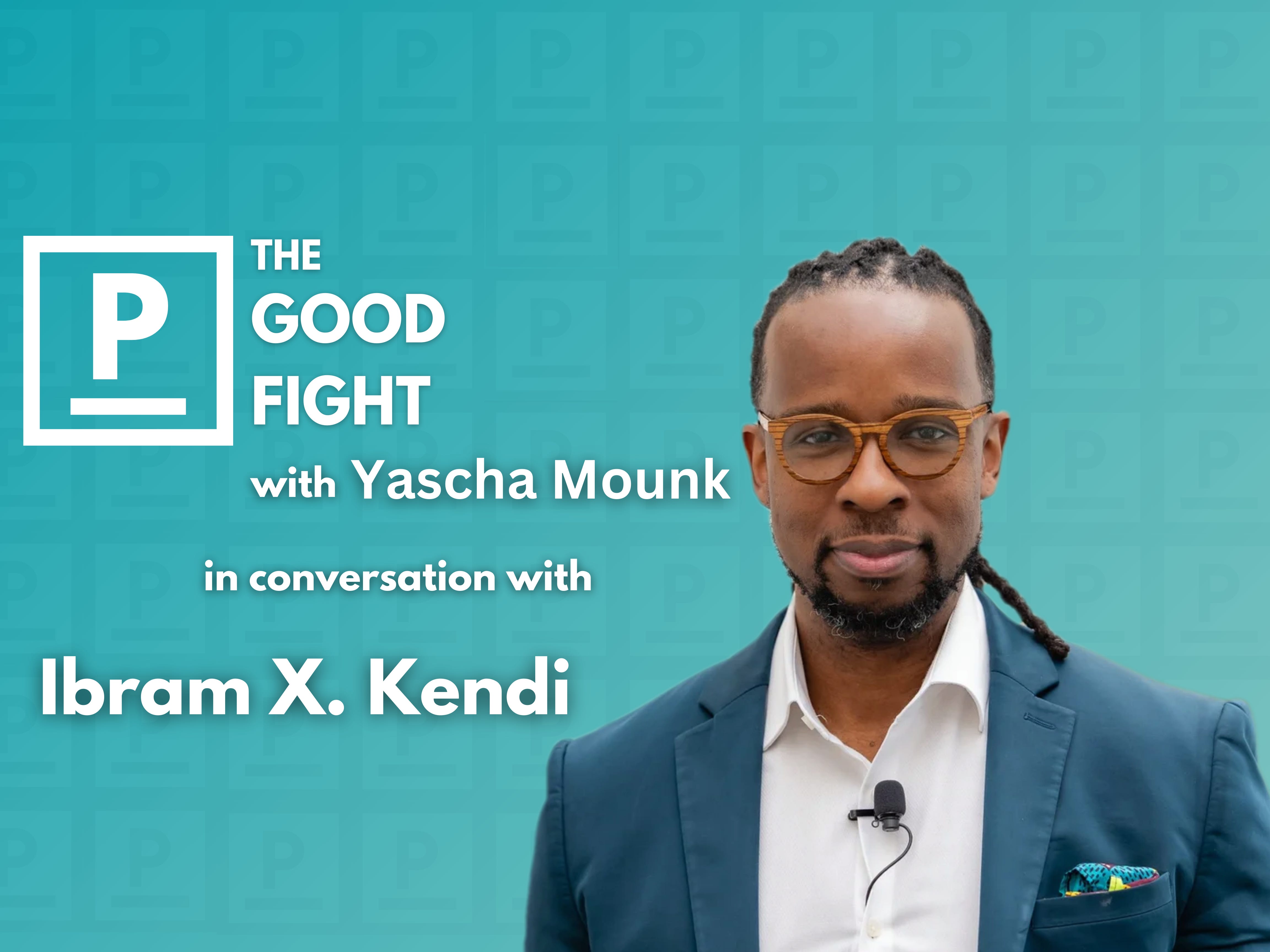
Ibram X. Kendi is Professor of History and the founding director of the Howard University Institute for Advanced Study, an interdisciplinary research enterprise examining global racism. His latest book is Chain of Ideas: The Origins of Our Authoritarian Age.
In this week’s conversation, Yascha Mounk and Ibram X. Kendi discuss whether great replacement theory is the common basis for political movements from India to Argentina, the role of racist policy in different outcomes between racial groups, and how to define equity vs equality.
This transcript has been condensed and lightly edited for clarity.
Yascha Mounk: You have a new book out called Chain of Ideas, which covers an incredible amount of terrain, including political movements from around the world and from different time periods. As the title suggests, you argue that they are connected by one unified chain of ideas. What is that chain of ideas?
Ibram X. Kendi: Well, that chain of ideas in its totality is what’s known as great replacement theory. This theory was named in 2010, but it has been around for several decades. It’s a political theory that suggests that “globalist elites” are enabling people of color to displace the lives, livelihoods, and even electoral power of white people. So, when you hear phrases like “people of color are invading the United States or Europe,” that’s an example of great replacement theory. When you hear notions like “multiculturalism is harming the indigenous, white Christian culture,” that’s great replacement theory. When you hear attacks on defenders of abortion, or on women—particularly white women—who decide not to have children or only have a few children, suggesting they are engaging in “white genocide,” that’s also great replacement theory.
Mounk: Great replacement theory is obviously very influential around the world. There is a conspiracy theory about me in Germany because I gave an interview on a major German television channel when my book, The Great Experiment, came out. People were claiming this was proof that I was conspiring with Angela Merkel to replace the German people. I am well acquainted with the feverish imaginations of people who believe in these ideas.
As an intellectual historian, I always struggle to define the contours of ideas; I wonder where a particular set of ideas ends and a different set begins. In this book, you cover a huge range of different political movements. You include the people who actually coined the great replacement theory and who would call themselves advocates of these ideas, people who advocated for Britain to leave the European Union, and people I would describe as right-wing populists who have ideological differences between them. Why do you think it is helpful to connect them all to this particular idea? Do you recognize any significant differences among people within those political strains?
Kendi: There are tremendous differences in the way great replacement theory manifests in different national or regional contexts, because the demographic makeups, political histories, and organizations of every country are different. In Chain of Ideas, I used a definition that sought to classify great replacement theory as a racist idea. It is a political theory that powerful elites are enabling people of color to replace white people who apparently now need authoritarian protection.
I also tried to show how this theory has mutated in different geopolitical and demographic contexts. It is not just the notion that African immigrants are replacing white Germans. In a country like India, authoritarian leaders position Muslims as replacing Hindus. In a nation like Russia, the Putin administration makes the case that queer people are seeking to replace traditional Russian heterosexual Christian culture. This originally racist and anti-Semitic idea has mutated to justify new forms of Islamophobia, xenophobia, homophobia, and transphobia. It links these different ideological movements into the notion that these disadvantaged groups are not only inferior, but are literally dangerous and coming to destroy you.
Mounk: The idea in your book is that this is one unified political theory, and you trace its emergence to Renaud Camus, a particular French thinker who started on the far left before migrating to the far right. A different way of putting this might be that these are distinct political phenomena arising from a unified psychological force inherent in humans. When Hindus in India insist on majority status and try to redefine a secular nation founded by Mahatma Gandhi into a Hindu nation, they are not influenced by a French thinker from the early 2000s. They are acting within their own local political traditions.
Another way of putting this is that human beings are tribal creatures with a tendency to be generous and altruistic toward the in-group, while easily justifying cruelty and discrimination toward the out-group. What we see in these different phenomena is not one political theory that started in the south of France and spread; it is simply different manifestations of human nature. The goal of decent politics is always to manage that aspect of human nature to ensure it does not take over. Why would you disagree with that way of explaining these disparate phenomena, from Narendra Modi in India to Donald Trump in the United States to Marine Le Pen in France?
Kendi: I do not argue that Camus in particular influenced these great replacement theorists around the world. What I show is that he named a theory that was already circulating in different contexts. Indeed, it has been circulating in global political thought since the 19th century, when colonial thinkers were fearful about what would happen if there were a global decolonization movement. They started to imagine that if global white supremacy did not persist, there would be a turning of the table, and formerly colonized people in Latin America, Asia, and Africa would come and colonize Europe. Renaud Camus and others, whether influenced by him or not, have argued that the “great replacement” is what he calls counter-colonization, which directly connects to that old ideological fear.
In the book, I try to show that Camus merely named an idea that was already circulating and connecting around the world. I then show how those different ideological movements started to organize together, particularly by 2016 and 2017. As they organized, their ideas began to converge while maintaining the specificity of their own national contexts. Regarding the notion that this is natural to humans—that we are tribal creatures naturally suspicious of out-groups and protective of in-groups—I would not necessarily challenge that idea, even though I think there is no evidence that it is inherently natural. There is a tremendous amount of evidence showing that it is a sociological phenomenon, meaning we are socialized to believe it.
We hope you’re enjoying the podcast! If you’re a paying subscriber, you can set up the premium feed on your favorite podcast app at writing.yaschamounk.com/listen. This will give you ad-free access to the full conversation, plus all full episodes and bonus episodes we have in the works! If you aren’t, you can set up the free, limited version of the feed—or, better still, support the podcast by becoming a subscriber today!
If you have any questions or issues setting up the full podcast feed on a third-party app, please email leonora.barclay@persuasion.community
I would emphasize how people come to consider what constitutes an in-group and an out-group. For example, we as human beings have been led to believe that there is something meaningful about the color of one’s skin, but not about the color of one’s clothes. How did we come to think that way? How did we come to think that there is something meaningful about particular religious characteristics, but not about the ways people eat? These may seem like ridiculous ideas, but I am trying to show that political thinkers and actors have long caused human beings to place meaning on certain human characteristics while downplaying others. They play up human differences for specific political gains, and we are seeing that in this moment.
Mounk: I agree with that idea strongly. Whether we think the tendency to draw boundaries between in-group and out-group is natural or sociologically rooted, we agree that human beings are quick to latch onto them. History shows that what defines a member of an in-group or out-group has varied over time; at different junctures of history, different markers determined group membership.
What does that mean for the identity we should construct to keep that tendency in check? My sense is that a sense of patriotism can be very healthy because it provides a common identity to people who stem from different regions, have different skin colors, or follow different religions. Emphasizing that we are both American can keep in check the tendency to organize ourselves around identity lines likely to lead to discrimination and exclusion. There is a tension between recognizing the ways different forms of identity structure society and ensuring they do not lead to persistent discrimination. However, teaching people to make that the primary prism for viewing society and the primary source of identity can create divisions between in-groups and out-groups along lines like race or religion, which are susceptible to exploitation by those we politically oppose.
How are you thinking about the implications of the malleability of these lines for whether schools should teach patriotism or how they should talk to young students about questions like race?
Kendi: I am happy you asked this question because I think there have largely been two answers to it, both of which are equally fraught. One, which I would classify in my work as a segregationist answer, is to say that in a nation like the United States, or even globally, there are separate racial groups. These are imagined to be biological, or in the case of Camus, cultural-historical constructs, but they are viewed as fundamentally separate. Therefore, every person is inherently a member of one of those groups. These thinkers typically position a hierarchy among these groups, claiming certain races are superior or inferior to explain racial disparities. They might argue, for instance, that Black people are more likely to be incarcerated because they are naturally more likely to break the law, and that those who reject this racial hierarchy are unwilling to accept common sense. I reject this position.
The second, more liberal position, rightfully rejects the idea of race as a biological construct, which geneticists have now proven. However, it then takes a step further to argue that since race does not exist biologically or scientifically, no one should identify by race. This view suggests that everyone in the United States should identify only as an American. It posits that when Black Americans identify as such, they reinforce the segregationist position that there is a separate Black race, and that if we stop identifying by race, we will undermine racism.
I also reject this second position because it does not account for cultural and historical differences. Furthermore, scholars and historians have long found that race is not the creator of racism; rather, racism is the creator of race. There is almost no way to eliminate the persistence of racism without identifying the mirage of race. From a statistical standpoint, how would we measure the spread of racial disparities or racist violence if no one identified by race? It is possible for us to identify by race while knowing it does not exist biologically, simply so we have a sense of the spread of racism. We also identify that ethnicity exists and that racialized ethnicities have developed particular cultures we should value in a multicultural society.
Great replacement theorists argue that a society of multiplicity and multiculturalism will lead to one race and culture destroying the others. The response to that is often to deny the existence of multiplicity and claim we are all one, but that erases actual multiplicity.
Mounk: I agree with that idea quite strongly. I reject the two poles you outlined, but I would argue there is a huge amount of terrain in between them. Our differences might emerge in which parts of that in-between terrain we occupy.
When you think about questions like education, one approach a teacher could take is to say that racism exists in the United States, that it has historically deeply structured how this society works, and that it continues to have real influence today. Of course, in order to understand the contemporary United States, you need to understand the existence of different racial groups, and there are good reasons to value the cultural traditions that come with different ethnicities. What is really important is that you—as a six-year-old, eight-year-old, or ten-year-old child—recognize that those things are not the most important in this classroom. We need to create a society where those things come to matter less rather than more. Therefore, we are going to instruct you together. We are going to come down very hard when kids exclude each other on the basis of ethnicity in any kind of way. We are modeling very clearly that, while we are deeply aware of those realities in society, we are trying to eliminate them from the classroom insofar as possible.
The way in which particularly the most progressive institutions in the United States have gone over the last 10 years, including some of the most elite ones, is very different. They have started to create affinity groups which are not just self-selecting. It is not just 15- or 16-year-olds deciding that they want to spend time with each other as an after-school club. They are often mandatory. They often start very young, in elementary school, sometimes in kindergarten. They take those kids at the age of six or seven and, for at least part of a week, they teach them separately. The idea here is laudatory in certain ways; it is meant to make people aware of that history of discrimination and the ways in which they can organize together.
If you agree with me that there is this tendency to form in-groups and out-groups—and actually even more so if you believe it is the society that sends that signal rather than a natural tendency—do you not worry about the way in which that actually teaches these kids? It suggests the most important thing about you is the color of your skin and your belonging in these racial groups. You are actually encouraging these school communities to organize and polarize around racial groups much more than they might under the first pedagogical approach I outlined.
Kendi: I think it’s important to emphasize that it is rare that affinity groups are mandatory, whether in colleges or even schools. Certainly many colleges and schools have created affinity groups, but this idea that they’re generally or mostly mandatory is a myth. Indeed—
Mounk: You think they shouldn’t be mandatory? Would you oppose mandatory affinity groups?
Kendi: Do I think they should be mandatory?
Mounk: Yes, would you oppose mandatory affinity groups?
Kendi: I do not think anybody should be mandated to do anything. You have Black students, for instance, who may go to a college or university having been raised in a predominantly white community, and the culture they learned with their upbringing is certainly not Black American culture. If they go to that affinity group, they are not going to feel that is their place, particularly if that affinity group is organized around Black American culture. No, I do not think it should be mandatory, because I recognize that one’s racial identity may not necessarily connect to one’s cultural practices. Many of these affinity groups are connected to cultural practices.
Alternatively, you have affinity groups oriented toward challenging a particular form of bigotry, such as anti-Black racism, and you have Black people who are reinforcing anti-Black racism. I do not think they should be mandated to join the anti-racist Black group. That Black person at that college would probably feel more at home in the white supremacist group.
The other thing I want to emphasize is that I know very few scholars and writers who study racism—who talk about the importance of Black history and of recognizing and supporting African American culture—who would say that the most meaningful aspect of a person’s being is their race. I have never said that. I have rarely come across a thinker or an activist who would say that. I think that has been incredibly overblown, and I am still looking for the people who actually say it. What people are saying, and what I have said in my work, is that as we move through life, other people look upon our racial identity as the most important thing about us and make determinations based on it. People reject that, and anti-racist thinkers push back on it.
Mounk: In some ways, it is a question of emphasis. You spoke about the college context where people have more agency. If you say it is not mandatory, it is perhaps easier for students to decline to engage in these activities. However, I have heard from many people who showed up at an orientation activity on their first day of college and were told that an affinity group is part of the programming. They felt pressure to join, even when they may have parents from different ethnic groups, and felt they must choose between the identities of their parents. While this may not be technically mandatory, if it is part of a broader welcome activity, it may be quite hard to get out of in practice.
At the college level, I agree that for the most part, people have the agency to opt out. But how do you feel about an institution like the Dalton School in New York? It is only one school, but a very influential one where much of the city’s elite goes. It states that one of the prime purposes of a progressive education is to get children to see themselves as “racial beings.” Like other private schools, it starts affinity groups when children are much younger than college age. Some of these schools have these groups for children who are seven or eight years old. Perhaps at some level these are technically voluntary, but if you are seven or eight and your teacher says, “We are now doing this activity; if you are Black, you go to this group, and if you are Latino, you go to that group,” it is very hard to have the agency to get out of it. Do you think it is helpful to have those kinds of groups for seven- or eight-year-olds, or do you think there is a risk that it might backfire?
Kendi: I wrote a book called How to Raise an Anti-Racist, which analyzed about a century’s worth of scholarship and studies on racial attitudes in children. What that book documented, and what scholars have shown, is that the overwhelming number of educators and parents in this country do not talk to five-, six-, seven-, or eight-year-old children about race, racism, or the history of particular racial groups. This is because it is imagined that the subject is one for which people are too young. It is also generally imagined that a seven-year-old child cannot think that people with dark skin are ugly.
Studies actually show that as early as three years old, in this larger environment where teachers, daycare workers, and parents are generally not protecting children from these racist ideas, kids are connecting skin color to negative and positive characteristics. By the time they are seven or eight years old, according to studies, children have developed the language to start expressing those ideas that connect skin color to negative qualities. Studies consistently show that when kids start articulating those ideas—saying, for example, they do not want to play with a “bad Black kid”—the response from teachers and parents is to say, “Do not talk about that; that is not a subject we talk about.” Those ideas then continue to deepen and spread among our youth with very few people checking them.
When a school decides to take action, it is because we know, according to scholarship and studies, that kids are already making connections between skin color and negative or positive qualities. We need to actively teach them that there is nothing superior or inferior about any racial group. We need to actively teach them that white people do not have more because they are more, and Black people do not have less because they are less. That is making an intervention that responds to the social and cultural environment kids are operating in. Part of that can be affinity group teaching, which studies have shown is particularly effective for white students who are consistently told by their parents that they are colorblind. It can also be helpful for certain Black students who feel more comfortable saying certain things among other Black kids than they do in integrated classrooms. These schools have actually responded to the science as opposed to the politics.
Mounk: I disagree with your reading on the scientific studies and we can go through various ones. There’s a lot of them showing that all manners of diversity training and affinity groups actually aren’t very effective and very often backfire. You can look at the work of Frank Dobbin.
Kendi: Well, those are not the studies that I talked about. The studies that I mentioned are the ones about how as early as three years old, kids are connecting skin color to negative and positive characteristics. Studies have also shown that by six or seven or eight years old, kids are articulating their ideas. Those are the only studies that I’ve cited. And so if you’re saying you disagree with those studies, I’m not stating that diversity trainings, as an example, are incredibly effective. I didn’t make that case. So I just want to just underline that.
Mounk: Well, you were saying that affinity groups are effective, right?
Kendi: I said affinity groups in the context of that form of anti-racist education can be effective, particularly with students like Black students who don’t feel comfortable talking about particularly sensitive topics in front of white kids. There’s all sorts of evidence, particularly anecdotal evidence from Black kids themselves, who say they feel more comfortable talking in the midst of other Black students.
Mounk: You were also saying that they’re effective for white students. I want to make two points. One is that I think you’re running together two quite different things. The first is that there are going to be some racist attitudes that kids imbibe from the environment and may start to have at a relatively early age, and that, of course, teachers should address those, certainly correcting them when they come up. We should also have broader teaching about the effects of race in America, all of which I agree with. I think that’s quite an uncontroversial position, at least in center-left and more centrist spaces. The second thing you’re tying this to is the idea of affinity groups, which I think is a much more controversial idea. So I just want to separate those two things out because on the first one, I agree with you.
Kendi: Affinity groups exist across ethnicity and religion. The idea that Black people, for instance, can’t get together based on a shared culture in history would also presuppose that particular religious groups in which that religion is essentially a culture and a culture derived from a particular history can’t get together either. There’s a way to create a society where we can both acknowledge that there are differences while simultaneously recognizing those differences as equals.
Mounk: Of course, and as a philosophical liberal I believe in freedom of association. Every adult should be free to choose whom they associate with, which obviously includes what we might call affinity groups. The question we are discussing is whether institutions with a lot of authority in society, such as colleges and universities—but also high schools, middle schools, and elementary schools—should be encouraging the formation of these kinds of groups. In particular, should they be encouraging the formation of these kinds of groups when there are children who are too young to have much agency for themselves?
I would distinguish between high schoolers of 16 or 17 years old deciding they want to have some kind of cultural club and teachers coming into classrooms when kids are much younger and doing that. One thing I want to ask you specifically, because you brought up the...
Kendi: So do you think we should abolish religious schools?
Mounk: Well, first of all, I think there is a difference between race and religion in this context. Secondly, again, there’s a question about—
Kendi: Affinity groups are usually based on two ideas: either a shared cultural or historical experience, or they’re typically based on an effort to essentially challenge a particular bigotry that’s affecting that ethnic group or racial group in this context. So in the case of religious schools—
Mounk: Well, I will tell you that I think that—
Kendi: I was sent to a Christian school, a Lutheran school. I didn’t have much agency in choosing that school. I didn’t have much agency in choosing the fact that I had to literally go to service chapel every week. I don’t see any outrage about forcing kids to do that, for instance, and this is not necessarily what affinity groups are doing, but there’s no outrage about that. So that to me doesn’t really make much sense.
Mounk: First, when they are publicly funded schools, I certainly have a strong objection to this. The United Kingdom has publicly funded religious schools, and I think that is a mistake. The state should not be encouraging more separation and division in its pupils. The fact that the state is funding schools for Christians to go to one school, Muslims to go to another, and Jews to go to a third—a policy, by the way, introduced by the New Labour government in the 2000s—is a big mistake. It is a great virtue when students from different walks of life go to school together, are exposed to each other, and learn together. That is much preferable to a system that encourages division on the basis of religion.
I also think the state banning private schools would be a mistake. As I was telling you, when people who are old enough to make those choices for themselves choose to pursue affinity groups, that is a different thing. That is part of freedom of association. What I am talking about specifically is schools where very young kids are divided into those groups.
This is essentially what I experienced growing up Jewish in Germany, where there were confessional religion classes. Those were obviously only for Catholics and Protestants because there were very few people of other religions around, at least at the time. I and the two children of Turkish immigrants simply hung out and did nothing during that time. I think that was deeply alienating. It was not a good system, and I would not want to replicate it in the United States.
My question more specifically concerns the white students and what you think will happen to them. I think the aspiration here is for white students to learn about white privilege and the ways in which society is biased in their favor so they become good anti-racist activists. If you believe that human beings can easily form different kinds of tribes and that they learn from their environment which markers make them part of an in-group, it seems much more likely that the opposite will happen. What you are actually teaching those students is that we live in a school community where the most important dividing line is race. You are showing them that this is how people self-organize.
When people advocate for their interests within this context, they do so on the basis of their racial affinity groups. Consequently, the student learns that the most important thing about them is that they are white. The most important way they will be able to fight for resources or make demands within the school is to organize along those lines. I think we see a lot of evidence of younger white kids, including those in very progressive environments, starting to find the appeal of the alt-right and gravitating toward those ideas. This is partly because they have been raised in an environment that racializes them in that way.
Do you worry at all that these affinity groups might backfire? You either have them hang out and do nothing—as I did because I was not Catholic or Protestant in a German school—or you put them together and say the most important thing about them is that they are white and have white privilege. Do you not worry that it might backfire in those ways?
Kendi: Well, the first presumption of your question is that those white kids, before they entered into that space, were not racialized as white and did not see themselves as white. The idea that a class exercise suddenly caused them to realize they were white is blatantly false.
All sorts of studies document that the most effective form of whiteness education—in which white people, particularly white children, and even white adults, develop their sense of white identity—is by having no education about race and racism at all. Actually, all a white...
Mounk: I agree with you that that’s wrong and we’ve established that, right? So that’s not where we disagree.
Kendi: I just want to establish the fact that the presumption of your question and even the outcome is that this affinity space among white students or even anti-racist education among white students made the student conscious of her or his whiteness and then led that student to become a part of the white identity movement. I just want to—
Mounk: With respect, I think that you’re really strawmanning my position. You want people to choose between either teachers never mentioning race, pretending it doesn’t exist at all, or we separate kids out at the age of eight into these racially separate groups. Now on this question, you’re trying to divide between either my position is nobody knows the color of their skin, 8-year-olds aren’t at all aware of the existence of race, or—
Kendi: I’m just trying to—
Mounk: —all these racial affinity groups are good. I think the sensible middle position that I have is that, yes, of course, teachers should call attention to racism where it exists—
Kendi: So do you believe before they enter into that classroom that those white students have a consciousness and a conception of the fact that they’re white? I just want to ask that.
Mounk: I think that they’re aware, yes, I think they’re aware of the fact that they’re seen as white in society. They’re also aware of lots of other identity markers they have. I don’t think that they necessarily—
Kendi: I just want to get a sense of what you’re asking me based on your presumptions. Cause you stated that my presumption about what you’re stating is wrong. So now I just wanna ask a few questions to get a sense of what your actual presumptions are. So you stated that you believe that those white kids have a sense of their white identity before entering into those spaces. You’re saying that that’s something you do believe.
Mounk: I think that they’re aware that they’re white. I think if you ask an eight-year-old, according to those different census categories, which of those categories do you fall into? I think most of them will broadly give you the “correct answer” of how they would be classified in those census categories. I don’t think that necessarily means that they think of that as their defining feature. I don’t think that when you ask them, describe yourself, what is important about you, they would foreground the fact of their whiteness. My concern is that these affinity groups and the wider culture in some of these schools will teach them that, actually, the most important thing about them is that they are white. I do not think that is going to be conducive to long-term political development.
Kendi: Thank you for underlining that. I think the first assumption, just so I am clear, is that they had a sense that they were white, but they also had a sense of other identities. They did not perceive their whiteness to be the defining aspect of their identity. You are arguing that when they enter into this education, the educators teach them—you are claiming—that whiteness, or them being white, is the defining feature of their identity. Just so I am clear that is your position, am I correct?
Mounk: That as a result of what they are taught, they come to identify more strongly with their white identity because they come to understand that it is the criterion on which they are being separated from the other kids. At the very least, it is like, why am I in this room with these other people? Well, it clearly is important enough that on Mondays at 3 p.m., that is what governs which room I am sitting in.
Kendi: Okay, and then you’re stating that because they then come to see their white identity as their defining feature, they are pulled toward these white nationalist sort of movements. In your mind, it is actually these affinity groups and this education that are causing white students and even adults to ultimately become great replacement theorists. Am I correct? That is your position.
Mounk: Yes, so let me elaborate on that. A, I think that is right for some subsection of our students—
Kendi: I want to reemphasize that you are radically exaggerating the amount of time students spend in affinity groups. In the vast majority of cases, that almost never happens. Would I say there are instances in which teachers ask different racialized groups to sit in affinity groups? Does that happen? Yes. Does it happen often? No. How much time might they spend? Ten minutes, fifteen minutes, an hour. The notion that asking students to do that completely reshapes their racial identity is a pretty amazing argument you are making. Ultimately, I want to state that the argument you are making has no scholarly or scientific basis; in fact, all the evidence points to the very opposite.
Scholars have documented that it is the students whose parents and teachers do not talk about racism, white privilege, or the benefits white people may have as a result of racist policies who are more likely to believe that white people have more because they are superior. They are more likely to believe that immigrants and Black people are coming to harm and replace them. They are more likely to be seduced by a Nigel Farage or a Donald Trump, according to studies. Anti-racist education is actually protective for white students against racist ideas.
I am also glad you asked about white students, because what often happens in these conversations—particularly around affinity groups—is that the decision of whether to have them is dictated almost entirely by what people think is best for white students. There is almost no conversation about what is helpful for Black students. Most of our conversation and most of your concern has been expressed regarding what you think could help or harm white students. Even though studies show it actually helps white students, we have had no conversation about how affinity groups can help Black students. Is that something you are not interested in?
Mounk: Sure, I am happy to talk about that. To be clear, I am not talking about what helps or harms white students; I am talking about how we can contain some of the ideas that you and I are both worried about. My concern about these affinity groups in the context of white students is not that they might be upset or that they may encounter challenging ideas. I know those are common criticisms, but I think being uncomfortable is actually an important part of an education, so I am not as concerned about that.
What I worry about specifically is that we do not want to incentivize white students to embrace ideas that you and I both agree are very dangerous to our ability to thrive together as a society. You are making it sound as though I am concerned about the well-being of these “poor white students,” but I am concerned about the long-term future of our politics.
I want to touch on a couple of other points as well. Explain, if you will, how you’re framing the difference between equity and equality and what your definition of equity is.
Kendi: To me, equity, particularly as it relates to policy, is ensuring that every racial, gender, or class group is not necessarily being undermined by policies that lead to them being less likely to have a particular opportunity. When we have equitable policies, we all truly have equivalent opportunities, equivalent forms of access, and equivalent forms of resources in a democracy.
I would also add that, to think even further, equity is about the groups that have the greatest needs receiving the greatest amounts of resources. Equity to me means that a low-income person is going to pay less in taxes than a billionaire. By contrast, equality from a policy standpoint is that a billionaire is going to pay the same dollar amount in taxes that a low-income person would, which to me is not fair. I think to most people, that would not be fair.
Mounk: I guess I am a little bit confused by this way of framing the issue because there is a long tradition of egalitarian political philosophy, and certainly people who argued for the value of equality in those debates have never been in favor of a flat tax, for example. The idea of higher marginal tax rates for people who earn more money is something that political egalitarians have advocated for for a long time. It is not clear to me that the idea that we should adjust how we treat people based on their circumstances goes in any significant way against the longstanding egalitarian tradition.
The idea, for example, that we are not going to give out wheelchairs to everybody in society, but instead give them to those who have impediments that make it impossible for them to work otherwise, does not really seem to be contradicted by the idea of equality as understood by philosophers like John Rawls or Amartya Sen. But I want to get more specifically at what your measure is of when society—
Kendi: I’m sorry, did I say something that was in contrast to any of that? Because I would agree that we shouldn’t give out wheelchairs to everyone in society, that the people who need accommodations from a society should receive those accommodations. So that’s pretty much what I said. That would be equity.
Mounk: No, of course, I know you agree with that, but the way you are defining it implies that people who believe in equality would not believe in that. What I am saying is that is a kind of strange redefinition of “equality.”
Do you think there are sometimes group differences that arise in societies caused by something other than racist policies? How, for example, do you explain the fact that Asian Americans are hugely overrepresented at top colleges in the United States? Do you think that Asian Americans are beneficiaries of racist policies in ways that white Americans—who are not overrepresented at top American colleges at this point—are not?
In the rest of this conversation, Yascha and Ibram discuss the difference between equity and equality, why Asian Americans are overrepresented in elite college admissions, and to what extent racial inequality is determined by racist policies. This part of the conversation is reserved for paying subscribers…
Listen to this episode with a 7-day free trial
Subscribe to Yascha Mounk to listen to this post and get 7 days of free access to the full post archives.


