




Steve Stewart-Williams is a professor of Psychology at the University of Nottingham’s Malaysia campus and runs The Nature-Nurture-Nietzsche Newsletter. His latest book is A Billion Years of Sex Differences.
In this week’s conversation, Yascha Mounk and Steve Stewart-Williams discuss why women and men are more similar than is often thought and what the real sex differences between men and women are, from casual sex to career choices.
This transcript has been condensed and lightly edited for clarity.
Yascha Mounk: Last time we spoke, you gave a really great introduction to how to think about the influence of evolution on human nature and human psychology. You are now out with a book that speaks more specifically about sex differences and how those are rooted in biology. Let’s go through some of the sex differences that the literature establishes relatively decisively.
One way you break this down is to say some sex differences are just completely dimorphic—women give birth, men do not—while others are more statistical variances. Tell us a little bit about how to think about the kinds of sex differences and what some of the most common ones are.
Steve Stewart-Williams: The new book is called A Billion Years of Sex Differences. I start by listing what I call the standard issue sex differences: a list of very well-established sex differences in our species. As you say, they range from the very large and strictly dimorphic and categorical, to the not-so-large—at the other end, just statistical differences, relatively modest discrepancies in the average scores of massively overlapping distributions.
At the larger end of the spectrum, we generally just have physical differences between the sexes: reproductive differences, the reproductive organs, the capacity to nurse versus not, the capacity to give birth versus not—those are all very large differences. The difference in upper body strength is quite large—actually very large, with very little overlap. There is very little overlap either in voice pitch, so voice pitch is another quite large sex difference.
Moving down the scale, when we are talking about psychological sex differences, the only one that is even remotely in the ballpark of those physical differences is the sex difference in the primary target of sexual attraction. Most men are primarily attracted to women, most women are primarily attracted to men—there are exceptions, of course—but nonetheless, that is a very large psychological difference. It shows, I think, that natural selection can create large levels of dimorphism.
Mounk: That is interesting, because in the first category—and we are certainly not going to get into the whole trans debate for purposes of this conversation, we are talking about biological sex—men can produce sperm, women can produce eggs. Those are just completely different biological processes: strictly dimorphic. Here, we are talking about how most men are attracted to women and most women are attracted to men, but then there are these subcategories of men who are strongly attracted to men and women who are strongly attracted to women. So that is a very different kind of distribution.
Stewart-Williams: It is a different kind of sex difference. Even though people attracted to the same sex are exceptions and a minority, they are not a trivial minority—there is a non-trivial number of exceptions. Whereas that is not the case for the first sex differences I named.
Mounk: Not to go down a rabbit hole, but a lot of people are going to have in their mind this idea of a Kinsey scale—that actually most people fall somewhere on a long spectrum between complete heterosexuality and complete homosexuality. So it’s not that most men are attracted to women and then some significant percentage of men happens to be very attracted to men, but rather that we all fall somewhere along that spectrum.
Is that compatible with modern science? Is that something that scientists today believe? How does what you are saying fit onto that kind of model of the Kinsey scale?
Stewart-Williams: I was thinking of the Kinsey scale when I framed the exact wording. My exact wording was that most men are primarily attracted to women, most women are primarily attracted to men—so that accepts the fact that it is not uncommon at all for there to be some degree of attraction to the same sex among people who are primarily attracted to the other sex.
There are differences in the degree of attraction to each sex that individuals have. One thing is that people often understand it to mean that there is a spectrum and that people are distributed fairly evenly across it, whereas you do actually have clustering toward the two extremes of the continuum—that is, primarily attracted to the other sex versus the same sex. That is especially true with men. With men you get quite strong clustering, either primarily attracted to the other sex or the same sex. With women, the distribution is a bit more even across that scale.
Mounk: So if you are picturing the scale from left to right, there is one big mountain on the left—attraction to the opposite sex—and then a smaller mountain on the other end of the scale, primarily attracted to the same sex, and then in between are all kinds of people who fall at all kinds of points, but those are not going to be big local maxima?
Stewart-Williams: That is exactly right, with just the one proviso that there are fewer men in the in-between category than there are women in the in-between category.
Mounk: So the peaks are going to look higher for men than for women for the same reason. Interesting. That was the second kind of category. The third category is where most of the interesting debates lie. The first category—the biological differences—is relatively straightforward and uncontested. The second category is super interesting and important, but perhaps applies to slightly fewer characteristics. A lot of the things that we really have big social debates about fall into the third category: is it true that men have an innate attraction to certain kinds of professions, to certain kinds of socializing, to certain kinds of ways of thinking about the world? All of that contested stuff lies in the third category—minor statistical differences that might nonetheless make a really significant impact on the world. So tell us about those.
Stewart-Williams: That is exactly right. The vast majority of psychological sex differences in our species are in that third category—statistical sex differences, or what I call fuzzy sex differences—where you have differences in the average of highly overlapping distributions. A big part of the reason there are so many debates about it is because they fall awkwardly into a middle ground where a lot of them are small enough that you can question whether they actually exist, but large enough that they trouble us. So they sit in that awkward middle ground where you can deny them, but they also have real-world effects to some degree.
They span a range of different magnitudes as well. Among the larger ones, you mentioned career-related interests—that is actually one of the larger sex differences in this category. There is usually about a standard deviation difference between the mean for men and the mean for women in career-related interests.
Mounk: Can you explain for lay listeners what that means—both in terms of how strongly a different professional preference drives professional choice, and roughly how big an effect a standard deviation is?
Stewart-Williams: On average, men tend to be more interested than women in things—how machines work, mathematical and formalized systems, impersonal subject matter—and more interested in careers involving those things. Whereas women on average tend to have a greater interest in people, how people work, and in people-related professions: professions that involve helping and interacting with people.
We hope you’re enjoying the podcast! If you’re a paying subscriber, you can set up the premium feed on your favorite podcast app at writing.yaschamounk.com/listen. This will give you ad-free access to the full conversation, plus all full episodes and bonus episodes we have in the works! If you aren’t, you can set up the free, limited version of the feed—or, better still, support the podcast by becoming a subscriber today!
If you have any questions or issues setting up the full podcast feed on a third-party app, please email leonora.barclay@persuasion.community
The difference is about a standard deviation between the means for the two scores, which is considered to be quite a large effect size. There is still a great deal of overlap. What it would mean in practice: if you were to choose two people at random, one man and one woman, for interest in things—where men score higher—there would be about a 70% chance that the man would score higher than the woman, and about a 30% chance it would go the other way. The converse holds for interest in people: in about 70% of randomly chosen pairs, the woman would score higher than the man, but there would still be a very non-trivial minority of cases where the man scored higher than the woman.
Mounk: That is, I think, a little bit of what makes this awkward. Let’s cash this out with this relatively uncontroversial example, and then we can think about how it applies to more controversial ones.
What you are saying is that in the literal sense, stereotypes about this are right. There is a stereotype that men love their machines and their tools—they go into the man cave and potter around in the workshop—and that women gravitate toward more social professions, or, pejoratively, gossip, or whatever. You can make a negative caricature of each, or a positive one. The positive version: the man likes to build things and get things done, and the woman loves to be a connector in the neighborhood, making sure people are doing well and cared for. Or you can put a negative spin on each: the man locking himself away in his workshop, or the woman engaging in mean-girl gossip behavior. The point is that this is a stereotype we hold in society, and what you are saying is that there is some real empirical grounding for it.
And yet, of course, if you apply that to everybody—if you were hiring at an engineering firm and said, well, this is a female applicant, surely she does not actually like machines—you would not only be perpetrating an injustice towards that woman, but you would very often be wrong. A good number of women are interested in these kinds of things, and among women who are actually applying for such a position, probably most of them are.
Stewart-Williams: That is exactly right. A lot of stereotypes are on the right track—at the very least they are a response to something real. The danger is in exaggerating the magnitude of them, which is what you are doing if you say: this is a woman applying for a male-typical job involving machines, it is just impossible that she could be interested in them or good at working with them, and vice versa for men applying for people-related jobs. You would be exaggerating the strength of the sex difference.
I think that is a big reason why people are nervous about talking about sex differences: they worry that people are going to do exactly that. They worry that if there is any acknowledgement that there is some truth in these sex differences, people are going to misunderstand it, blow it out of proportion, and that it will become a justification for—or a cause of—discriminating against one sex or the other. I do take that concern seriously, and in the book I discuss it as something we genuinely need to concern ourselves about.
Nonetheless, I think it is really worth exploring this topic for two reasons. One is that whether we like it or not, there are average differences between the sexes in many different areas, and we cannot simply lie about that. The second reason is that even though there are dangers in talking about sex differences—dangers associated with exaggerating them and moralizing them—there are also dangers in the converse: in minimizing them, ignoring them, and moralizing the absence of sex differences instead. The only responsible solution to that conundrum is to look at what the data say, try to convey it accurately, and talk about sex differences carefully.
Mounk: Motivate where the dangers lie. The danger of the first kind of error is relatively straightforward: I am a hiring manager at an engineering firm, an excellent female candidate applies, and I say, well, she is a woman, she is not really going to want to be doing this kind of job, and I do not hire her even though she is an excellent, well-qualified candidate. That is a very straightforward danger. Where does the danger lie in not talking about these sex differences?
Stewart-Williams: There are quite a few, and there are actually other dangers with exaggerating sex differences as well—for instance, if we develop a mental image of what men and boys are supposed to do and what girls and women are supposed to do, we might pressure people to fall into stereotypical definitions of the sexes, which is bad for people who do not fit the norm.
Mounk: That is obviously related, but slightly different. In the first case, I am a hiring manager at an engineering firm—I may have no belief that it is wrong for women to want to be engineers. It would be great if women were super into engineering, but sadly not all of them are, so I am not going to take this candidate seriously. Now we have moved to a slightly different thing: because there are some statistical sex differences in the world, that is in fact what men and women should be like. So now let’s say I am a dad and my daughter is interested in engineering—well, that is not for you, you should really study psychology. Here we have moved to the danger of ignoring the is-ought distinction.
Stewart-Williams: There are dangers with exaggerating and moralizing sex differences, as I just mentioned. But there are converse dangers with minimizing sex differences and moralizing the absence of sex differences. One of these is directly symmetrical with the problem of trying to force men and women into traditional gender roles: there is a danger of trying to force them out of those roles—of not accepting the fact that, although there will always be exceptions, some people are simply going to fit with gender-typical norms, roles, and preferences. People sometimes have a tendency to think that that is a bad thing, a product purely of sexism, or—if it is their own kids—to feel guilty that they have done something wrong in parenting because their child falls into typical patterns: boys engaged in rough-and-tumble play, girls loving pink and dolls. That is one danger.
Another is that if we ignore sex differences in career-related preferences, then when we find discrepancies in the sex ratios of different professions, we will assume it is one hundred percent due to discrimination and sexist socialization. While it is very probably partly due to those factors, it is not necessarily—and not even likely to be—the case that they are the only causes. Given that men and women do have, on average, these different preferences, it seems very likely that part of the reason we have different sex ratios in some professions is a result of those statistical differences in preferences. In fact, given that those different preferences exist, it seems very unlikely that they would not be one of the causes of the differences.
Mounk: There seems to be some preliminary evidence that men are not just more interested in tools generally, but also more interested in a specific tool: artificial intelligence. If that turns out to be the case, at a moment when it seems very likely that AI is going to fundamentally reshape our society, is that going to be to the detriment of women? Are we entering a technological age in which professions that many women occupy—like human resources—become relatively less lucrative, while professions involved in creating these new AI systems, in which men continue to be overrepresented, come to dominate?
Stewart-Williams: That is a very interesting question, and I think it is possible. One reason it is not necessarily going to turn out that way, though, is that the interface between people and AIs is quite a social activity—it does not feel like tool use in a traditional sense. You are interacting with something verbally; it can feel quite social.
I was recently at the How the Light Gets In festival at Hay-on-Wye, and I met a few people who work in AI. One was looking at how AI can be used in the medical sphere—that is Charlotte Blease, who is very interested in applying it there to help people. In that area, you might actually find a predominance of women over men being interested in the question. Someone else I met was very interested in the use of AI for psychotherapy—again, a field where women currently predominate over men. It is possible that if AI moves into that area in a big way, there will likewise be a predominance of women over men in AI applications of psychotherapy.
Mounk: Let’s make a simple prediction. If you think that professional choice is really down to socialization and social pressure—informal prohibitions on men becoming hairdressers or women becoming engineers—then you would expect that the more gender-egalitarian a country is, the less pronounced those gender differences in professional choice would be. So you would expect that in a more traditional society like Egypt, there would be a large difference, with very few women becoming engineers and very few men becoming hairdressers. And in Sweden, or whichever country is relatively gender-egalitarian, you would expect those differences to be relatively more minor. My understanding is that that is not in fact what the evidence shows.
Stewart-Williams: Your understanding is correct. I would have made that same prediction before I saw the data. Even accepting that there is an innate contribution to preferences, I would have thought that in cultures where people are treated more differently and gender roles are stricter, sex differences would be even bigger—so if there is an innate contribution, it would be amplified—and then smaller in more gender-egalitarian, more individualistic, and wealthier societies where people are freer to pursue their own interests.
But as you say, there is this phenomenon called the gender equality paradox, which reflects the fact that for many traits, including career-related preferences and job choices, it is the exact opposite: the more gender-equal, wealthy, and individualistic a nation is, the larger those sex differences become rather than smaller. Very counterintuitive.
Mounk: Really interesting finding. I had an interesting episode that touched on that with Alice Evans on the global gender paradox, among other things.
One of the things that makes these conversations often unproductive—and I think this is true not just of this conversation but of many conversations—is that different people have different audiences in mind, and that drives them to talk about things in slightly different ways. Let me give a totally different example.
A lot of social science disciplines, like sociology, love to make the move of saying: this thing actually turns out to be socially constructed. I find that useful for an introductory undergraduate class, in the sense that a lot of 18-year-olds come in thinking that something like the United States Constitution is a God-given thing that is objectively correct and beyond question. To say: these are particular people who built this at a particular moment—brilliant people doing something important, but with their own shortcomings and blind spots—is a helpful corrective. I am not sure how many 18-year-olds still arrive at college with that kind of naive view, but I can see where it comes from. There is a danger, though, in over-inflating what it means for something to be socially constructed, which is a general pet peeve of mine, and also in making your whole academic career invested in pointing out that this or that thing is not natural or God-given—speaking to an audience that already agrees with you.
I think something similar happens when people talk about gender differences. A lot of people, for understandable reasons, think: there are stereotypes and prejudices in society that coerce men and women into gender roles and obstruct women from advancing in certain professions—that is really what we need to be on the lookout against. From that perspective, writing a book about sex differences seems actively unhelpful. Then there are others who say: the mainstream has become so concerned about that real danger that it has overshot the mark and gone in the other direction, producing all kinds of other confusions—and that is what we should be setting ourselves against. We can call these alpha bias and beta bias. Talk us through that.
Stewart-Williams: Those are not my terms, but they are very useful ones. The alpha bias is the tendency to exaggerate the magnitude of sex differences, and the beta bias is the opposite—the tendency to minimize, downplay, and perhaps deny them. There is quite a strong tendency toward the beta bias in media and academia, in the mainstream and among the chattering classes. The alpha bias is perhaps the historical starting point, and it does exist in some small areas of academia and probably journalism as well. I would have to say the tendency to exaggerate sex differences sometimes exists in my own field of evolutionary psychology—perhaps because we are responding to the beta bias we find elsewhere in academia, and it may have swung to the opposite extreme to some extent.
What I am trying to do with the book is respond to both, critique both, and walk a happy medium between the two. I would love to think that people on both sides will agree and perhaps come to a truce—but of course another possibility is that I will simply annoy people on both sides of the debate. That is nonetheless what I am trying to do: strike a balance.
Mounk: Let me pose the question so we can address this directly. To make things more complicated, you then add two further biases—the gamma and the delta bias. What are those?
Stewart-Williams: The gamma bias is the tendency to highlight sex differences that put women in a better light than men, while downplaying those that put men in a better light than women. I think it is a response to historical anti-female sexism—basically an attempt to set right the reverse tendency, where differences were highlighted in ways that cast men as superior and women as deficient. It is a kind of overcorrection that aims to be protective of women.
The delta bias, on the other hand, is a tendency to highlight and favor sex differences that go in the opposite direction to traditional sex differences. For instance, devoting everything to your career and placing family lower down the list might be frowned upon if a man does it, but celebrated if a woman does it. Sleeping around is sometimes considered a bad thing if men do it, but a good thing if women do it. I think that is a response to traditional social norms.
Mounk: That reminds me of one of the very early viral internet controversies—the Duke “Fuck List,” if you remember that. A senior at Duke University had made a joking PowerPoint, styled like a senior thesis, about all the men she had slept with in college. In a way you can see how it was a fun, charming idea, though the slides themselves were quite demeaning and objectifying—ranking all of these men in various ways. Some people thought it was a mean way to interact with and write about other people. But Jezebel and the early internet feminists defended it as a great act of female empowerment. It was obvious that the same people, had it been a man ranking and grading the genitals of women he had slept with in similar ways, would have found it to be terrible. But because this was typically something men did and not women, when a woman did it, it was considered empowering.
Stewart-Williams: That is a good example of the delta bias, and also a good example of where I think it comes from—different standards are applied because of the history, because it is turning the tables. Those are the four biases that I think make the discussion harder and make it trickier to research and talk about sex differences without it getting heated. There are these biases and preferences that people have for what kind of sex differences they want to see or not see.
Mounk: We have done a lot of the preparatory ground for thinking about how to approach these questions. Let’s go a little deeper into how we should think about particular sex differences in light of all this. Why don’t you tell me the three most juicy ones we should talk about for the next twenty or so minutes?
Stewart-Williams: How about the sex difference in interest in casual sex, in choosiness about sexual partners, and in aggression?
Mounk: Let’s start with casual sex.
Stewart-Williams: The difference here—and you will be very surprised to hear this—is that on average men are more interested in casual sex, no-strings-attached sex, and sexual variety than women are. That is a pretty big difference as human sex differences go. Depending on exactly what you ask about, the difference is about 0.8 of a standard deviation between the means for men and women, with men scoring higher. To use the analogy of plucking two people at random, one man and one woman, for that sex difference you would find about two thirds of the time that the man would be more interested in casual sex than the woman. Again, there is a significant minority where it would be the other way around. So it is a real sex difference and it is pretty substantial as human sex differences go, but it is not quite as big as people sometimes make it out to be.
This raises an interesting point about sex differences in general: even when you have a sex difference that is fairly modest at the mean, when you go out to the extreme of the distribution, the difference will typically get a lot bigger. If you go out to the extreme of the distribution for interest in casual sex, you will find that even though it is about 0.8 or one standard deviation at the mean, out at the extreme there are many more men than women. I think a lot of our stereotypes come from thinking about those extremes rather than about people closer to the mean.
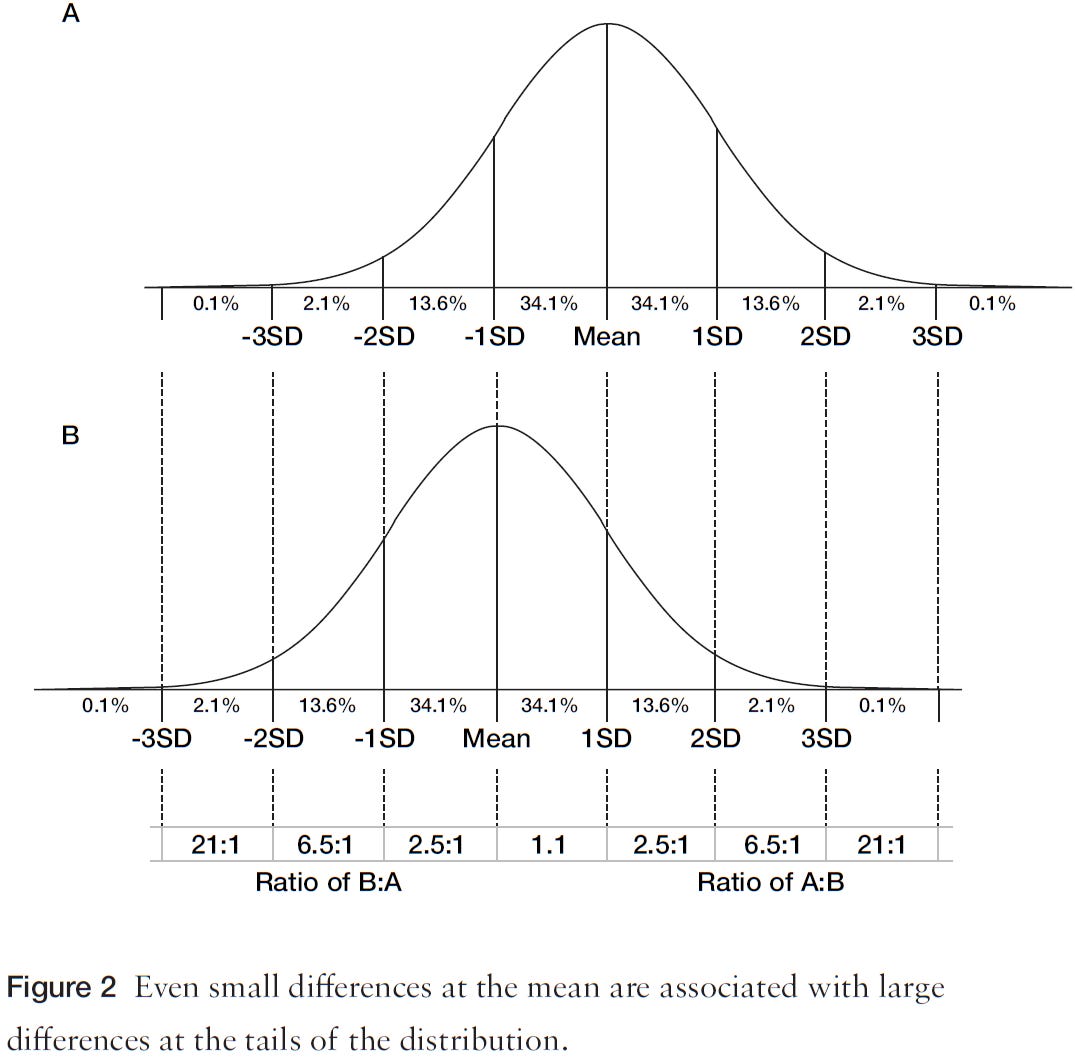
Mounk: It is just a function of how normal distributions work. If you have a relatively small difference at the median—where the top of the distribution is—that relatively small difference can mean that once you are three or four standard deviations out, where you are talking about people at the extremes—the most or least intelligent, the most or least interested in casual sex, the most or least violent—that small difference in the mean can translate into a four, five, or tenfold difference at those extremes. Now that we have established those statistical properties, how does that shape social behavior—and things like casual sex in particular?
Stewart-Williams: It is often going to be the case that men are pursuing casual sex to a greater extent than women are. One mistake people often make when they hear about that sex difference is thinking that the claim is that men are more interested in casual sex whereas women are more interested in long-term relationships. But actually men and women have similar levels of interest in long-term committed relationships—it is really only within the domain of casual sex that we find this sex difference.
There are actually two differences here. One is that men are more interested in casual sex on average. The second is that when it comes to casual sex and low-commitment relationships—and also early courtship—women tend to be choosier about their mates: choosier about who they are willing to have a short-term thing with.
Mounk: On the first topic, before we get to mate choosiness—what do lesbian and gay relationships tell us here? Obviously there may be ways in which lesbian women’s sexual behavior differs from heterosexual women’s, and gay men’s sexual behavior differs from heterosexual men’s—not just in terms of the object of attraction, but presumably this is at least a suggestive field of study: what happens if you take two people with male sexual preferences and put them in a relationship together, versus two people with more female sexual preferences in a relationship together? Obviously there is going to be a huge range, from very monogamous gay couples to very open ones. But do we see systemic differences between lesbian and gay couples, and what does that tell us?
Stewart-Williams: We do see differences, and they stem from the fact that in same-sex relationships, people are not having to negotiate with the preferences of the other sex. They can typically express their own preferences to a greater degree, with less compromise. Looking at the sexual behavior of gay men and lesbians can therefore provide a clearer window into the sexual preferences of men and women in general.
What you find is that gay men typically engage in a lot more casual sex than straight men, because they are interacting with other men who typically have similar preferences. Lesbians, on the other hand, typically have less casual sex than straight women—again, because they are not having to accommodate the average preferences of the other sex. It fits very nicely with the idea that there are these average differences between the sexes when it comes to interest in casual sex, and it is a good piece of evidence for that idea.
Mounk: You were saying that men do not necessarily have less interest in long-term committed relationships, but they do have a much greater interest in casual sex. If you just know those two things, you would predict that you would end up with a lot of couples that are open to each partner having casual sex—which is certainly not the universal norm among gay couples, but is true of many of them.
Stewart-Williams: It is true of more gay couples than straight couples. In straight couples, some men do want that, but sexual jealousy often gets in the way—a man might think: it would be great if I could sleep with other people, but I do not want my partner sleeping with other people, so I will content myself with monogamy. That seems to be less often the case with gay men. I am sure many do fit that description, but there do seem to be more gay couples where jealousy is not quite such a big issue as it is in straight couples—that is the impression I have, anyway.
Mounk: Just to up the level of intrigue here—I have read, though I am not sure if this is true, that there are significantly higher rates of divorce among lesbian couples than among gay couples. Why is that?
Stewart-Williams: I have read the same thing—there are good data on that. Why that is, I am really not too sure. It could be a selection effect, or it could be related to the fact that among straight couples, around two thirds of divorces are initiated by the woman rather than the man. Maybe it is an offshoot of women’s greater choosiness about their mates—our next juicy topic. But I am not a hundred percent sure about that.
Mounk: Let’s go to choosiness about mates. Two things here are striking. The first is that evolutionary theory would suggest that women are choosier about mates than men because they invest more in offspring—if only through pregnancy, and often well beyond that. That is true throughout the animal kingdom and is true for humans as well. The other thing that is often forgotten—and you will have to remind us of the Greek designation for it—is that actually the difference between the two sexes in humans is relatively smaller than it is in most other animals in this regard.
Stewart-Williams: At least for long-term relationships it is smaller. When we think of women being choosy and men being not choosy, that has some truth in the short-term context.
Mounk: So at 2 a.m. in a club, the man is happy to go home with whatever woman, but the woman says: even though I might enjoy casual sex, I am still going to be quite picky. But when it comes to long-term relationships, suddenly the men become picky too.
Stewart-Williams: Both sexes tend to be pretty picky in long-term relationships—and maybe similarly picky. So you get the alpha bias, the exaggeration of sex differences, when it comes to the long-term context. It is a general truth, actually, that sex differences in sexual psychology are a lot smaller when it comes to long-term committed relationships than to short-term relationships, casual sex, and early courtship. It is in early courtship and low-commitment relationships that the sex differences are a lot bigger.
Mounk: Is this a challenge for evolutionary theory? Or is it simply downstream from the fact that humans procreate in very different ways from most other animals, because they invest in offspring for so much longer?
Stewart-Williams: It is not a challenge to an evolutionary perspective—I think it fits very nicely with one. According to the evolutionary perspective, the greater female choosiness we see right across the animal kingdom follows directly from the fact that female animals in general invest more in each offspring they produce than male animals do. Because they invest more, they can have fewer offspring in their lifetimes. Males, on the other hand, typically invest less in each offspring, and therefore in principle could have many more offspring than any female could. That creates different selection pressures on both sexes, and produces a range of traits in males that increase their chances of being one of the few males that has many offspring, rather than one of the many males that has none or just a handful. That is where most sex differences come from: the difference in the maximum offspring number each sex can produce.
We have some of the same thing in our species, but because of the great dependence of our young, we have evolved a reproductive system where we fall in love, form pair bonds, and engage in high levels of biparental care—much higher than you see in most mammals. When males are investing heavily in their young as well as females, that reduces the sex difference in the maximum offspring number each sex can produce. It brings down the ceiling number of offspring that men can produce—a few exceptional historical examples notwithstanding—and as it brings it down, it has led to the evolution of reduced sexual dimorphism in our species. One area where that is evident is in the sex difference in choosiness.
The sex difference in choosiness is a result of females investing more, but in a long-term context both sexes are typically going to be investing quite heavily—in the relationship and in any offspring that result from it. For exactly the same reason that females evolved to be choosy when they can only have a relatively small number of offspring, men likewise evolve to be choosy in a context where they are only going to have a relatively circumscribed number of offspring.
Mounk: I once leafed through a book arguing that when we compare humans to other animal species, we fall somewhere towards the middle of the range on the extent to which we are wired to be monogamous—that some species are strongly monogamous, and many species, perhaps most, are not monogamous at all.
When you look at a whole set of physical characteristics of humans, they tend to fall somewhere in the middle between those extremes. The book was arguing that we are semi-monogamous, and that this is how to think about us and how to explain a lot of conflict in social life—the fact that we have both a tendency towards pair-bonded long-term committed relationships and a tendency beyond that. Do you find that a helpful way of thinking about this topic?
Stewart-Williams: We have a strong tendency toward pair bonding and biparental care, but it is not like gibbons or some birds. We also have an interest in sexual partners other than our main partner, which is not uncommon, and that nudges us toward arrangements other than strictly monogamous pair bonding. Men have a desire for sexual variety—some members of both sexes do, but men typically have a stronger desire for it—and that sometimes translates into polygyny, where one man has more than one partner. Pair bonding is the most common relationship type found in basically all human societies, including polygynous ones. Even in societies where men can take more than one wife, it is a minority activity. It is not like gorillas, where a male either has a harem of females or is a bachelor—with humans, most men who have more than zero mates have only one. There are a small number who have multiple mates. Pair bonding is our main reproductive approach, but we are very flexible and do all sorts of other things as well.
On to the third topic: aggression. At least when it comes to direct or face-to-face aggression, men on average do more of it. That includes verbal aggression, where the effect size is medium—about half a standard deviation between the means for men and women, so not a massive sex difference. But as you go up the scale toward more intense forms of aggression—physical violence, pushing and shoving, more extreme forms of physical violence—the gap gets bigger and men come to predominate more. At the extreme of one-on-one violence, which would be homicide, men predominate massively: around ninety percent of homicides worldwide are perpetrated by men. Only a minority of men commit homicide, but among those who do, it is massively skewed toward men.
When it comes to indirect aggression—the mean girls phenomenon, gossip, spreading rumors, where you are trying to harm someone but not to their face—we find either no sex difference, with both sexes doing it about evenly, or we find it is slightly more common among women than men. But for most forms of aggression, men predominate.
Mounk: There is another area where stereotypes seem to hold up to some degree. When you talk about the extreme forms of violence, that difference is very obvious in the statistics and easy to understand—men are more likely to murder, more likely to be soldiers, more likely to be in criminal gangs, and prisons are much more full of men than women. But when you are not talking about the extremes, when you are talking about people towards the middle of the distribution, how big is that difference in standard operating procedure? Is it that the average man is not particularly violent, but perhaps once or twice in his life has gotten into a small scuffle at a bar? The average woman is not particularly violent, but when she engages in social aggression, it takes the form of rounding up a few people to ostracize somebody in the friend group they have a grievance with?
To what extent are those stereotypes about the middle of the distribution true? Is that a helpful lens for understanding society? As an evolutionary biologist and psychologist, do you feel like you can watch Cruel Intentions or whatever high school movie and check off the behaviors—that your training helps you understand what is going on in ways it would not for someone without it? Or do you think it does not in fact illuminate social reality in that kind of way? Is the alpha bias or the beta bias more tempting here?
Stewart-Williams: That is a good question. I think with low-level aggression the alpha bias comes in more, and people exaggerate. People are maybe a little surprised when they hear that the difference is not larger for verbal aggression and the like. The way you describe it is pretty accurate for modern Western societies: most men are not especially aggressive—they may get into an occasional scuffle over the course of their lifetimes, or more commonly the odd verbal altercation—and likewise women are not especially aggressive either.
Women may have as many verbal aggressive interactions, but with less of a sense that there is a physical threat and that it could turn into actual violence. I think that is accurate in the West. We have successfully tamed our aggressive impulses to quite a high level in the West, and in other and more traditional cultures there were higher levels of violence—especially among men. Culture brings it out more in some contexts, while simultaneously suppressing it somewhat in modern Western populations, which I personally think is a good thing. I imagine most people would agree. It is an example of a case where we have a natural tendency that society pushes against—but it is a tendency that is generally a bad thing, so it is a good thing that we are able to engineer unnaturally low levels of aggression.
Mounk: One benefit of thinking about the world in evolutionary terms is that it helps us see where the dangers lie for society. One very fundamental insight from evolutionary biology and evolutionary psychology is the human tendency to split into in-groups and out-groups. You could fall into the naturalistic fallacy and say: therefore we should encourage people to stick to their tribe and hate the other. But we have learned from history that that is a disaster. The whole point of civilization, the whole point of building positive institutions, is to mitigate the impact of the in-group and out-group tendency. The way to do that is to channel it—not to deprive people of any outlet for it, but to redirect it.
That is why you have sports rivalries in high schools. That is why, if you think of Harry Potter, you split a boarding school into different houses so that they can compete with each other. There are dangers with that—sometimes they come to blows—but the main point is to make people within each house aspire to work hard and take pride in it. The city of Siena is split into around twenty contrade—parts of the city that compete against each other in a huge horse race—as a way of instilling solidarity within each neighborhood. They hate each other and compete fiercely, but it has historically strengthened Siena’s ability to work together as a whole, because it instills a strong civic identity. In terms of aggression, you might think sports work similarly: when you are playing American football, rugby, or even a less violent sport like basketball, that is a way of channeling aggression into something socially non-harmful.
Stewart-Williams: A way of, as Freud would have said, sublimating those potentially destructive desires. I think that is true and interesting. When you study the fact that we are so prone to in-group and out-group biases, evolutionary biology and psychology, rather than saying it is natural and therefore good, can equally well puncture it. You might genuinely think your in-group really is great and that the out-group really is terrible. But if you realize that we have this built-in tendency in human nature to divide the world into in-groups and out-groups, it can make you challenge that. It can make you think: maybe I am just falling prey to this evolved illusion, and it is not actually true that we are superior and angelic and they are genuinely terrible and demonic.
In the rest of this conversation, Yascha and Steve discuss how society should respond to sex differences, why there are more female double threats than male ones, and to what extent certain disciplines being dominated by men are due to sex differences versus discrimination. This part of the conversation is reserved for paying subscribers…
Listen to this episode with a 7-day free trial
Subscribe to Yascha Mounk to listen to this post and get 7 days of free access to the full post archives.


