


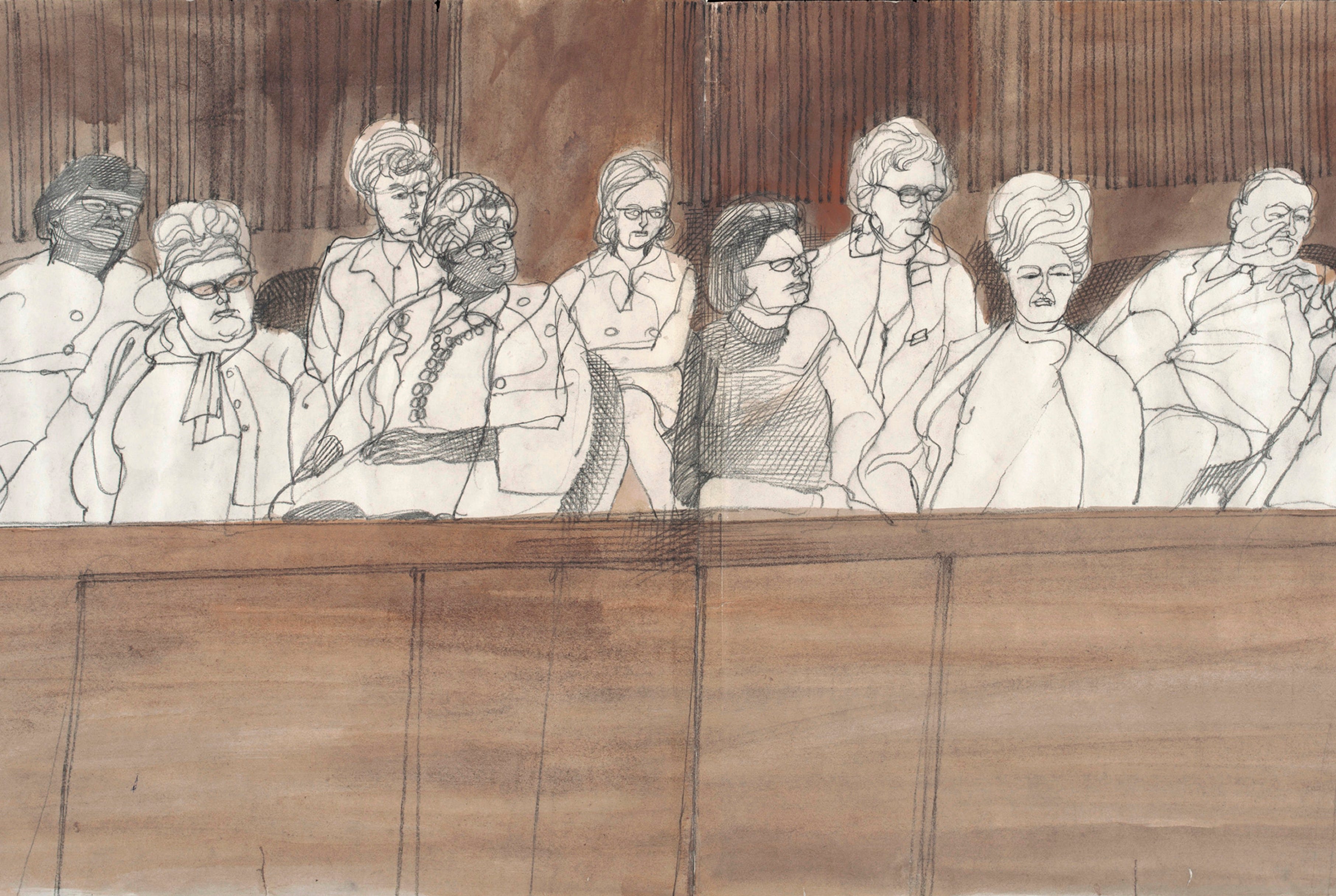
A couple of months ago, I received an official letter from the District of Columbia with the words JURY SUMMONS printed atop the envelope in big, intimidating letters.
I have been an American citizen since 2017. But so far I have never been called upon to perform this particular duty bestowed by American citizenship. The historical purpose of the right to a trial by a jury of one’s peers was to ensure that an out-of-control executive could never turn the criminal justice system into a tool to augment its own power; at a time when the Department of Justice, adorned with a giant banner of Donald Trump’s face, is attempting to prosecute a number of his critics on spurious grounds, the relevance of this tradition feels far from abstract.
So, one Wednesday morning in February, I dutifully trudged to the Superior Court of the District of Columbia at nine in the morning. It was the first mild day after a few brutal winter weeks. As the sun was rising high into the sky, the snowbanks that still marked the city’s streets were starting to melt. In the distance, I could make out the cupola of Congress.
It was hard to know what to expect. As a political scientist, I know all kinds of facts about the jury system but have never seen a jury in action. Would I serve as a juror on some minor civil case or some spectacular murder trial? And would they even want me to serve? Both prosecutors and defendants can strike a number of potential jurors from the pool simply because they have a hunch that they may not be favorable to their case—and professors, suspected by the prosecution of being overly progressive and by the defense of being overly smartalecky, are often among the first to be voted off the island.

At the entrance to the courthouse, I joined the first of many lines I would be standing in that day. As I made my way through an airport-style security check, I spotted one well-worn sign noting that the wearing of masks was no longer mandatory and another which exhorted visitors to the court not to wear gang insignia or expose their underwear.
Once inside, I made my way up to the fourth floor and caught the first glimpse of my peers: a long line of people waiting to prove their identity and receive their juror cards. There is something strange about seeing a statistical average manifest in the flesh. I realized that I had, in my life, looked at countless polls and sat through numerous focus groups. But never before had I actually been part of that statistical abstraction: a group of average Americans.
It turned out we all had something in common: young and old, dressed in the grey suits favored by the city’s well-heeled lobbyists or the sneakers and sweatshirts worn by its poorer residents, most (but not all) of us were staring at our phones. A long-faced Asian woman wearing a bright pink shirt was one of the few to raw-dog reality, staring into space without any form of entertainment. A single prospective juror, a white lady in her late 50s, was reading, her paper copy of The New Yorker turned to a short story called “The Heat of the Moment.”
A short video, based on the findings of the “implicit bias test” (which has, I couldn’t help grumble to myself, been widely debunked) was playing on loop. “It’s pretty well settled that most biases happen at an unconscious level,” the chief justice, Milton C. Lee Jr., an elderly black man with a fastidiously trimmed grey beard and a benevolent tone of voice, explained.
“At the beginning of this video we all saw the chief justice,” a chipper young woman seconded in the cadence of the devout. “The truth is that we all immediately judged him.” What judgment, I wondered, had I unwittingly passed on the chief justice? That he takes pride in his appearance and, after a long day at the courthouse, likes to sit back in a large armchair with a small tumbler of fine whiskey?
When it was finally my turn to enter the office, a court clerk checked my ID, then handed me a lanyard with a sign that read Petit Juror and bore the number by which I’d be known for the remainder of the day. The next stop was the “juror’s lounge,” which turned out to be a giant waiting room, with about ten rows of forty chairs, all facing towards the front.
Want to hear me in conversation with leading thinkers of our time? Sign up for ad-free access to full episodes by becoming a paying subscriber today!
To listen on your favorite app, click “Set up podcast” below. Once your personal link is properly installed, you should see “PREMIUM FEED” in the top-left corner of the podcast icon. If you are having trouble setting this up, please email support@substack.com.
After an hour, a court official announced over a tinny intercom that a jury was about to be convened. She would call some of us by our names and the last three digits of our juror numbers. After a couple dozen other people, I finally heard something resembling my name: “Moo… Mou… Muuunk? 063.” I looked at my card to verify that she meant me, picked up a new piece of paper which had the number 23 written on it, then lined up along the back wall, wedged between jurors 22 and 24.
When our little troupe of fifty or so would-be jurors was complete, we were marched, single-file, into a windowless courtroom. The AV system was playing a loud background hum of static. The defendant, a young black man accused of driving without a license and fleeing the police, and his wizened defense lawyers, sat to the right. The prosecutors, a man and a woman, both fresh-faced and surprisingly young, sat to the left. Jurors one through 14 took a seat in the jury box; the rest of us, still arranged by number, sat in the public gallery.
For ten long minutes, the whole courtroom was silent. Then the static suddenly cut out; the judge composed his face into a benevolent smile and turned towards us. Judge Jason Park, an Asian-American man in his mid-forties who had (I later learned) been nominated for his position by Donald Trump, explained that the American justice system is founded on the “belief that regular folks in the community have the experience and intelligence to make these judgments and make them well. This truly is government of the people, by the people, and for the people. Whether you are selected or not, I hope you leave today with a sense of having served your civic duty.”
Judge Park administered an oath to us, then started to read a long list of numbered questions. Had we heard anything about this case? Had we ever been arrested for a felony? Did we have any relatives who had been to jail? If the answer was yes, we were supposed to write its number on our juror card. Like me, Juror 24, an elementary school teacher in her twenties who was sitting to my right, handed in a blank sheet. Juror 22, a black woman in her forties with a friendly demeanor and a tired face who was sitting to my left, had, I saw out of the corner of my eye, written down three or four numbers.
Judge Park asked Juror 1 to step forward to a microphone positioned in front of his dais. The lawyers put on headphones, and the static noise returned. We all watched as one juror after another was called up to give answers we couldn’t make out to questions we couldn’t hear. I glanced at my phone and realized it was well past noon.
Some jurors spent ages answering questions about themselves before returning to their seats. Others were up there for a grand total of sixty seconds. Juror 22, the woman who had written various numbers on her card, answered questions for at least five minutes. Finally, it was my turn. By this stage, I had endured so many earnest lectures about the importance of jury service that my ambivalence had disappeared: I really wanted to be picked.
Was there, Judge Park asked in his benevolent demeanor, any reason why I wouldn’t feel able to consider this case without prejudice? “No, your honor,” I said, the customary honorific feeling strange in my mouth, as though I were reciting lines in a movie.
“What do you do for a living?” the judge asked. How, I wondered, could I answer this question in an honest way without inspiring either the defense or the prosecution to blackball me? “I’m a professor of political science,” I said.
“What is your work about?” the judge asked.
“Um, I have written a lot about democracy in the past,” I said, groping for words that would be accurate yet sound innocuous. It occurred to me that it would be rather ironic if being a scholar of democracy should get me excluded from this most democratic of traditions. “My current project is about artificial intelligence,” I added, tentatively.
“Thank you very much,” the judge said. “You may take a seat.” I had barely been up there for thirty seconds.
A few more people were called up to answer questions about themselves. Then the static cut out again, and the judge told us that we would need to come back after lunch.
The elementary school teacher and I got lunch together at a nearby deli. “I really hope I don’t have to serve,” she told me over pastrami sandwiches. “The kids would be really upset if I’m not in school for Valentine’s Day.” But, she said, she wouldn’t be picked anyway: “My colleagues told me that they never select teachers.”
When we returned to the courtroom, all trial’s protagonists were already inside, standing in a show of respect for us as we returned to our earlier seats. The static cut out again. Everybody who was still in the room, Judge Park explained, had been found constitutionally eligible to serve. Now, both the prosecution and the defense would be allowed to strike ten potential jurors from the pool for any reason other than protected characteristics such as their race or religion. “Please don’t take it personally if you are struck. I myself have never been selected to serve on a jury.”
There was much passing of papers between the defense and the judge, and between the judge and the prosecution. Finally, Judge Park’s voice cut back through the static: “Juror number 4. Please vacate your seat and stand at the back of the room.” One by one, the judge asked five of the people seated in the jury box to get up from their seats. Evidently, they had been blackballed.

Then he started to go through the first people seated in the gallery. “Juror number 16, please take the fourth seat in the jury box.” I did some quick math in my head and realized that my juror number would likely be low enough to be promoted to the jury if neither the defense nor the prosecution had nixed me. To my surprise, I felt my heart starting to pound. “Juror 22, please take seat 11.” The lady sitting to my left stood up and took a seat in the jury box. She had no visible reaction to being selected, but her face looked to me a little more tired than it had before.
If I were to be chosen, they’d have to call me next. “Juror 26, please take seat 12.” I had not been chosen. Nor had the elementary school teacher. We looked at each other, and I tried to match her smile of relief. But all I felt was a pang of disappointment.
Then I remembered what Judge Park had said earlier: Even though I wouldn’t actually help to decide the fate of the defendant, I had still served my civic duty. Earlier, that had sounded a bit hokey; now, it rang true.
The whole day had, in a sense, been a waste of my time. I had stood in a never-ending succession of lines, and spent hours playing on my phone, only to be dismissed for reasons that would never be explained to me.
But that is not the main lesson I took away from the experience. When I first arrived in America, I was in awe of the country’s institutions, from its courts to its universities. Today, it can feel as though many of these institutions are in a state of terminal decline—failing to do their jobs, run by incompetent loyalists, increasingly distrusted by the general public.
A deeply ordinary day in a deeply ordinary court reminded me that this collapse is not yet total: There are still judges who perform their duties with great professionalism; lawyers and clerks and security guards who take genuine pride in their jobs; and ordinary Americans willing to take upon themselves the awesome responsibility to sit in judgment of their peers. While the civic fabric is rotting rapidly, it is made of ample and sturdy cloth. As I emerged back into the sunshine and took a walk down the National Mall, trying to dodge the puddles of melted snow, I looked upon the glistening cupola of Congress with a little more optimism about my adoptive country than I had been able to muster that morning.
My first time being called to jury duty was also in New York City, about 22 years ago. I had a similar experience. Shuffled about, not picked, but also feeling like I was “bearing witness” to something profound. A truly civic process. Humbling.
A few years later, in Los Angeles, I actually was picked. A unique, treasured experience. Just hearing 11 other people doing real, live moral reasoning, with actual stakes. People step up to the plate. It’s beautiful.
Two years ago I was a litigant in an 8 day trial at the federal courthouse in Greenbelt, MD. The experience was profound in many ways. One thing that struck me during the process was the dignity of the jury. I’m sure few if any wanted to have their lives upended for 8 days sitting on a jury. But during my 7 hours of testimony under oath I saw that they were all paying attention and took their responsibilities seriously. The questions that came out of the jury room during their deliberations also testified to their diligence. I was also struck by the etiquette of everyone in the courtroom standing when the jury came in and went out - a deserved gesture of respect. I came through the experience with a greater respect for the process and appreciation for this service that the government and my fellow citizens provide.