



In January, I received an email from Klaus Schwab, the German professor who in 1971 founded a meeting of European business leaders in a small Swiss village town that quickly became the premier meeting place of global elites. As the founder and longtime head of the World Economic Forum, Schwab held enormous convening power; and with a series of books and contributions, advocating first for the concept of “stakeholder capitalism” and then for a “great reset,” he also aspired to set the agenda for the statesmen, business leaders, and dignitaries who converged on Davos every January.
Schwab wrote to me about a new book he had just published, called Restoring Truth and Trust. It was, he told me, “part of my broader series aimed at helping a global audience understand and respond to the profound changes shaping our societies, economies, and institutions.” Its aspiration was to “contribute to essential global discussions—particularly among thought leaders like yourself—on how we can collectively rebuild a foundation of truth and trust that is so urgently needed across public, private, and civil society institutions.” He wondered whether I might have any comments or reflections on the book, or even, “if you feel inspired, a short endorsement or blurb.”
Instead of offering a blurb, I decided to invite Schwab onto my podcast. In his role at Davos, he had helped to shape, or at least to midwife, the global order which is now suffering an unprecedented crisis. Given the themes of his book, he seemed open to a genuinely searching conversation about which elements of this order were worth preserving, which others in need of jettisoning—and what responsibility the elites he knew so well might have for our current travails. I was greatly looking forward to the conversation, and approached it the way I do most of my podcasts: I was determined both to give Schwab an opportunity to present his ideas in the most compelling possible way, and to interrogate them critically.
A few questions in, it became clear that the conversation was not going well. Whenever I mildly pushed back at some point he was making, Schwab looked visibly annoyed. After about twenty minutes, he suddenly broke off the conversation, saying that he had a migraine. After giving Schwab time to recover, a member of his team stepped in and requested that we reschedule the conversation, which we were happy to do in the circumstances.
Naturally, we gave Schwab’s team many opportunities to resume the conversation. We offered numerous options for when we could record the rest of the conversation, and invited them to suggest a time that would work for him. But after a few back-and-forth exchanges, it became clear that his team had no real interest in doing so. Eventually, they openly admitted as much, writing that “Professor Schwab has decided that he does not wish to continue with the podcast.” They also asked us multiple times not to release the part of the conversation we did record.
Some podcasters consider it a kind of trophy when a public figure like Schwab walks out of an interview because he does not like the line of questioning. I don’t. The point of my podcast is to facilitate genuine conversations across ideological differences. In the 437 episodes I have recorded so far, I have sometimes experienced moments of genuine tension, and perhaps occasional flashes of hostility; but not a single guest has ever walked out of a previous recording.
Given the nature of my questions, I must admit to being even more bewildered by this turn of events. Schwab has for decades been in one of the most influential positions in the international firmament of power and influence. None of the questions I asked were posed in the spirit of a gotcha question. Are some of the most powerful people in the world really that allergic to basic intellectual scrutiny?
But don’t take my word for it. Instead, read (or better: listen) for yourself.
—Yascha
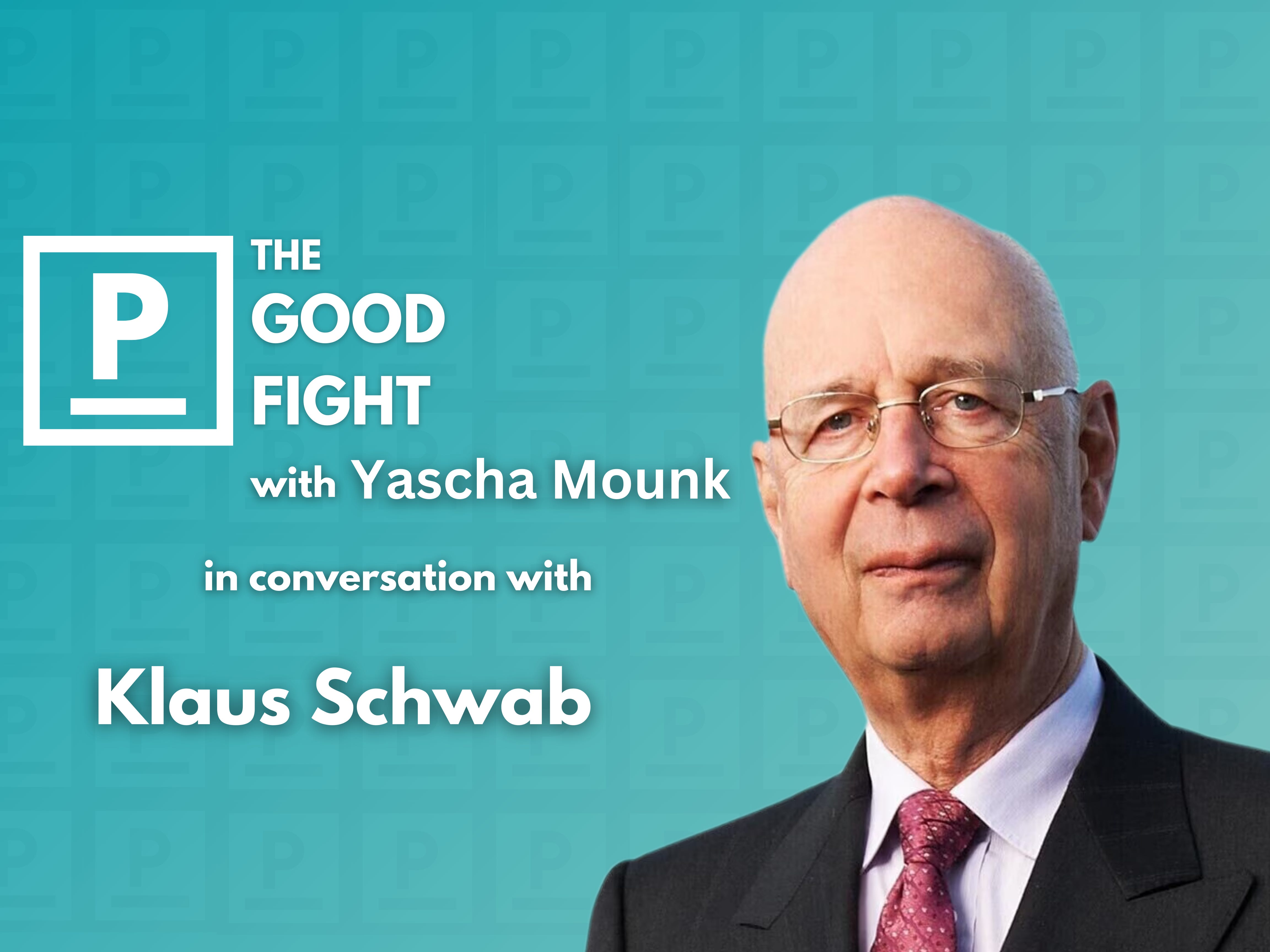
Klaus Schwab is the founder and former Executive Chairman of the World Economic Forum. His latest book is Restoring Truth and Trust.
In this week’s conversation, Yascha Mounk and Klaus Schwab discuss whether the principles underlying global cooperation can survive today’s political upheaval, how democratic institutions can respond to rising populist movements without appearing tone-deaf to voters’ legitimate grievances, and what stakeholder capitalism means in practical terms for corporate decision-making.
This transcript has been condensed and lightly edited for clarity.
Yascha Mounk: You founded one of the most important organizations in the world, the World Economic Forum, that is really a meeting ground of influential people in the world. We live in a strange time in which the political assumptions we’ve had about the world seem to be crumbling around us. There was a lot of talk about that at the last meeting in Davos. How do you see this moment? Do you think that the broader set of ideas and assumptions on which the World Economic Forum was founded are going to prevail through this moment? Or do you think that it’s the end of a political era and many of the ideas that you’ve advocated for over the course of your career?
Klaus Schwab: We are certainly going through a very dramatic period of change. When I look back and I look at the values on which the forum was created, it was particularly the stakeholder capitalism concept, which means that business also has a responsibility for society, and the concept of global cooperation.
I think those two values and those two principles are more important than ever before, even in the new context of today, which I call the Intelligent Age. If we look at current technological trends, we have a more globalizing world, not a deglobalizing world. We just need to adapt our standards, our patterns and so on to the new forms of globalization. Some people call this “re-globalization,” but I say “neo-globalization” or “intelligent globalization.”
Mounk: What is the role of democracy in this? You’ve spoken about a trilemma that underlies how we deal with changes in the world, in which you argue that globalization is in some core ways irreconcilable with democracy and the nation state. What do you mean by that trilemma—and which part of a trilemma should we choose if we have to give up one of the three important values that constitute the trilemma?
Schwab: I think there is a dilemma particularly between the need to act fast and the need to be very flexible and adaptive. The new speed of change requires this adaptability. On the other hand, we have our much-loved democratic systems which have a tendency to function in rather a slow way. So we have to find a balance here. I do not have a solution, but my home country of Switzerland is a very important example. We have to make sure that citizens feel that they are part of the process of determining policies and how to confront the change we are facing.
Mounk: That sounds very good, but I do think that there’s a fundamental question in this moment, where we’re trying to understand why it is that these populist forces are rising around the world, in the United States, in Brazil, in India, but also of course in Europe, with Reform ahead in Britain and the Rassemblement National leading in polls in France and the AfD leading in some polls in Germany.
In Switzerland, of course, the SVP is very strong. One of the key drivers of this is the feeling that the preferences that ordinary citizens have have been ignored by decision makers for a long time, that the demands of globalization and other things have in some way taken precedence over their preferences and priorities in the local context. So how do we deal with the evident displeasure that a lot of citizens have with the current systems in a way that preempts what seems to be the natural tendency at the moment, which is that they say, if you don’t listen to us, then we will vote for these people, and they’re willing to blow up this order in a much more radical way than the new countenance?
Schwab: I think the key, which I described in my latest book, Restoring Truth and Trust, is that people feel they’ve lost control over what’s happening in the economic, social, political, technological and environmental fields. There are so many factors which have to be digested at the same time. If you ask the question why, I think there is now this lack of common understanding of what is the truth. We have, particularly with digital media, different interpretations of truth, so there is no common objective evaluation of developments anymore.
This leads, of course, to what I describe in my book as erosion of trust. If you want to attack this issue, I think the first question should be, how do we make sure that we establish again a common basis of truth? I come back again to Switzerland. With the referendums and with the process which we have around the vote about each of the referendums, I think that although people are exposed to different ways to look for the truth, in the end they find at least some common ground. This means that the political erosion of trust in this country at least has not progressed as fast as it did in other countries.
Mounk: That’s really interesting. I think it shows a particular kind of vision of what the problem is. You’re saying that there’s a lack of trust in our institutions and that the reason for that is that there’s not a common basis of truth. So in a way that implies that people are wrong to mistrust institutions, right? That it’s a misperception of the world. Now I think that one response from a lot of the voters for these movements and parties would be to say, hang on a second. I look at the last 25 years and what do we see? We see the Great Recession brought on by bad economic management. The euro crisis brought on by a flawed infrastructure, and a flawed structure of a single currency. I see 2015 and the refugee crisis, and politicians making decisions that ignored what most people wanted. I see a global pandemic in which institutions like the Centers for Disease Control in the United States, which were founded on the promise that they’re going to be able to contain and respond to those kinds of pandemics in an efficient way, are flailing and making poor decisions.
In fact, that mistrust isn’t downstream from misinformation or downstream from the inability of the media to control the narrative, it’s downstream from the fact that these institutions just aren’t living up to the role and that they’re actually making mistakes.
Schwab: It’s easy to criticize. Let’s take the pandemic. We were certainly unprepared despite, let’s say, many warnings. So we had to find our way, and certainly mistakes were made in this respect. No government system is perfect, I think. Even if you look back on your own life, and if I look back on my own life, I certainly can enumerate a certain number of mistakes I have made. So, making mistakes is common in decision making.
The problem is now that everybody has a choice of what truth he wants to adapt for himself. That of course leads to a vicious circle. You choose your truth, you want to have a reconfirmation of your truth, and so you dig a hole into which you fall more and more. This creates this tremendous polarization of society.
How you describe the situation sounds very pessimistic. Of course we had all those setbacks, but finally if you look, for example, at the global crisis at the end of the 2010s. We suffered, but we overcame it. In my opinion—and of course, that’s the mantra which I have followed for 55 years in my life—what is needed are two things. It is to think more in strategic terms, which allows us to foresee such crises much more. Second, nobody alone can solve those crises. We are living inside a system which is interdependent. So dialogue among the leaders of the different nodes in the system is absolutely essential. That’s what I have devoted my life to.
Mounk: Let me stay with this for just one more moment, and then I want to make sure that we talk about stakeholder capitalism and other contributions that you know you’ve made. I guess the question is how do more moderate political parties, and political movements, among which I certainly count myself, try to respond to this political moment? My concern about the frame of misinformation or disinformation, about telling people that they simply haven’t really understood reality, that they’ve been misled, is that it just feels like a strategy in which you try with increasing irritation to tell voters the same thing you’ve told them before.
Joe Biden’s administration in the United States insisted that the economy was great when voters felt that it wasn’t great. That’s what led to Donald Trump getting re-elected. I worry that if the message that people take from this conversation, from your work is that, yes, there have been some mistakes, but really in the end, everything is fine. In order to stem the populist rise around the world, we simply have to somehow change the media ecosystem and make sure that there’s not that much misinformation and get people to see that we were right all along—that just feels tone deaf at this moment. It feels like it is likely to exacerbate the populist revolt that we’re seeing rather than to stem it.
Do you really think that if the next candidate for chancellor in Germany, whether it’s from the Christian Democrats, or the Social Democrats, or the next Labour leader, whoever comes after Keir Starmer, who’s likely on his way out, runs in the next election and says, the problem is just that we don’t have a right basis of truth. If you’re all upset, you’re just being overly pessimistic about the state of our institution—as you just told me—and just content yourself with the things that are going well. Do you think that has any chance of actually averting the people who intend on destroying this order and any limits on responsible capitalism, destroying the important national institutions from NATO to the EU, which I agree with you are worth preserving? Are we going to be able to stop them from winning?
Schwab: Yes, I would come back to one of the principal issues which we have, because the world has been becoming much more determined by short-term thinking in how we react to crises. For me, the question is, what is the ideology or the philosophy which is behind it? What are the frameworks of values with which we should approach the tremendous challenges which we have in front of us? I have been very much committed and formulated probably as the first person to develop this concept of stakeholder capitalism. I’m using it as just one example of taking a much more principled approach to the issues and not just to react to specific crises. Stakeholder capitalism means that a business has to serve not only shareholders—of course at the core is always the entrepreneurial activity and entrepreneurship which creates wealth. But at the same time, a company is part of society and has to take care of societal partners. Currently there’s a conflict between those two concepts—shareholder capitalism and stakeholder capitalism. I think this is the wrong approach in the long term. We need, of course, stakeholder responsibility.
At the moment, for example, people lose confidence and trust in companies because they see that companies serve only the shareholders and come back to a pure shareholder-dominated policy instead of embracing the stakeholder concept.
Mounk: Let’s talk about stakeholder capitalism for a moment. The idea that companies should be responsible for something other than maximizing the profits over the short run is very appealing. It’s appealing because companies might have a broader social responsibility to the environment around them. It’s appealing because, in fact, there’s some reason to think that that’s going to serve the company’s own long-term interests better than trying to maximize quarterly earnings for the next call with Wall Street analysts.
However, the problem with the concept of stakeholder capitalism is that it is very open to interpretation of what exactly it is that companies should then be pursuing. Which stakeholder is being consulted? What considerations take priority? Who’s making decisions about that? When you have shareholder values, it’s very clear what that means—the metrics are clear. With stakeholder value, the metrics are rather less clear. What do you think companies should prioritize when they are making those decisions? Who should they consult with? What are the criteria? Help us understand in slightly more concrete terms what it means for companies to actually pursue stakeholder value.
Schwab: I’m very sorry that I have to stop. I have such a migraine. I have difficulties understanding you and also the connection is not good. I think we have to rearrange. I’m sorry. Give me five minutes to relax so we can see whether we can continue.
If you have not yet signed up for our podcast, please do so now by following this link on your phone.
Email: leonora.barclay@persuasion.community
Podcast production by Mickey Freeland and Leonora Barclay.
Connect with us!
X: @Yascha_Mounk & @JoinPersuasion
YouTube: Yascha Mounk, Persuasion
LinkedIn: Persuasion Community


