

By Tom Ginsburg.
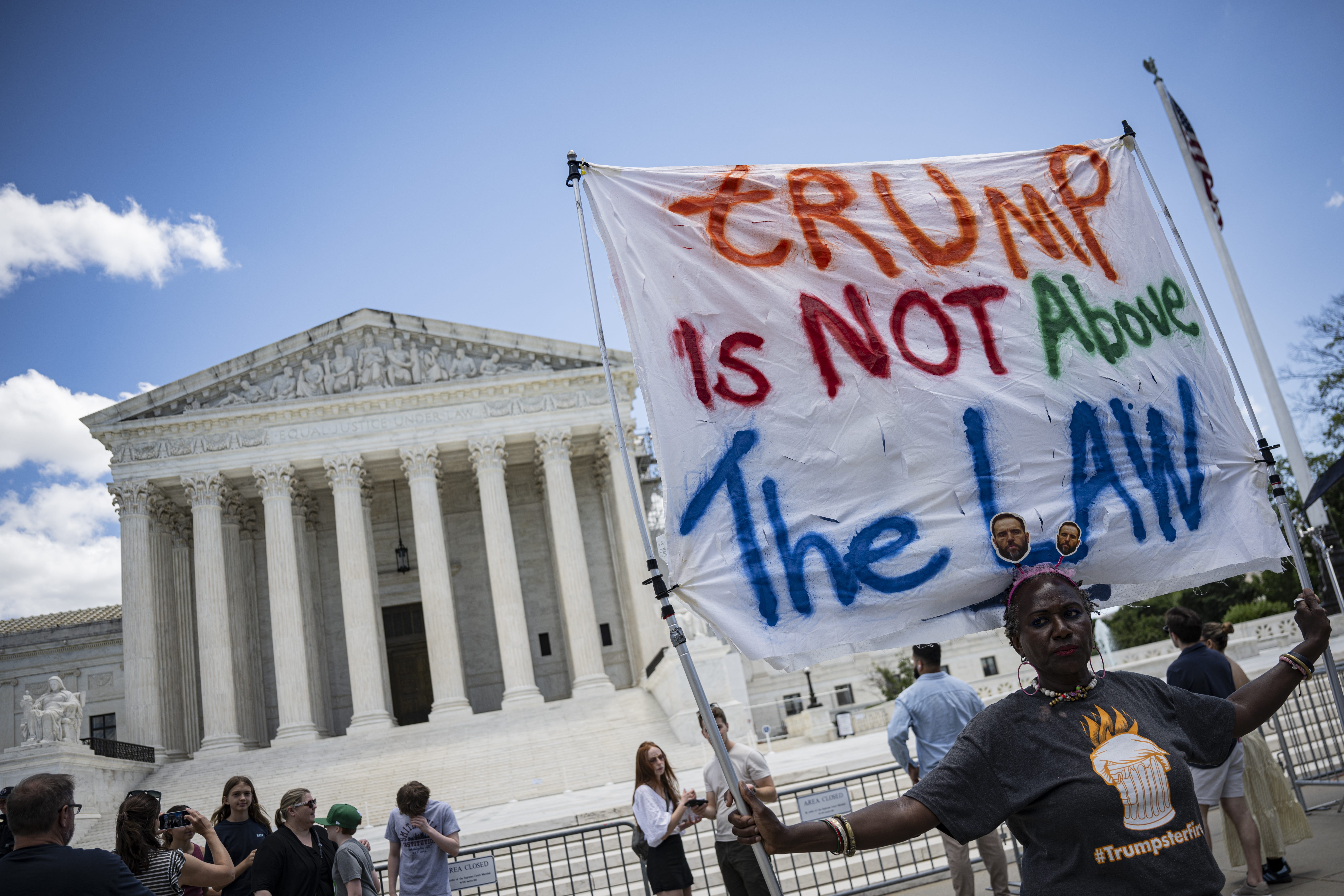
On Monday, the Supreme Court capped off its bombshell term with an attack on the rule of law. In Trump v. United States, the Court articulated a broad new law of immunity for ex-presidents that will significantly impede accountability and invite corruption. While some immunity for a president is a good idea, the breadth of immunity created by the Court goes too far, and we may soon feel the consequences.
In 2023, when a grand jury convened by Special Counsel Jack Smith charged Trump with conspiring to overturn the 2020 election, the ex-president and his lawyers responded by claiming that a president has absolute immunity for all actions taken while in office. This was the central issue that we needed an answer to in Trump v. United States. In answering it, the Court laid out a three-part framework for approaching claims of immunity.
First, it ruled that for actions in the core zone of the presidency’s constitutional powers, ex-presidents have absolute immunity from prosecution. This would cover things like the veto power, the pardon power, and the power of recognizing foreign governments.
Second, for actions in which presidents exercise powers according to law, but which do not fall within core constitutional powers, the Court ruled that ex-presidents have presumptive immunity. This is not an absolute immunity, but a functional one, and it means they are immune if their actions are determined to be official. The Court described this zone in expansive language.
Third, for purely private actions, the Court ruled that there is no immunity. Because the distinction between official and unofficial action is a factual one, the Supreme Court remanded Trump’s case back to lower courts for further hearings, in order to decide whether his alleged actions regarding the 2020 election were official or not. But this almost certainly delayed the case until after the November election. If Trump wins, he’ll end the case upon taking office in January.
Why is the Court’s judgment worrying?
On its face, the basic distinction between official and unofficial acts makes sense. Other countries’ courts, notably the UK House of Lords in the prosecution of Chilean ex-dictator Augusto Pinochet, have made a similar distinction between official and unofficial acts. But the UK notably declined to create any category of absolute immunity. The Supreme Court therefore articulated a broader standard than recognized in international law.
The Supreme Court also acknowledged that some of Trump’s alleged actions may not merit immunity. The president has no constitutional role in communicating with state officials about the election process, for example, and so potentially could be subject to judicial process. But the Court also stated that in communicating with federal officials or the public, the president is presumptively immune. Thus, Smith’s allegations concerning Trump pressuring Mike Pence to overturn the election result, or inciting the January 6 mob, cannot be part of the basis of a prosecution.
Another problem arises with what the Supreme Court said in remanding the case back to lower court. In trying to draw a line between official and unofficial conduct, the Court instructed, lower court judges cannot inquire into presidential motives. Nor can official acts be considered in evidence in inquiries into the motives for allegedly unofficial conduct. This means that investigating presidential misconduct will be much more difficult in the future, as any evidence relating to official acts will be inadmissible.
Under these standards, how far could a president go without facing punishment? The dissenting opinion by Justice Sotomayor made much of the threat that a president may be able to sell presidential pardons without facing consequences. This is hardly a far-fetched scenario. Remember Bill Clinton’s pardon of Marc Rich, whose wife had made substantial donations to Clinton charities and to Hillary’s Senate campaign? The opinion in Trump v. United States practically invites such behavior.
Abuse of the pardon power is hardly the worst of it, though, since a pardon is an individual-level action that rarely if ever impacts the national interest. Suppose, hypothetically, that a future president invokes his commander-in-chief power to cut off arms to Ukraine, and then recognizes Russian sovereignty over the Donbas, all in open exchange for a large deposit to his business bank accounts. Since these actions clearly fall within the core of the constitutional power of the presidency, they would be immune from legal investigation or punishment. Similarly, under the Court’s standards, the president could order his Attorney General to engage in specific prosecutions of his political enemies, or else be fired. The Court has essentially authored a how-to-guide for the use of public power for private gain, allowing the president to abuse their powers.
This all raises the stakes of presidential elections and the importance of character as a key quality in choosing candidates. But does it mean the end of the Republic?
Probably not. Ultimately, the rule of law depends not on one man, but the actions of those around the president. Presidential immunity does not extend to his supporters, who might still be prosecuted for obeying a patently illegal order, even if the leader issuing it can maintain immunity. Our system of federalism is a protector of liberty in this regard. Even if a president now enjoys broad personal immunity from both federal and state prosecutions, his helpers are potentially punishable in 51 different jurisdictions, so there is the ever-present chance of local accountability. Other consequences of misconduct can follow as well. Defendants who are lawyers can lose their ability to practice law: The provisional disbarment by the California Bar of Trump lawyer John Eastman is an example of a serious downstream consequence that can affect the calculus of sycophants.
The rule of law is a complex ideal that depends in large part on a public perception that no one is above the law. If a president seeks to overturn the system of government, or otherwise abuse their powers, it will now be even more critical for those around him to think twice before going along. What is needed for such people is a cold hard calculus, in which the probability of successfully disrupting democracy is lower than that of facing consequences before the courts or other authorities later on. In the wake of Trump v. United States, the calculus of the people in a president’s inner circle may mean the difference between the success and failure of a constitutional coup.
Tom Ginsburg is the Leo Spitz Professor of International Law at the University of Chicago.
Follow Persuasion on Twitter, LinkedIn, and YouTube to keep up with our latest articles, podcasts, and events, as well as updates from excellent writers across our network.
And, to receive pieces like this in your inbox and support our work, subscribe below: