


Humanity’s relationship with its mechanical helpers has always been a little bumpy. In a production of Lohengrin, the celebrated tenor Leo Slezak was supposed to climb onto a swan during his dramatic farewell. At one performance, the contraption departed without him. Slezak turned to the audience and asked: “When does the next swan leave?”
I was reminded of this anecdote from what very much feels like another era when I bought a coffee on the sidelines of the World Humanoid Robot Games in Beijing (also known as the robot Olympics). A metallic barista filled a cup with coffee, reached for a jug of hot milk, and made quick, delicate movements as it poured. The coffee was surprisingly good, and the robot had even decorated it with a remarkably detailed swan made out of milk.
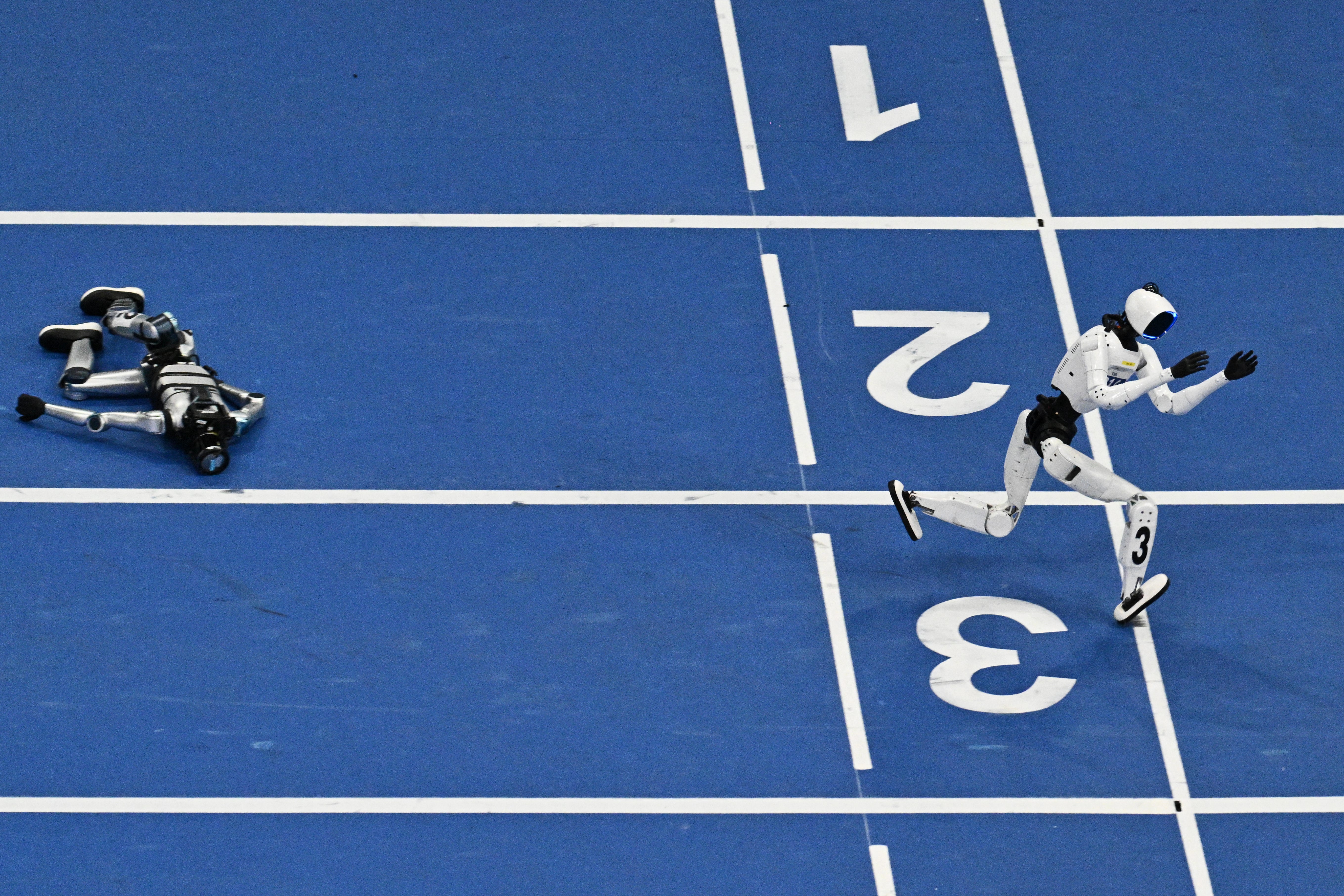
The performances of the robots inside the arena were more uneven. For five days, robots have been competing in human sports from boxing to soccer and table tennis. They also competed in competitions that were a little less coy about the reasons for the massive investments that are currently being made into this technology: for example, robots also competed to open packages and sort their contents as fast as possible.
It’s hard not to marvel at the progress the robots are making. In track and field, they have broken one human record after another. On Sunday, Tiangong Ultra ran 400 meters in 38.15 seconds, roughly five seconds faster than Wayde van Niekerk, the fastest human. The 100-meter record was also broken in Beijing: while Usain Bolt takes 9.58 seconds at his very best, Tiangong Ultra crossed the finish line in just 8.86 seconds.
Tiangong Omni, another victorious robot from the same manufacturer, attracted even more attention thanks to its peculiar style. While running, it leans far forward and swings its artificial arms wildly from left to right. According to its developers, nobody taught the robot the strange style that maximizes the robot’s momentum while making it look endearingly shy: it supposedly discovered it on its own. The best human chess players now borrow many of their strategies from the vastly superior AI models with which they train; perhaps some elite runners will similarly let themselves be inspired by Tiangong Ultra and Tiangong Omni.
The robots’ performance on the obstacle course, which was in full swing when I sat down in the stalls, is nearly equally impressive. On the track, robots have to jump onto high platforms, clamber over barriers of different heights, and perform all kinds of other feats of dexterity. It was riveting to watch as one robot after another jogged up to an obstacle, sized it up for a few seconds, and then elegantly cleared it—or theatrically failed to do so.
There are few Westerners at the Robot Games; both the engineers and the spectators are mostly Chinese. But as it happens, two engineering students from ETH Zurich, one of Europe’s leading universities, were sitting next to me. “Can the robots at your university do anything like this?” I asked them. “No,” one of them answered, looking a little deflated. “They’re way ahead of us here.”
But for all of the robots’ impressive feats, their limitations also became obvious over and over. In boxing, for instance, they had great difficulty locating each other and spent half the time punching in the totally wrong direction. One poor robot, visibly disoriented, kept getting tangled in the ropes of the ring before finally collapsing onto itself. In light of all the articles about the risk that artificial intelligence might one day wipe out all of humanity, I must admit to finding it at least a little reassuring that—for now at least—most of the robo boxers were about as intimidating as a blindfolded man after three or four beers.
Given the enormous performance gaps from one robot and from one sport to the next, it is hardly surprising that two kinds of very different videos from the games went viral in recent days. Those who in any case believe that we are living through a period of enormous technological disruption mostly shared videos of robots smashing human records. Those who in any case dismiss the entire discourse around artificial intelligence as so much hype delighted in videos of robots pitifully collapsing into a heap of scrap metal. As is customary on social media, everyone can confirm their own priors—without anyone being entirely wrong.
For in truth, the impressive videos and the ridiculous ones both reflect reality to some degree. In relatively predictable disciplines like the 100-meter dash, which require little interaction with other competitors, robots already outperform the best human athletes. In disciplines in which things can go wrong more easily and robots must react to opponents with speed and dexterity, they are still in their infancy. The robots I watched playing soccer would for example stand no chance against a team of not especially talented eight-year-olds.
In the real world, the picture is similar. In controlled environments like the small coffee station from which I bought my swan-milk coffee, robots are already useful. Developers are even making enormous strides in improving the fine motor skills of robots, long considered the greatest challenge in the field. But when confronted with unexpected obstacles or forced to coordinate with unpredictable humans, robots still get overwhelmed. In my Beijing hotel, a robot dutifully delivers takeout from the reception desk to my room. But it will probably take a little while for a robot to pick up food from a restaurant and reliably bring it to the hotel.
For the first hour or so, I found the Robot Games enthralling. What can robots already do, and where do they still fall short? Which robot will manage to crawl under an obstacle, and which will pitifully get stuck? But after a while, I suddenly realized that I had grown deeply bored.
In most of the competitions I watched, the performance of the robots was still too poor or spotty to generate any real suspense. There is a long way to go before the Robot Games can compete with the real Olympics. And even if robots do eventually play tennis or soccer better than any human, many of us will still prefer to watch Carlos Alcaraz and Lionel Messi rather than Tiangong Omni and Tiangong Ultra.
On my way back to the hotel, I was torn between relief and concern. The robot revolution is not yet upon us. But the machines I saw run, box, and play tennis are more capable today than they were a year ago, and vastly more capable than five years ago.
It remains hard to predict whether it will take three or thirty years for robots to penetrate every domain of human life. If we get lucky, we might have a good few years or even decades to prepare for the gigantic upheavals they will eventually bring about. But when that moment does finally come, the relationship between us humans and our machines will get even bumpier than before—and at that point, even the most clever quip is unlikely to save us.
This is a translation of an article I wrote in German for Die Zeit.1
I used Claude to create a draft translation, which I then extensively edited.
I was just describing a screenplay I wrote called, “Artificial Rose.” My premise was a question. Is a robotic caregiver more reliable than a human to care for a vulnerable senior? As a caregiver myself, I had witnessed the failure of other caregivers to follow a care plan, be compassionate, and sincerely try to enrich their lives. A robot is consistent and completely available, designed to be attractive and personable. I vote for the robot without an ego.
Why are we creating robots with human movements ? For example, shouldn’t we be creating robots to hover and glide rather than walk? We should be thinking out of the box and not merely imitating humans. I would ask, “What are things robots can do without the limitations of human form and function?” The bar should be much higher than it is currently.